



The Navy didn’t walk away from battleships because it forgot how to build them.
It walked away because battleships get people killed.
That lesson didn’t come from theory. It came from steel sinking and sailors drowning.
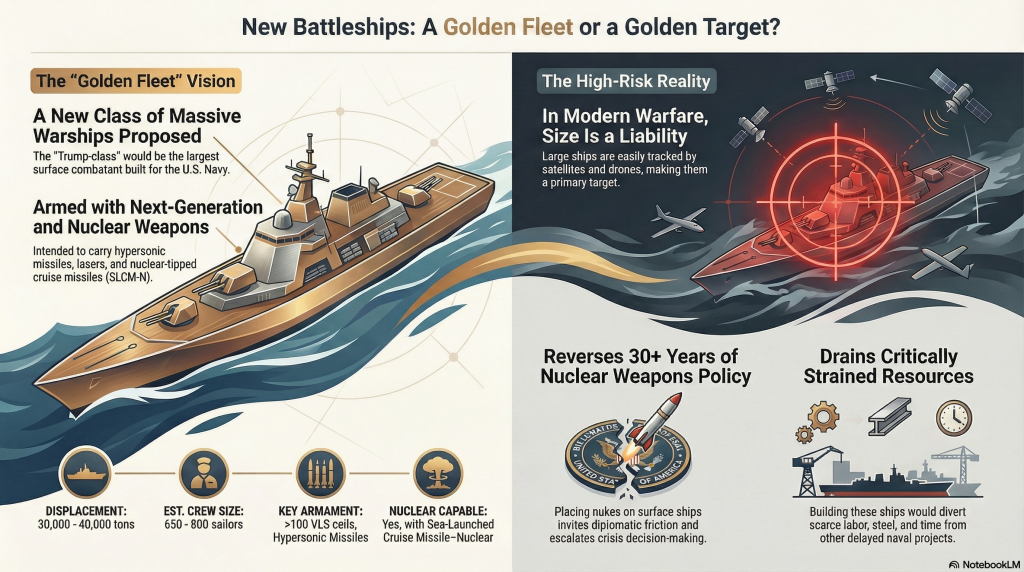
Now we’re being told the answer to modern naval warfare is a 35,000- to 40,000-ton surface ship, nearly 900 feet long, crewed by 650 to 800 sailors, sailing around with nuclear weapons onboard like it’s 1975 and nobody’s watching.
Today, everybody’s watching.
In today’s ocean, size doesn’t equal power. Size equals coordinates. Satellites track you. Drones shadow you. Submarines don’t chase — they wait. Missiles don’t negotiate. They arrive all at once.
Once a ship like this is spotted, it isn’t just another contact. It’s the contact. The kind of target you plan around. The kind you hit first.
And if it’s carrying nuclear cruise missiles, the math gets simple fast: kill it early or risk losing cities later.
That’s not alarmism. That’s how adversaries think.
We don’t need war games to prove this. We’ve already got history. In 1982, one British submarine found the Argentine cruiser Belgrano. Two torpedoes. One ship gone. 323 sailors dead. No lasers. No hypersonics. No satellite kill chain. Just a sub doing what subs do.
That was a conventional cruiser.
Now triple the size. Add nukes. Broadcast it to the world.
Modern navies spent decades shrinking crews for a reason. Fewer sailors per hull means fewer folded flags when something goes wrong. This design does the opposite. It piles people, prestige, command staff, and strategic weapons into one floating bullseye.

And then there’s the nuclear piece — the part that should’ve ended the conversation immediately.
Since 1991, the United States has kept nuclear weapons off surface ships. Not because we went soft, but because we got smarter. Nukes went onto platforms that hide, survive, and don’t force snap decisions — ballistic missile subs and strategic bombers.
Putting nuclear cruise missiles on a surface ship blows that discipline apart.
A cruise missile doesn’t tell the other side whether it’s nuclear or not. They won’t wait to find out. Decisions get made in minutes. That’s how accidents turn into history books.
Undoing that policy isn’t a footnote. It triggers lawyers, regulators, and allies.
You want nukes back on surface ships? Fine. Now you need a formal policy reversal. Money for warhead integration. New storage rules. New training. Department of Energy involvement. Environmental reviews under the National Environmental Policy Act. Public hearings about safety zones and emergency planning, homeporting. Courts checking whether you skipped a step.
Nuclear weapons bring paperwork the way fire brings smoke.
Allies notice when nuclear policy shifts. Japan’s long-standing principles on nuclear weapons don’t vanish because a ship flies a friendly flag. New Zealand’s nuclear-free law doesn’t make exceptions for “really big” battleships. Even close partners would demand assurances, inspections, and clarity about what is—and isn’t—on board before opening their ports.
That means fewer places to go, longer deployments, and more diplomatic friction. In a Navy already stretched thin, that’s not a rounding error.
The administration’s rhetoric makes it sound like this is just a shipbuilding story. It isn’t. It’s a governance story. Nuclear weapons drag law and policy behind them like anchors.
Meanwhile, back home, shipyards are already choking. Submarines are late. Destroyers slip. Repairs stack up. Skilled workers are scarce. Specialized naval steel isn’t sitting around waiting for a nostalgia project. Every plate of steel that goes into this hull comes out of something else.
Steel is zero-sum. Labor is zero-sum. Time is zero-sum.
Congress hasn’t approved this yet, and that’s the quiet truth beneath all the bravado. Warships don’t get built by applause. Congress authorizes. Congress appropriates. Studies get done. Designs get tested. That takes years.
If the administration tries to lock this in early with names and ceremonies, Congress can slow it down, fence the money, and demand answers. Courts can step in on process. Allies can close ports. Reality always shows up eventually.
Standing on a battleship to look tough is politics. Ordering new ones built — armed with nukes and packed with sailors — is policy.
And policy decides who becomes a target.
Big ships look great in renderings. They look even bigger on satellite feeds.
When the first missile gets through, the crew won’t care how “golden” the fleet was supposed to be.
They’ll just be the ones paying for it.