

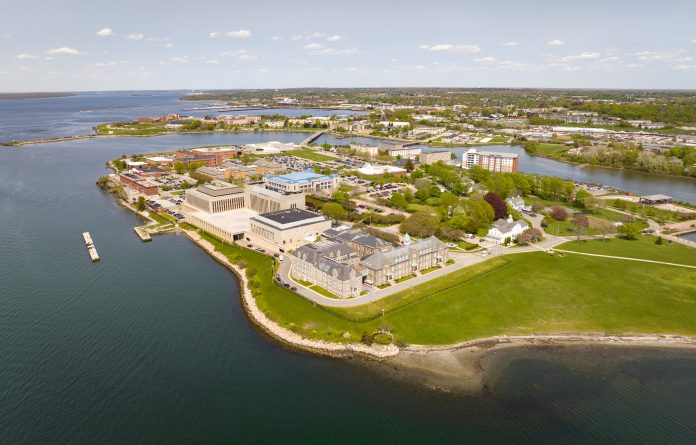
The officers who plan the next war are getting new marching orders for the classroom.
Defense Secretary Pete Hegseth has ordered a sweeping overhaul of the military’s advanced schools, including institutions such as the Naval War College. His Nov. 9 directive changes what officers study, how they are graded, who teaches them and how closely the Pentagon controls the whole operation.
These are primarily schools for people already wearing the uniform and preparing for greater responsibility. This order is aimed at the education officers receive later in their careers, rather than the undergraduate education at Annapolis, West Point or the Air Force Academy.
The consequences reach well beyond a classroom in Newport. An officer’s judgment can determine whether a ship survives, whether troops get their supplies and whether a mission is worth the lives it puts at risk.
That makes military education everybody’s business—especially the business of the people who have to carry out the orders.
More planning, tougher grading
Hegseth argues that the schools have wandered away from preparing officers to fight and win. His memorandum blames excessive theory and ideological distractions. It does not include the underlying review needed to judge those claims independently.
His prescribed remedy includes more military history, more study of how the services fight together and more exercises that force officers to make decisions.
Students will face a major war game or comprehensive examination carrying substantial weight in their final standing. Grades will depend more on individual writing, examinations and practical exercises, with less emphasis on classroom participation.
In plain English: Talking a good game around the seminar table will count for less. Students will have to demonstrate what they can do.
The order also requires schools to bring in officers who recently completed operational command so lessons from the fleet and field reach the classroom.
Changing who teaches
The faculty changes are substantial.
Hegseth wants most full-time instructors at senior military colleges to have military or defense experience. Civilian teachers would primarily come from military service, Pentagon civilian work, intelligence agencies or other national security backgrounds.
The directive also limits the proportion of instructors whose backgrounds are solely in technical specialties.
For newly hired faculty, it orders an end to lifetime tenure and emeritus status, subject to law and existing agreements. Where appropriate, civilian teaching positions would move to renewable three-year contracts.
Those contracts would be evaluated for teaching effectiveness and research serving defense priorities.
The question to watch is whether those rules attract strong instructors—and whether instructors feel free to tell senior officers something they do not want to hear.
An experienced teacher who challenges a bad assumption can be worth more than a roomful of agreeable veterans.
The Constitution stays in the classroom
One part of the order deserves as much attention as the talk about winning wars.
It explicitly requires instruction in the Constitution, civilian control of the military, the limits of command authority and officers’ legal obligations under their oath.
It also directs schools to examine recent operational and ethical successes and failures, including questions about lawful authority and the use of military power.
That is practical military education. Officers need to understand both how to execute an order and the legal boundaries governing it.
A decision can be tactically successful and still produce a strategic disaster. The classroom should be where officers learn to recognize that danger before troops pay for it.
More control from Washington
The Pentagon’s personnel and readiness office will gain greater authority over educational standards, school certification and research priorities. Another requirement directs a review of outside accreditation—the process through which independent organizations assess academic institutions.
The order also adds instruction in artificial intelligence and expands access to classified teaching and war games.
Despite its “effective immediately” language, the overhaul will take time. Many implementation plans are due within three to six months. Some classroom requirements are scheduled for the 2027–28 and 2028–29 academic years.
The directive sets the machinery in motion. It does not establish that the schools were failing or that the changes will fix them.
The measure will be the officers who come out the other end: Can they plan, adapt, question faulty assumptions and give honest advice up the chain?
The sailors, Marines, soldiers and airmen following their orders deserve leaders who can do all four.