

Some military commentators predicted an imminent American naval buildup against Iran. The Navy’s actual movements told a different story. Somebody should have been paying attention.
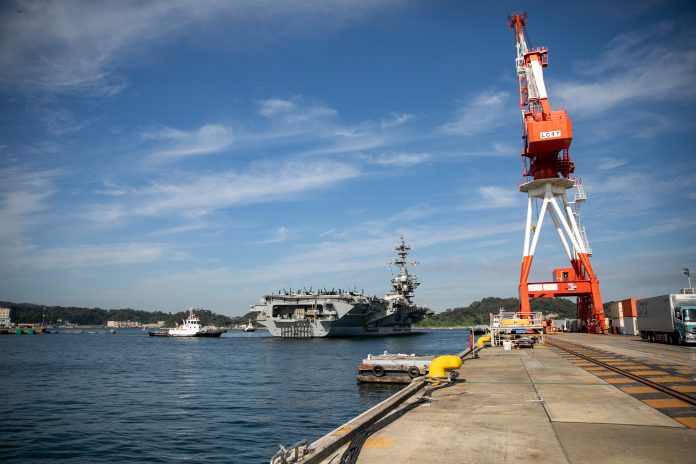
The USS Theodore Roosevelt pulled into Yokosuka, Japan, Friday morning.
Not the Persian Gulf. Not the Arabian Sea. Japan.
And with that arrival, the predictions of an imminent three-carrier American naval buildup against Iran took another hit.
Roosevelt arrived at 9:20 a.m. local time October 16, accompanied by the guided-missile cruiser USS Chosin and guided-missile destroyer USS Decatur.
The carrier strike group is preparing for KEEN SWORD 27, a major U.S.–Japanese military exercise scheduled for October 19–29.
That’s where the Navy says the carrier is going to be.
That’s where the ship actually went.
And that’s what some of the people predicting an immediate rush to the Middle East apparently failed to establish.
Follow the damn ships.
The Navy Never Said When
Here’s how the speculation got started.
The Navy announced that Roosevelt would deploy to the Middle East to relieve USS George Washington, the Japan-based carrier operating against Iran.
But the Navy didn’t announce when.
That’s a critical detail.
Roosevelt departed San Diego on Sept. 27 with Carrier Air Wing 11. Almost immediately, speculation began that she was heading directly toward the Middle East.
With George Washington and USS George H.W. Bush operating in the region, the prospect of three American carrier strike groups converging against Iran became an attractive headline.
Three carriers. Hundreds of aircraft. Thousands of sailors. Enough American naval firepower to make any adversary pay attention.
It sounded impressive.
There was just one problem.
Nobody had established that Roosevelt was going directly to the Middle East.
The Navy announced a carrier relief, not an immediate reinforcement.
Those are two different military operations.
One replaces an existing force.
The other increases the force.
Any reporter covering naval operations ought to know the difference.
The Ships Were Telling the Story
At The Military Report, we’ve been tracking the carriers.
Not the predictions. Not the dramatic graphics. Not the anonymous speculation passed from one outlet to another.
The ships.
George Washington, normally based at Yokosuka, had been operating in the Middle East since August.
George H.W. Bush was also operating in the region.
Abraham Lincoln, after an extended deployment, had returned to San Diego.
And Theodore Roosevelt departed San Diego in late September.
Those movements were real.
What wasn’t established was the claim that Roosevelt’s departure meant three carriers were about to assemble against Iran.
The Navy hadn’t announced such a concentration.
And the Roosevelt’s actual movement was taking her toward Japan.
There’s nothing particularly mysterious about this.
The Navy operates globally. Carrier strike groups have scheduled exercises, maintenance requirements, logistics commitments and operational missions.
They don’t automatically head for the nearest shooting war simply because somebody on television thinks they should.
Forty-Five Thousand Japanese Troops Are Not a Detour
Roosevelt isn’t in Yokosuka for a quick fuel stop.
Her strike group is preparing to participate in KEEN SWORD 27, one of the largest recurring U.S.–Japanese military exercises.
Japan’s participation includes approximately 45,000 personnel, 6,100 vehicles, 40 ships and 260 aircraft.
That’s a major military operation.
Exercises involving tens of thousands of personnel and dozens of warships don’t get thrown together over a weekend.
They require months of planning, coordination, logistics and operational preparation.
The Navy says Roosevelt’s strike group will conduct maintenance, resupply and tactical coordination with the Japanese Maritime Self-Defense Force.
Those are actual military commitments.
And they matter.
The United States hasn’t abandoned its military responsibilities in the Western Pacific because American forces are fighting in the Middle East.
China remains a major strategic concern. Japan remains a critical American ally. The Seventh Fleet still has a job to do.
Roosevelt’s participation in KEEN SWORD is a reminder that the Navy has responsibilities in more than one ocean.
That should have been part of the reporting from the beginning.
The Calendar Doesn’t Lie
Now look at the dates.
Roosevelt departed San Diego Sept. 27.
She arrived in Yokosuka Oct. 16.
KEEN SWORD begins October 19 and ends October 29.
The American midterm elections are Nov. 3.
If Roosevelt completes the exercise before proceeding toward the Middle East, she faces a transit of thousands of miles.
George Washington’s movement through the Strait of Malacca in August provides a useful comparison. The carrier passed through the strait Aug. 13 and entered the Central Command area of responsibility Aug. 19.
Six days.
And that’s after reaching the Strait of Malacca.
Roosevelt would first have to sail from Japan through the Western Pacific and Southeast Asian waters.
Assuming she remains committed to KEEN SWORD through Oct. 29, an arrival in the Arabian Sea before the Nov. 3 elections looks highly unlikely.
An expedited transit could put her there sometime in early November, more plausibly after Election Day.
But that’s an estimate, not an announced Navy schedule.
And that’s precisely the distinction some commentators failed to make.
There is no evidence that the Navy planned this timetable around the election. There is also no publicly announced date for Roosevelt’s arrival in the Middle East.
The facts are sufficient without inventing a political explanation.
Three Carriers? Maybe. But Prove It.
Could the United States eventually have three aircraft carriers operating in the Middle East simultaneously?
Certainly.
Bush and Washington were operating in the Arabian Sea in mid-October. If Roosevelt arrives before either carrier departs, there could be a temporary three-carrier overlap.
But an overlap during a carrier relief is not necessarily a planned, sustained three-carrier buildup.
That’s another distinction worth understanding.
The Navy routinely coordinates arrivals and departures to maintain combat capability.
Ships don’t simply abandon their stations the moment their replacements appear on the horizon.
The question is how long any overlap would last and whether commanders intend to employ all three carrier strike groups in the region.
We don’t know.
Neither does anybody outside the relevant chain of command unless they’ve been given that information.
Yet the speculation about three carriers converging against Iran got ahead of those facts.
That’s not analysis.
That’s guessing.
The Navy Doesn’t Operate on Cable-News Schedules
I’ve covered the American military for decades, including time aboard Navy ships and watching the consequences of demanding operational schedules.
I’ve seen carriers waiting for equipment before deployment. I’ve watched the strain that sustained operations place on ships, aircraft and sailors.
The Navy was wrestling with those problems years ago.
It still is.
An aircraft carrier isn’t a chess piece that can be pushed around a map without consequences.
It’s a floating airfield with thousands of sailors, dozens of aircraft, escorting warships and a logistical system that must keep the entire force supplied and operating.
Moving another carrier into a combat theater is a major military decision.
It affects readiness, maintenance, personnel and the Navy’s ability to respond elsewhere in the world.
That’s why responsible reporting must distinguish between an announced deployment, an expected relief and an actual reinforcement.
They are not interchangeable terms.
And when journalists blur those distinctions, they mislead the public about what the military is doing.
Report What You Know
There’s nothing wrong with reporting that Roosevelt is expected to relieve Washington.
That’s what the Navy announced.
There’s nothing wrong with explaining that three carriers could temporarily operate in the Middle East.
That’s a legitimate operational possibility.
But turning those facts into a prediction of an imminent three-carrier buildup before the midterms requires evidence.
Where’s the deployment schedule?
Where’s the confirmation that Bush will remain in the theater when Roosevelt arrives?
Where’s the evidence that the Navy intends to maintain three carriers rather than rotate one home?
Without those answers, the three-carrier buildup is a possibility, not an established operation.
And the media ought to label it accordingly.
Follow the Damn Ships
Roosevelt is in Japan.
George Washington and George H.W. Bush have been operating in the Middle East.
KEEN SWORD runs through October 29.
Roosevelt is expected to relieve Washington, allowing the Japan-based carrier to return to the Pacific.
That’s what we know.
What happens afterward depends on orders the Navy hasn’t publicly disclosed.
Maybe Roosevelt will head directly toward the Arabian Sea after the exercise.
Maybe the Navy will adjust the schedule.
Maybe there will be a brief three-carrier overlap.
But nobody should be reporting an imminent buildup as an established fact without the evidence to support it.
The Navy’s actual movements have already demonstrated the danger of confusing an announced relief with an immediate reinforcement.
Some commentators got ahead of the ships.
The ships didn’t cooperate with their predictions.
The American public deserves military reporting based on facts, not somebody’s imaginary fleet movements.
Follow the damn ships.