

BROWNSVILLE, Texas — A defense technology company that didn’t exist four years ago is assembling a new American shipbuilding network along the Gulf Coast.
In Louisiana, Saronic Technologies is building 180-foot autonomous ships.
In Mississippi, it is putting them through on-water testing.
And in Texas, it has broken ground on a $3-billion-plus shipyard intended to build autonomous and conventional vessels on a scale the company has never attempted before.
The U.S. Navy is already buying.
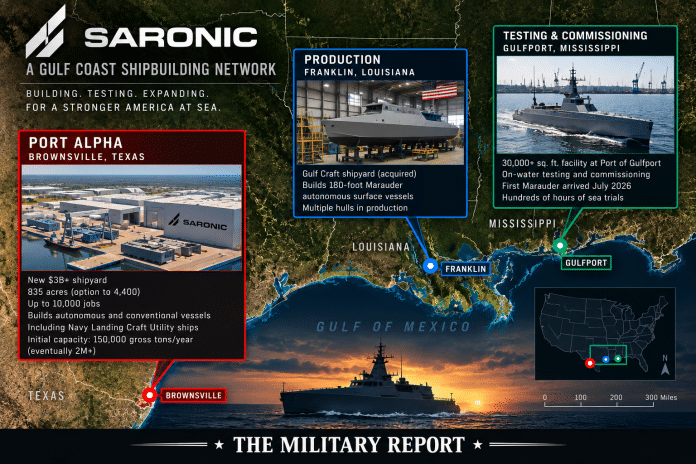
Saronic broke ground Sept. 30 on Port Alpha, an 835-acre shipyard at the Port of Brownsville. The company has an option to expand the site to nearly 4,400 acres and says the project eventually could employ as many as 10,000 people.
But Port Alpha makes more sense when viewed alongside what Saronic already is doing in Louisiana and Mississippi.
This isn’t one shipyard.
It is becoming a Gulf Coast production system.
Build in Louisiana, Test in Mississippi
Saronic was founded in 2022 with a focus on autonomous surface vessels.
Its expansion into traditional shipbuilding accelerated with the acquisition of Gulf Craft, a Louisiana shipbuilder in Franklin.
That yard is now producing Saronic’s Marauder, a 180-foot autonomous surface vessel designed to operate for extended periods and carry substantial payloads without the crew required aboard a conventional Navy ship.
But building the ship is only part of the process.
Saronic announced in September that it had selected the Port of Gulfport, Mississippi, as the site for Marauder on-water testing and commissioning.
The company established a facility of more than 30,000 square feet at the port, giving it access to the Gulf of Mexico for sea trials.
The first Marauder arrived in Gulfport in July and began an intensive testing program. Saronic says the vessel has accumulated hundreds of hours on the water, with testing sometimes running more than 12 hours a day, seven days a week.
More Marauders being built in Louisiana are expected to follow.
The geography is beginning to reveal the strategy.
Build in Louisiana.
Test and commission in Mississippi.
Then add enormous new production capacity in Texas.
Then Came Port Alpha
Port Alpha takes Saronic into an entirely different class of shipbuilding.
The initial Brownsville yard is designed to handle vessels up to 850 feet long. With future expansion, Saronic says it could accommodate ships longer than 1,200 feet.
Initial production capacity is projected at about 150,000 gross tons annually. The company says eventual capacity could exceed 2 million gross tons a year.
The first phase is expected to produce autonomous, autonomy-capable and conventional ships.
That includes Landing Craft Utility vessels for the Navy.
Port Alpha therefore isn’t simply an enlarged factory for Saronic’s unmanned boats.
It is an attempt to create a major American shipyard.
The Navy Is Already a Customer
Saronic isn’t spending billions and hoping that someday the Pentagon becomes interested.
The Navy already is a customer.
This week, the Navy awarded Saronic a production agreement for Marauder under its Medium Unmanned Surface Vessel Marketplace.
Before the award, Marauder underwent eight days of continuous Navy evaluation involving more than 140 test scenarios, according to Saronic.
The company says its third Marauder hull has already been flipped, with several more vessels moving through production.
Saronic also has Navy work involving its smaller Corsair autonomous vessel and has been selected to build Landing Craft Utility vessels at Port Alpha.
That makes what is happening along the Gulf Coast more than a venture-capital experiment.
Actual Navy ships are entering the pipeline.
Who Is Saronic?
Saronic is privately held and was founded in 2022.
Its co-founders include CEO Dino Mavrookas, a former Navy SEAL who served for 11 years before entering private equity, along with Vibhav Altekar, Doug Lambert and Rob Lehman.
The company’s exact ownership percentages aren’t publicly disclosed.
What is known is that some very large investors have put money behind it.
Saronic raised $1.75 billion in a Series D financing round led by Kleiner Perkins, valuing the company at $9.25 billion. Investors have included Andreessen Horowitz, 8VC, Caffeinated Capital, Bessemer Venture Partners, Advent International, DFJ Growth, BAM Elevate, Franklin Templeton and others.
That money is financing something rarely seen in modern American defense manufacturing: a startup attempting to move rapidly from relatively small autonomous vessels into industrial-scale shipbuilding.
Port Alpha is the largest part of that gamble.
The Government Is Helping
Private investors aren’t doing it alone.
Federal, state and local governments are part of the equation.
The Navy is providing contracts.
Texas and local governments have provided or offered economic incentives for Port Alpha.
Mississippi has spent years developing an unmanned maritime technology ecosystem around the Gulf Coast, including the University of Southern Mississippi’s Roger F. Wicker Center for Ocean Enterprise.
Saronic’s Gulfport operation plugs directly into that existing infrastructure.
The result is an interesting mixture of Silicon Valley venture capital, state economic development, university research, Pentagon procurement and old-fashioned heavy industry.
But there is one thing none of that money can immediately buy.
Experienced shipbuilders.
Now Find the Workers
The Navy’s shipbuilding problem isn’t simply a shortage of shipyards.
It is a shortage of people.
Navy Secretary John Phelan said earlier this year that American shipbuilders and their suppliers will need to hire roughly 250,000 skilled workers over the next decade to meet expected demand.
That doesn’t mean 250,000 shipyard jobs are vacant today.
It means the industrial base must hire on that scale as production expands and older workers retire.
Phelan has said roughly a quarter of the existing shipyard workforce could become eligible for retirement within five years.
“Systems don’t build ships,” Phelan said. “People do.”
And those people aren’t interchangeable.
Shipbuilding requires welders, electricians, pipefitters, machinists, fabricators, engineers, naval architects and other skilled workers. Many of those trades take years to master.
Saronic says it intends to work with educational institutions on engineering programs, technical training and apprenticeships to create a pipeline of workers for Port Alpha.
It will need one.
The company says the Texas operation alone eventually could employ 10,000 people.
At the same time, established Navy shipyards, private shipbuilders and thousands of suppliers are chasing many of the same workers.
You can raise $1.75 billion relatively quickly.
You cannot create 10,000 experienced shipbuilders quite so quickly.
A Different Kind of Shipbuilding Race
There is a larger strategic reason to watch what Saronic is doing.
China possesses the world’s dominant commercial shipbuilding industry. Its huge network of yards, suppliers and workers also provides an industrial foundation for the rapid expansion of the People’s Liberation Army Navy.
The United States allowed much of its commercial shipbuilding capacity to disappear over decades.
The Navy now is trying to expand its fleet while American yards struggle with delays, labor shortages, supplier problems and limited capacity.
Ordering more ships doesn’t solve that.
Congress can authorize another destroyer.
The Pentagon can sign another contract.
Neither creates a shipyard overnight.
And neither produces an experienced welder, electrician or pipefitter overnight.
That is what makes Saronic worth watching.
Four years ago, the company didn’t exist.
Today it is building autonomous ships in Louisiana, testing them in Mississippi, winning Navy production work and breaking ground on a multibillion-dollar Texas shipyard capable of building vessels far larger than anything Saronic has produced before.
It has private investors willing to put billions behind the effort and government customers looking for more ships.
Now comes the difficult part.
Saronic has to prove it can turn money, technology and acres of Gulf Coast waterfront into ships — and do it at the speed and scale it is promising.
Because ultimately, someone still has to walk through those shipyard gates wearing work boots, pick up the tools and know what to do with them.
Port Alpha won’t just have to manufacture ships.
Saronic is going to have to help manufacture shipbuilders.