

Look at the Navy today and you can almost see the watch changing.
Ships are coming home. Ships are going out. A carrier is trying to get back into fighting shape. Sailors and Marines are saying goodbye to their families while others are finally pulling into homeport.
Taken separately, they are Navy news briefs.
Taken together, they tell us something about the fleet.
The Navy never really stops.
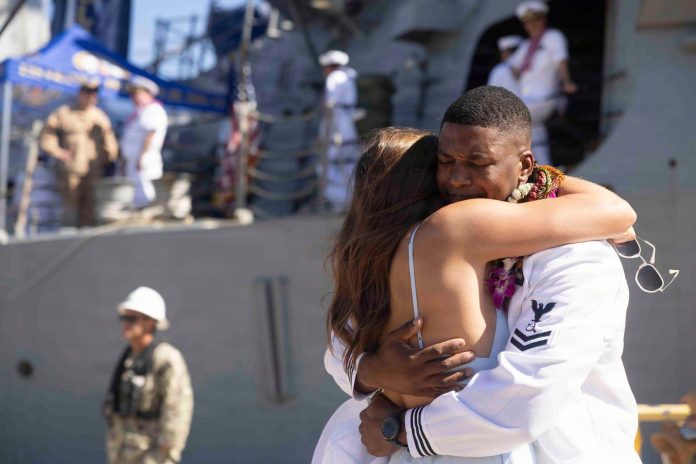
In Hawaii, USS Frank E. Petersen Jr. arrived home at Joint Base Pearl Harbor-Hickam after roughly 10 months deployed with the USS Abraham Lincoln Carrier Strike Group.
That matters beyond the homecoming photographs.
Petersen is one of the first pieces of the Lincoln strike group to reach home. The destroyer operated across the Pacific and Middle East before peeling away from the carrier force and heading for Hawaii.
The sailors aboard her are home.
The sailors aboard Lincoln are not.
The carrier is still making her way east after an extraordinary deployment lasting more than 300 days. She stopped at Guam on the long trip across the Pacific and continues toward San Diego.
For months, we have been writing about Lincoln not because carrier deployments are unusual, but because this one became unusually long.
More than 300 days is not just a number on a deployment chart.
It is missed birthdays, anniversaries and holidays. It is machinery running hour after hour. It is aircraft being launched and recovered. It is maintenance performed at sea because the ship cannot simply pull into the neighborhood garage.
And while Lincoln comes home, another carrier is going the other way.
USS Theodore Roosevelt departed San Diego on deployment Sunday.
That is the Navy’s conveyor belt.
One carrier comes east. Another heads west.
And now the amphibious fleet is moving, too.
USS Makin Island, USS John P. Murtha, USS Anchorage and Marines of her amphibious ready group and Marine expeditionary unit departed San Diego Monday, right on the heels of the Roosevelt.
Another set of families stood on the pier and watched their sailors and Marines leave.
Nobody knows exactly what the world will look like when they come home.
That is the point of sending them.
An amphibious ready group carries something Washington values enormously: options.
Marines, helicopters, F-35Bs fighters, Ospreys, landing craft, medical capability, and thousands of people who can be moved toward a crisis without waiting for somebody to find an airport and give the United States permission to use it.
While all of that is happening in the Pacific, USS Dwight D. Eisenhower is working on the other side of the country.
And Monday evening came a reminder that simply preparing a carrier for operations can be dangerous.
During flight operations off Virginia, a two-seat aircraft suffered a mishap during recovery aboard Eisenhower. Both aviators ejected and were recovered. Four sailors on the flight deck were injured, according to the Navy.
One was taken to a hospital with injuries described as non-life-threatening.
The investigation will determine what happened. Until then, there is no reason to guess.
But there is something worth remembering.
Carrier aviation is dangerous even when nobody is shooting at you.
A flight deck is several acres of controlled violence.
Jet engines are screaming. Aircraft are landing and taking off. Propellers and rotors are turning. Fuel and weapons are nearby. Sailors work within feet of aircraft moving fast enough to kill them before they have time to react.
And they do it day after day.
Eisenhower is particularly worth watching because the carrier has been working its way back toward operational readiness after maintenance. Carrier qualifications are part of rebuilding that capability — getting the ship, air wing and people back into the rhythm required to deploy.
So look again at the Navy on this particular day.
In Hawaii, sailors from Frank E. Petersen Jr. are hugging their families after 10 months away.
Somewhere east across the Pacific, Abraham Lincoln continues toward San Diego after more than 300 days deployed.
From San Diego, Theodore Roosevelt is heading out.
Makin Island and her sister ships with their Marines are heading out, too.
Off Virginia, Eisenhower is rebuilding carrier capability after maintenance, and four sailors have already been hurt doing it.
Different oceans.
Different ships.
Different missions.
Same Navy.
There is a tendency in Washington to measure naval power by counting hulls.
How many carriers?
How many destroyers?
How many submarines?
Those numbers matter.
But ships do not deploy themselves.
Every deployment consumes something: fuel, spare parts, flight hours, missile inventory, maintenance time and human beings.
Eventually somebody has to bring the ship home and fix what the sea has worn down.
Then somebody else takes the watch.
That is what we are watching today.
The Navy is changing the watch.
And somewhere, another crew is already packing its sea bags.