

While the U.S. military focuses on air and naval operations against Iran, another battlefield may be forming in the mountains along Iran’s western border — one that relies not on American troops, but Kurdish fighters who have fought Tehran for decades.
Most Americans don’t spend much time looking at maps of Kurdish territory.
Military planners do.
Because when you pull back and look at the northern Middle East, something jumps off the page. There’s a long, crooked band of mountains and territory running from Syria all the way to Iran. Call it the Kurdish belt. Call it the Kurdish arc.
Either way, it stretches about 700 miles across the top of the Middle East like a rough scar across the map.
And right now, that scar runs along Iran’s western border.
If the reports are accurate that Kurdish fighters are moving into the mountains near Mariwan, Tehran may be staring at a familiar problem: Kurdish insurgents operating in terrain that armies hate and guerrillas love.
The map tells the story
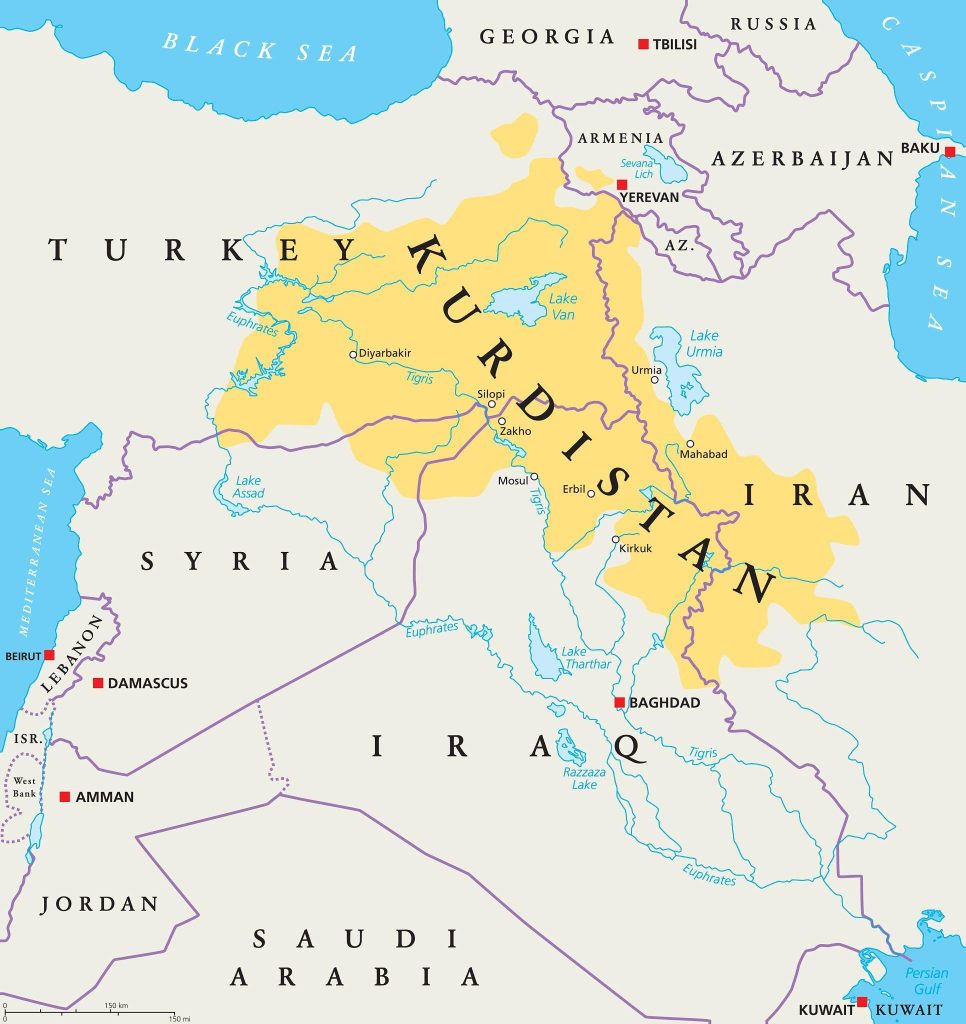 Start in northeastern Syria.
That’s where Kurdish fighters — the same ones who helped smash ISIS — control wide stretches of territory along the Turkish border.
Slide east and you hit Iraqi Kurdistan. That’s a semi-autonomous Kurdish region with its own government, its own army — the Peshmerga — and mountains that have sheltered insurgents for generations.
Keep going east and the terrain rises into the Zagros Mountains, where the Iraq-Iran border turns into a maze of ridges, valleys, forests, and villages that have frustrated armies since the days of the Persian Empire.
This is where PJAK, the Kurdish militant group fighting Iran, has operated for years.
From a mapmaker’s perspective, it looks almost continuous:
Syria → Iraqi Kurdistan → Western Iran
A corridor of mountains and Kurdish territory that doesn’t care much about national borders.
Military planners have watched that corridor for decades.
Because if it ever starts moving as a single front, Iran suddenly has a problem.
Mountains beat armies
The Zagros range isn’t gentle countryside.
It’s brutal terrain — steep ridges, narrow passes, and valleys that twist like snakes.
Perfect guerrilla country.
A few hundred fighters who know the mountains can frustrate thousands of regular troops.
That’s exactly what Kurdish fighters have done repeatedly.
They did it to Saddam Hussein.
They’ve done it to Turkey for decades.
And Iranian Revolutionary Guard units have been chasing Kurdish militants through these same mountains since the early years after the 1979 revolution.
The pattern rarely changes.
Insurgents move through the mountains, strike military positions, then vanish into terrain where tanks and armored vehicles are about as useful as a lawn mower in a rock quarry.
Iran knows this ground
Tehran understands the danger.
Iran’s western provinces are home to millions of Kurds. Cities like Sanandaj, Mahabad, and Kermanshah sit just east of the mountain belt.
Whenever the region becomes unstable, Kurdish insurgencies tend to flare up.
That’s why the Iranian Revolutionary Guard keeps forces stationed throughout the region.
The government has spent decades making sure those mountains never turn into a full-blown insurgent sanctuary.
But mountains are stubborn things.
They tend to favor the people who live there.
The strange case of PJAK
Here’s where the story gets complicated.
The Kurdish militant group PJAK — the one most often mentioned in reports about fighting in western Iran — is officially listed as a terrorist organization by the United States.
That designation dates back to 2009, largely because PJAK is tied to the PKK, the Kurdish group that has fought a long insurgency against Turkey.
So on paper, Washington considers PJAK terrorists.
But on the ground, PJAK is also one of the few groups actively fighting Iranian forces inside Iran.
Geopolitics has always been full of contradictions like that.
Pressure, not collapse
A Kurdish insurgency isn’t going to topple Iran.
The country is too large and its security apparatus too strong.
But insurgencies don’t need to win to matter.
They just need to create pressure.
A few thousand fighters operating in rugged mountains can tie down large numbers of troops and force governments to divert attention from other problems.
And right now Iran has plenty of those.
A fault line in the mountains
For decades, the Zagros Mountains have been one of Iran’s quiet fault lines — a place where ethnic tensions, geography, and politics intersect.
Most of the time it stays quiet.
But when the region gets unstable, the mountains have a way of coming alive.
If Kurdish fighters are truly moving into western Iran in large numbers, Tehran could be facing something it has dealt with before — a slow-burning insurgency in terrain where governments rarely get the upper hand.
History suggests one thing about those mountains.
Once fighting starts there, it tends to last a long time.