

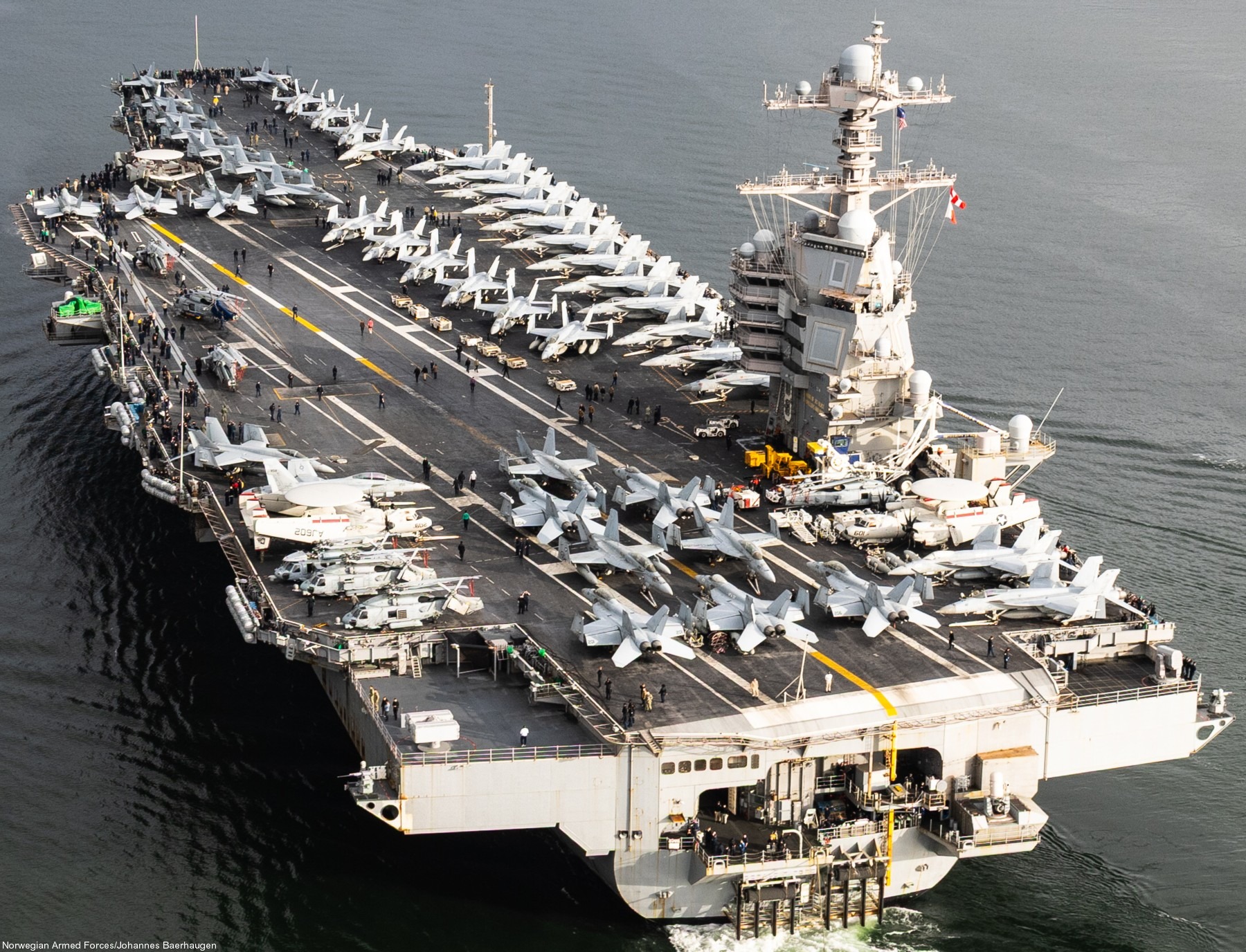
The Pentagon’s top brass sends America’s $13 billion supercarrier to chase drug lords—and rattles Caracas in the process.
The U.S. Navy’s showpiece warship, the USS Gerald R. Ford, just sailed into U.S. Southern Command territory—the stretch of ocean that wraps around Latin America and the Caribbean. Until recently, she’d been cooling her reactors in the Eastern Med, part of Washington’s permanent “ready for anything” posture. Then came a strange hesitation: a quiet pause off the western coast of Africa while the administration mulled whether to take a swipe at Nigeria, citing reports that Christians were being slaughtered there.
Nothing came of it. No strike, no speech—just radio silence. And then, almost overnight, Defense Secretary Pete Hegseth decided to make a statement. Late October, he ordered the Navy’s biggest stick to steam south and start swinging.
According to the official line, the Ford Strike Group’s new mission is to “dismantle Transnational Criminal Organizations and counter narco-terrorism.” Translation: Washington’s dusting off the old “War on Drugs” playbook and planting a carrier strike group on it.
Caracas, naturally, lost its mind. Venezuela’s defense minister, Vladimir Padrino López, declared a “massive mobilization” to fend off what he called an “imperialist threat.” That’s diplomat-speak for “we’re outmatched but too proud to admit it.”
The Ford isn’t exactly subtle. She’s a 100,000-ton slab of steel with more than 4,000 sailors, nine squadrons of aircraft, and a flight deck that can launch and recover jets faster than a Vegas blackjack dealer. Alongside her are the destroyers Bainbridge, Mahan, and Winston S. Churchill—each bristling with Aegis missiles and 5-inch guns. It’s overkill for drug runners in go-fasts, but it sure looks impressive on the evening news.
And here’s the kicker: with the Ford and her strike group now under SOUTHCOM’s flag, roughly 20 percent of the entire U.S. Navy’s operational assets are sitting in or around Latin American waters. That’s not routine deployment—that’s a message. Somebody in Washington wants the hemisphere’s attention, maybe to shift the lens from the administration’s aborted brush with Nigeria to a more familiar enemy: the cartels.
Adm. Alvin Holsey, who runs SOUTHCOM, said the move “reinforces our resolve to protect the security of the Western Hemisphere.” Maybe so. But you don’t send a supercarrier to play Coast Guard. The Ford burns half a million gallons of jet fuel in a day of heavy ops—somewhere out there, an accountant’s ulcer just got worse.
Still, the signal is unmistakable. Behind the flag-waving and press releases sits an old American truth—when in doubt, send the Navy. It’s part power projection, part muscle memory.
One thing’s certain: the Gerald R. Ford didn’t come all this way to sit idle. She’s America’s newest toy, and Washington intends to make her look busy—even if the fight’s more about optics than operations.