

USS Theodore Roosevelt has left San Diego on Sunday.
And somewhere across the Pacific, USS Abraham Lincoln is still coming home.
One San Diego carrier is heading west for another deployment. The other is heading east after more than 300 days away.
The timing is striking because the Navy already knows Roosevelt may be gone a long time.
Before the carrier left San Diego, Master Chief Petty Officer of the Navy John Perryman said its sailors were being prepared for more than the traditional seven-month deployment.
“They know they’re going to be there longer than seven months,” Perryman said in August. “Their CO is giving them eight months to plan on.”
Chief of Naval Operations Adm. Daryl Caudle was just as candid.
“I would prefer, you know, seven-month deployments,” Caudle said. “I typically am not a big fan of extensions, and I push back hard on that. But the enemy gets a vote.”
This time, however, the Navy isn’t simply warning sailors that the deployment could run long.
It packed the ship for it.
Lincoln Was the Lesson
Before Roosevelt deployed, the Navy studied what happened aboard Lincoln and made changes.
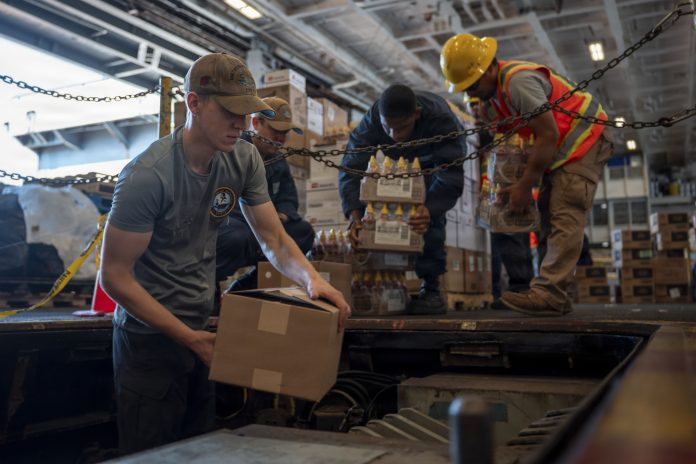
More food, hygiene products and other supplies were loaded aboard Roosevelt. Available spaces were turned into additional storage. Entertainment and fitness equipment were added or updated. The Navy also worked on communications between the ship, sailors and their families.
Those may sound like small things aboard a 100,000-ton nuclear-powered aircraft carrier.
After eight or nine months away from home, they aren’t.
The Navy also worked on the logistics problems exposed during Lincoln’s deployment.
Carriers may be nuclear-powered, but almost everything else aboard them isn’t. Five thousand people need food and everyday supplies. Aircraft need fuel and parts. Machinery breaks. Ammunition has to be replenished.
Caudle said the Navy developed a more reliable supply network stretching through Diego Garcia, Singapore, Japan, the Philippines and the United States — what he called the “combat logistics force treadmill.”
“I think we have got that cracked now,” Caudle said.
There was another lesson from Lincoln: sailors need to get off the ship.
Gerald R. Ford deployed for 326 days but made several port visits.
Lincoln’s sailors went roughly eight and a half months without one.
The Navy is now looking at additional ports in Africa, India and elsewhere where carrier crews operating around the Arabian Sea could get ashore during extended deployments.
That isn’t a luxury.
It is part of keeping a crew functioning.
Lincoln Is Still Out There
As of Sept. 25, Abraham Lincoln was underway in the U.S. 7th Fleet area after a two-day logistics stop in Guam.
She had been deployed 308 days.
The carrier is expected back on the West Coast in early October.
But before Lincoln could get home, Roosevelt sailed.
And that’s the part worth paying attention to.
The Navy has gotten better at sustaining a carrier for a very long time.
It has improved the supply chain.
It is loading ships differently.
It is searching for more liberty ports.
And instead of telling families to expect seven months and then repeatedly extending the deployment, Navy leaders are telling Roosevelt’s families before departure: plan for eight months.
All of that makes sense.
But none of it changes the underlying problem.
The Navy isn’t shortening these deployments.
It is getting better at enduring them.
Two Carriers, Two Directions
There is an image here that tells the story better than a deployment chart ever could.
Theodore Roosevelt is heading west.
Abraham Lincoln is heading east.
The two crews may never see each other across the Pacific, but what happened aboard one carrier has shaped how the Navy prepared the other.
The Navy learned from Lincoln.
Now, Roosevelt gets to find out whether those lessons were enough.
Because we already know the answer to one question.
Can the United States Navy keep an aircraft carrier deployed for eight, nine or ten months?
Yes.
It has proved that.
The harder question is how many times the Navy can ask its ships, aircraft, sailors and their families to do it.