

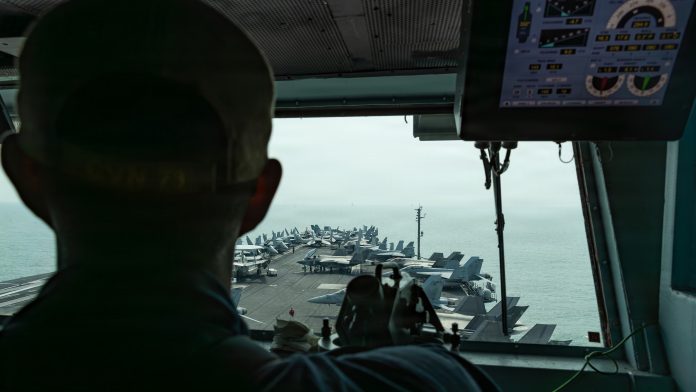
Abraham Lincoln went out early and stayed out. Now George Washington has left the western Pacific to relieve her as China pushes its own carrier force farther into the Pacific.
Nine months ago, The Military Report warned that USS Abraham Lincoln’s early departure from San Diego was more than another carrier deployment.
She was leaving outside the Navy’s normal Optimized Fleet Response Plan.
At the time, The Military Report wrote:
“Breaking OFRP Isn’t Routine. It’s a Signal.”
And The Military Report listed some of the things that signal could mean:
CENTCOM facing unrelenting demand. Carrier gaps opening. Forces stretched thin.
Now one of those gaps has opened.
Abraham Lincoln went out early.
Then she stayed out.
And the Navy has now pulled USS George Washington, America’s forward-deployed carrier in Japan, out of the western Pacific to relieve her.
The Navy borrowed readiness from the future when it sent Abraham Lincoln out early.
Nine months later, the bill has reached the Pacific.
Lincoln Broke the Cycle
The Optimized Fleet Response Plan isn’t some Pentagon scheduling exercise that matters only to planners.
It is supposed to keep the fleet sustainable.
A carrier moves through maintenance, training and certification, deploys, returns and remains available during a sustainment period before eventually going back into maintenance.
That rhythm matters because carriers aren’t just ships.
Thousands of sailors have to be trained. An air wing has to be ready. Aircraft have to be maintained. Escorts have their own readiness requirements. Weapons, parts and supplies have to be available.
In November 2025, Lincoln departed San Diego outside that normal cycle.
The Military Report wrote then that the important story wasn’t that the Navy wouldn’t disclose where the carrier was going. The Navy routinely doesn’t announce carrier destinations in advance.
The story was that Lincoln was going early.
“When a carrier leaves the cycle early,” The Military Report wrote, “it means something in the global picture is moving fast enough that the Navy isn’t waiting for the next tidy box on the 36-month schedule.”
That turned out to matter.
Lincoln was ultimately sent to the Middle East and has now spent more than 250 days deployed, including more than 200 consecutive days without a port call. Her air wing has flown thousands of combat sorties during the war with Iran.
Eventually, she had to be relieved.
And that relief had to come from somewhere.
George Washington Goes West
The carrier coming to relieve Lincoln is USS George Washington.
That is where this becomes more than a Middle East story.
George Washington is forward-deployed at Yokosuka, Japan. Her purpose is to keep American carrier power close to the Korean Peninsula, Taiwan, the East China Sea and the South China Sea without waiting for a carrier to make the long transit from the West Coast.
Now she has left.
George Washington was publicly observed transiting the Strait of Malacca last week. Associated Press subsequently reported that the carrier was heading through the Indian Ocean toward the Middle East to relieve Lincoln. Her precise position today is not publicly known.
The consequence is straightforward.
The United States temporarily has no aircraft carrier in the western Pacific.
That doesn’t mean the Pacific is undefended.
American attack submarines remain in the region. So do destroyers, Marines and land-based aircraft. Guam remains a major American military hub. Japan, South Korea, Australia and the Philippines provide additional allied military capability.
But an aircraft carrier is different.
A carrier strike group is both combat power and political signal.
Its presence is noticed.
So is its absence.
Where Are the Other Carriers?
The United States has 11 nuclear-powered aircraft carriers.
But it doesn’t have 11 deployable carriers.
That distinction gets lost whenever somebody simply counts hulls.
Carriers spend years moving through maintenance, training, deployment and sustainment cycles. Some are in shipyards. Some are rebuilding readiness. Some are working up. Others have just returned from deployment.
There are three carriers worth watching on the West Coast.
USS Ronald Reagan has recently come out of maintenance.
Coming out of the yard, however, doesn’t mean a carrier is ready to deploy. The ship has to rebuild proficiency, integrate with its air wing and escorts, and complete the training and certifications required before it can be sent back into combat operations.
That takes time.
USS Theodore Roosevelt is farther along.
Roosevelt, with Carrier Air Wing 9 embarked, led the American naval contingent at RIMPAC this summer. She operated with a cruiser, four destroyers, two attack submarines and Military Sealift Command oilers and a dry-cargo ship during the massive multinational exercise around Hawaii.
That is substantial integrated training.
But RIMPAC is not necessarily the final certification event before deployment.
As of this writing, The Military Report has not found public confirmation that the Theodore Roosevelt Carrier Strike Group has completed its final pre-deployment certification.
That makes Roosevelt the carrier to watch.
The Navy could accelerate her remaining workups if commanders decide the Pacific carrier gap needs to be closed quickly.
But we’ve already seen where that road can lead.
Send a carrier early and you start consuming tomorrow’s readiness today.
Then There’s Carl Vinson
USS Carl Vinson is also in San Diego.
She returned in August 2025 after a nine-month deployment that included operations in the western Pacific and Middle East.
Vinson has continued getting underway from San Diego, indicating that she remains operationally active.
But publicly available information does not tell us whether the entire Carl Vinson Carrier Strike Group could deploy immediately.
And that’s what matters.
A carrier doesn’t go to war by itself.
It needs an air wing.
It needs escorts.
It needs ammunition.
It needs logistics support.
Those ships, aircraft, and crews have readiness cycles of their own.
Seeing an aircraft carrier tied up at North Island doesn’t tell you whether the carrier strike group can sail for the western Pacific tomorrow.
The Navy knows that answer.
The public doesn’t.
China Is Moving the Other Way
And this is where the timing becomes difficult to ignore.
As American carrier power moves west toward the Middle East, China is continuing to push its carrier force farther into the Pacific.
China’s newest aircraft carrier, Fujian, is part of that expanding naval reach.
There is no evidence China sent Fujian into the Pacific because George Washington left.
Carrier operations of this size require advance planning. China’s movements were almost certainly planned before the Navy decided to send George Washington west.
But China doesn’t have to create an opening to take advantage of one.
It only has to recognize it.
Beijing has spent years extending naval operations beyond the first island chain—the geographical line running through Japan, Taiwan and the Philippines that separates China’s coastal seas from the broader Pacific.
Its carriers have been operating progressively farther from home.
Fujian represents another step.
Unlike Liaoning and Shandong, which launch aircraft from ski-jump bows, Fujian uses electromagnetic catapults. That gives China the potential to launch heavier aircraft with greater fuel and weapons loads and to operate fixed-wing airborne early-warning aircraft.
China is still learning how to conduct complex carrier operations.
The U.S. Navy has generations of experience doing it.
But experience comes from going to sea.
And the Chinese are going to sea.
Two Navies, Two Directions
Look at the map.
An American carrier normally stationed in Japan has passed through the Strait of Malacca headed west.
China is pushing carrier operations farther east into the Pacific.
Those movements were not necessarily responses to one another.
But strategically, the picture matters.
China can concentrate most of its military power in one region.
The United States cannot.
America is maintaining commitments in Europe, the Middle East, the Indian Ocean and the Pacific simultaneously.
Every one of those commitments draws from the same finite pool of ships, aircraft, weapons, logistics vessels and sailors.
The United States can move a carrier from one theater to another.
What it cannot do is put that carrier in two oceans at once.
The Logistics Chain Behind the Carrier
There is another constraint behind all of this.
Logistics.
A nuclear carrier can operate for years without refueling its reactors.
Its aircraft cannot.
Neither can the conventionally powered destroyers accompanying it.
Carrier strike groups require Military Sealift Command oilers to bring fuel. Dry-cargo and ammunition ships bring food, aircraft parts, repair components, missiles, bombs and the countless consumables required to keep a floating air base operating.
Those logistics ships have their own crews, maintenance problems and availability rates.
The farther the carrier operates from established supply hubs, the longer and more complicated that chain becomes.
And the longer a deployment lasts, the greater the strain.
Aircraft accumulate flight hours.
Machinery wears.
Parts break.
Maintenance gets deferred.
Weapons are expended.
And sailors get tired.
That was the warning behind Lincoln’s early deployment in November.
The Navy could push the schedule.
It could send the carrier early.
What it couldn’t do was erase the consequences.
The Warning Was There
On Nov. 26, 2025, The Military Report wrote that Lincoln’s early deployment could indicate:
“CENTCOM facing unrelenting demand.”
“Carrier gaps opening.”
“Forces stretched thin.”
Nine months later, Lincoln is still in the Middle East.
The carrier sent to relieve her has been taken from the Pacific.
It doesn’t mean the United States has abandoned the Pacific.
It means something much simpler.
The United States has global commitments and a finite fleet.
Last November, the Navy needed another carrier sooner than its normal readiness cycle provided.
So it sent Abraham Lincoln.
She went out early.
She stayed out long.
Eventually, somebody had to relieve her.
The Navy reached into the western Pacific and sent George Washington.
Nine months ago, we called Lincoln’s early departure a signal.
Now we know what that signal was warning us about.