

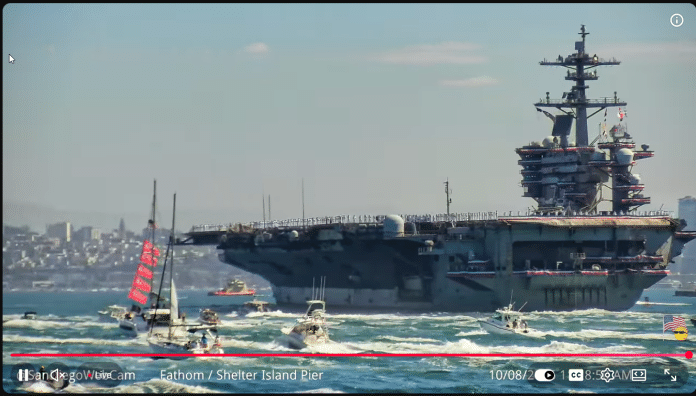
The aircraft carrier returned to San Diego with a Presidential Unit Citation, a record 265 consecutive days at sea and lessons already shaping how the Navy prepares its ships for future deployments.
SAN DIEGO, Oct. 8, 2026 — The aircraft carrier USS Abraham Lincoln returned to Naval Air Station North Island Thursday, completing a 321-day deployment that included combat operations against Iran, a record-setting period without a port call and growing concerns about the strain prolonged operations place on American sailors.
Thousands of family members and friends gathered along San Diego Bay.
The morning began with coastal fog obscuring the harbor entrance. As the haze lifted, the carrier gradually appeared offshore.
Tractor tugs moved out to greet the Lincoln, spraying streams of water from their fire monitors. Dozens of pleasure craft gathered nearby.
Sailors lined the flight deck as the carrier approached North Island.
Then came the moment families had waited nearly 11 months to see.
The ship tied up, the gangways were positioned, and the first sailors began making their way ashore.
For some families, the reunion included meeting children born during the deployment.
The Lincoln was home.
But this was no ordinary homecoming.
The carrier returned with the Presidential Unit Citation, the nation’s highest award for extraordinary heroism by a military unit.
It also returned with lessons the Navy is already applying to another aircraft carrier.
A Deployment That Became a War
The Lincoln departed early from San Diego on Nov. 21, 2025, initially bound for the Indo-Pacific.
Its mission changed when the strike group was ordered west toward the Middle East.
By late January, the Lincoln had entered the U.S. Fifth Fleet area of operations.
When American military operations against Iran began Feb. 28, the carrier was positioned to participate.
The Lincoln became a major component of Operation Epic Fury.
According to Pentagon figures, the strike group conducted 3,693 combat sorties during 40 consecutive days of combat operations.
The Defense Department also credited the strike group with launching 450 Tomahawk land-attack cruise missiles, delivering approximately 1.37 million pounds of ordnance, shooting down 77 Iranian one-way attack drones and destroying 21 anti-ship cruise missiles.
The Pentagon further credited the strike group with sinking 64 Iranian vessels.
Those figures represent the Defense Department’s account of the strike group’s collective accomplishments. They should not be interpreted as actions performed exclusively by the aircraft carrier.
The Lincoln supplied the aircraft, flight deck and aviation support facilities necessary for sustained air operations.
Its escorts provided additional offensive and defensive capabilities.
Together, the ships formed a naval combat force capable of striking distant targets while protecting itself against incoming threats.
The Destroyers That Fought Alongside the Lincoln
The Lincoln was the centerpiece of the strike group.
But it did not fight alone.
Three guided-missile destroyers were part of the original deployment organization.
USS Frank E. Petersen Jr. served as the strike group’s integrated air and missile defense commander.
The Pearl Harbor-based destroyer helped coordinate protection against aircraft and missile threats.
Its role was especially important during operations involving Iranian drones and anti-ship missiles.
The Petersen returned to Pearl Harbor on Sept. 28, completing approximately 10 months of deployment.
USS Spruance deployed from San Diego with Destroyer Squadron 21.
Equipped with the Aegis combat system, surface-to-air missiles and Tomahawk land-attack cruise missiles, the destroyer possessed both defensive and offensive capabilities.
As of Thursday, the Spruance remained deployed in the Indian Ocean.
USS Michael Murphy, based at Pearl Harbor, also deployed with the Lincoln.
Named for Navy SEAL Lt. Michael P. Murphy, who was posthumously awarded the Medal of Honor for his actions in Afghanistan, the destroyer carries the weapons and sensors required to protect a carrier strike group and conduct independent operations.
The Michael Murphy remained in the Arabian Sea as of Thursday.
The guided-missile cruiser USS Robert Smalls also operated with the strike group during the deployment.
The publicly available record does not establish which individual ship fired every weapon or received credit for every engagement.
But the collective combat record cannot be understood without recognizing the surface combatants.
Much of their fighting took place inside combat information centers, where sailors monitored radar displays, tracked incoming threats and coordinated weapons engagements.
The work rarely produces dramatic photographs.
A missile interception may last only seconds.
The training required to accomplish it takes years.
Destroyers also face logistical challenges different from those aboard a carrier.
Their crews are smaller, their storage capacity is limited and their ability to remain at sea depends heavily on replenishment ships.
Their sailors endure the same separation from families.
And unlike the Lincoln’s crew, some have not yet returned home.
The carrier is home. Some of the sailors who protected it are still standing watch thousands of miles away.
The Combat Record Painted on Steel
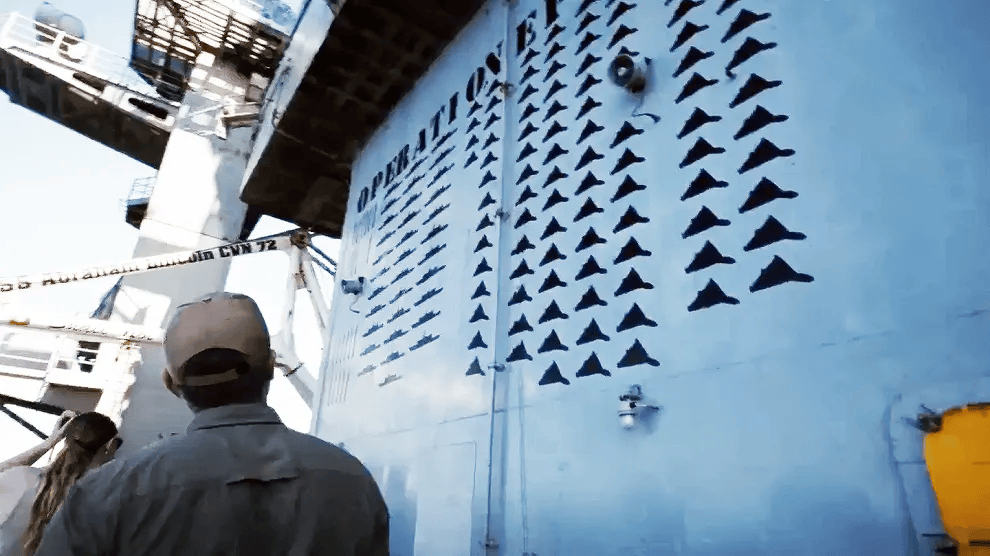 The Lincoln returned carrying an unusual visual record of its combat operations.
Rows of dark silhouettes painted on the carrier’s island superstructure represent Iranian drones destroyed during the campaign.
The markings resemble the victory symbols painted on military aircraft during earlier wars.
Aircraft assigned to the Lincoln also returned with combat markings.
An F/A-18F Super Hornet assigned to Strike Fighter Squadron 41, the Black Aces, returned to Naval Air Station Lemoore carrying the image of a submarine broken in half.
The marking was accompanied by the words Sub Buster.
Marine F-35C fighters assigned to Marine Fighter Attack Squadron 314 also returned with submarine silhouettes among their combat markings.
Those symbols suggest the aircraft participated in attacks against Iranian submarines.
The Navy has not publicly detailed the circumstances behind every marking.
The markings provide a striking visual record of the range of targets engaged during the campaign.
A Presidential Unit Citation
On Wednesday, Defense Secretary Pete Hegseth visited the Lincoln as the carrier approached San Diego.
He announced that the strike group had received the Presidential Unit Citation for its performance during operations against Iran.
The award recognizes extraordinary heroism by a military unit engaged in combat against an armed enemy.
It recognizes collective performance rather than individual accomplishments.
For the Lincoln strike group, that includes the sailors aboard the carrier, the personnel assigned to its air wing and the ships included in the cited unit.
Hegseth also acknowledged that he had authorized two extensions that kept the Lincoln deployed beyond its original schedule.
Those extensions helped sustain American military operations.
They also imposed extraordinary demands on the crew.
A Record Nobody Wanted to Set
The Lincoln spent 265 consecutive days at sea without a port call.
That surpassed the previous modern Navy record of 206 days established by USS Dwight D. Eisenhower in 2020.
For nearly nine months, the Lincoln’s sailors lived and worked aboard the same ship without going ashore.
A nuclear-powered aircraft carrier can remain at sea for extended periods because its reactors provide propulsion and electrical power.
But nuclear propulsion does not eliminate the need for food, ammunition, aviation fuel, spare parts and other supplies.
Those necessities must be delivered by replenishment ships.
The process allows the carrier to remain operational without entering port.
But replenishment at sea does not provide the relief of a port visit.
There is no liberty ashore.
No ordinary break from the shipboard routine.
No opportunity to spend an evening away from the ship.
Meanwhile, aircraft must be maintained, catapults and arresting gear kept operational, and weapons prepared for combat.
The ship’s propulsion, electrical, communications and damage-control systems require continuous attention.
The work never stops.
And when a deployment stretches toward a year, the strain accumulates.
The Problems Below Deck
The Lincoln’s extended deployment exposed serious problems involving supplies and crew welfare.
Reports described shortages of food, personal hygiene products and other necessities.
Mail deliveries were disrupted.
Families raised concerns about the conditions aboard the ship and the mental health of their loved ones.
The Navy initially disputed or downplayed some reports.
But Acting Secretary of the Navy Hung Cao subsequently acknowledged that eight sailors assigned to the Lincoln strike group had attempted suicide during the deployment.
None of the attempts resulted in a death, according to Cao.
The incidents do not establish that the deployment itself caused the attempts, nor does the number alone demonstrate an unusually high rate among approximately 6,000 personnel.
Nevertheless, they raised serious questions about the human costs of prolonged naval operations.
The Navy’s logistical problems were complicated by damage to its regional support network during the war against Iran.
Some supply operations had to be shifted to more distant facilities.
That made an already demanding deployment more difficult.
The Lincoln’s sailors continued performing their missions.
But their combat accomplishments did not erase the problems they experienced.
Both are part of the deployment’s history.
The Roosevelt Sails With Lessons From the Lincoln
The Navy began applying lessons from the Lincoln’s deployment before the carrier returned home.
USS Theodore Roosevelt departed San Diego on Sept. 29.
The Roosevelt sailed with additional food, hygiene products and other supplies in preparation for the possibility of a prolonged deployment.
Navy leadership had already acknowledged that the preparations reflected lessons learned from the Lincoln’s experience.
The changes included increased storage capacity, additional supplies and efforts to improve communications with sailors’ families.
The Navy was preparing for the possibility that another carrier could face an extended period at sea with disrupted replenishment.
Those changes are important.
But additional supplies address only part of the problem.
More food can improve living conditions.
Additional storage can help a ship withstand interruptions in replenishment.
Better communications can reduce uncertainty for families.
None eliminates fatigue.
None replaces missed birthdays, anniversaries or the birth of a child.
And none prevents the maintenance demands that accumulate when equipment operates continuously for months beyond its planned schedule.
The Carrier Rotation
The Lincoln’s return also marked the completion of a major carrier rotation in the Middle East.
In August, the Navy redirected USS George Washington from the Indo-Pacific to relieve the Lincoln.
Once the replacement carrier arrived, the Lincoln was released to begin its journey home.
The Lincoln departed the Middle East on Aug. 22.
It reached Thailand on Sept. 2, ending its record-setting period without a port call.
The carrier subsequently operated in the South China Sea before stopping in Guam for logistics support on Sept. 19.
It then continued across the Pacific toward California.
The rotation illustrates an important distinction in naval operations.
A carrier arriving in a region does not automatically mean an increase in American naval forces.
It may simply be replacing another ship.
And the departure of a carrier does not mean every ship in its strike group leaves at the same time.
Destroyers may remain deployed or receive new assignments.
That is precisely what happened with the Lincoln.
The Cost of Keeping Carriers at Sea
At 321 days, the Lincoln’s deployment ranks among the longest American aircraft carrier deployments since the Vietnam War.
It also followed a relatively short interval between major deployments.
The carrier returned from a 162-day deployment in December 2024 before sailing again in November 2025.
The Navy’s carrier readiness system depends on a cycle of maintenance, training and deployment.
Ships return from operations, undergo repairs and inspections, train their crews and prepare for their next assignments.
Extended deployments disrupt that process.
Equipment accumulates wear.
Maintenance requirements grow.
Training and repair schedules may have to be adjusted.
And when one carrier remains deployed longer than expected, other ships may have to change their schedules to maintain American naval presence overseas.
The consequences can extend across the fleet.
The Lincoln’s deployment demonstrated the Navy’s ability to sustain extraordinary operations.
It also demonstrated the costs of doing so.
The Lincoln Heads for the Shipyard
The Lincoln’s return to San Diego does not mark the end of its operational commitments.
The Navy plans to shift the carrier’s homeport to Naval Base Kitsap in Bremerton, Washington.
The ship will undergo a Drydocking Planned Incremental Availability at Puget Sound Naval Shipyard.
That is an extensive maintenance period during which the carrier enters dry dock for inspections, repairs and upgrades.
The Lincoln has completed its homecoming activities and air wing offload in San Diego.
Then it will head north.
The maintenance period will provide an opportunity to address wear accumulated during the deployment and prepare the ship for future operations.
But it will also remove the carrier from the deployable fleet while the work is performed.
That is another reality of naval readiness.
A carrier operating at sea can project American military power.
A carrier undergoing major maintenance cannot.
Both are necessary.
Home at Last
On Thursday morning, the Lincoln approached San Diego through the coastal fog.
Thousands waited along the waterfront.
Tractor tugs moved out to meet the carrier, spraying water into the air.
Pleasure craft gathered offshore.
As the ship emerged from the haze, its enormous silhouette became visible against the San Diego skyline.
For the families watching from shore, the sight meant more than the completion of another deployment.
Their sailors were coming home.
Soon, the Lincoln was alongside the pier at North Island.
The first sailors descended the gangways.
The Lincoln’s deployment will be remembered for its combat operations against Iran, its Presidential Unit Citation and its record-breaking 265 consecutive days at sea.
It will be remembered for the combat markings painted on the carrier and its aircraft.
It should also be remembered for the destroyers that fought alongside it, the sailors who endured extraordinary hardships and the families who waited at home.
The lessons are already influencing another carrier.
The mission continues.
But for the sailors stepping onto the pier Thursday, the immediate concerns were much simpler.
After nearly 11 months away, they could finally embrace their families.
The Lincoln had completed its mission.
Now its sailors could finally go home.