

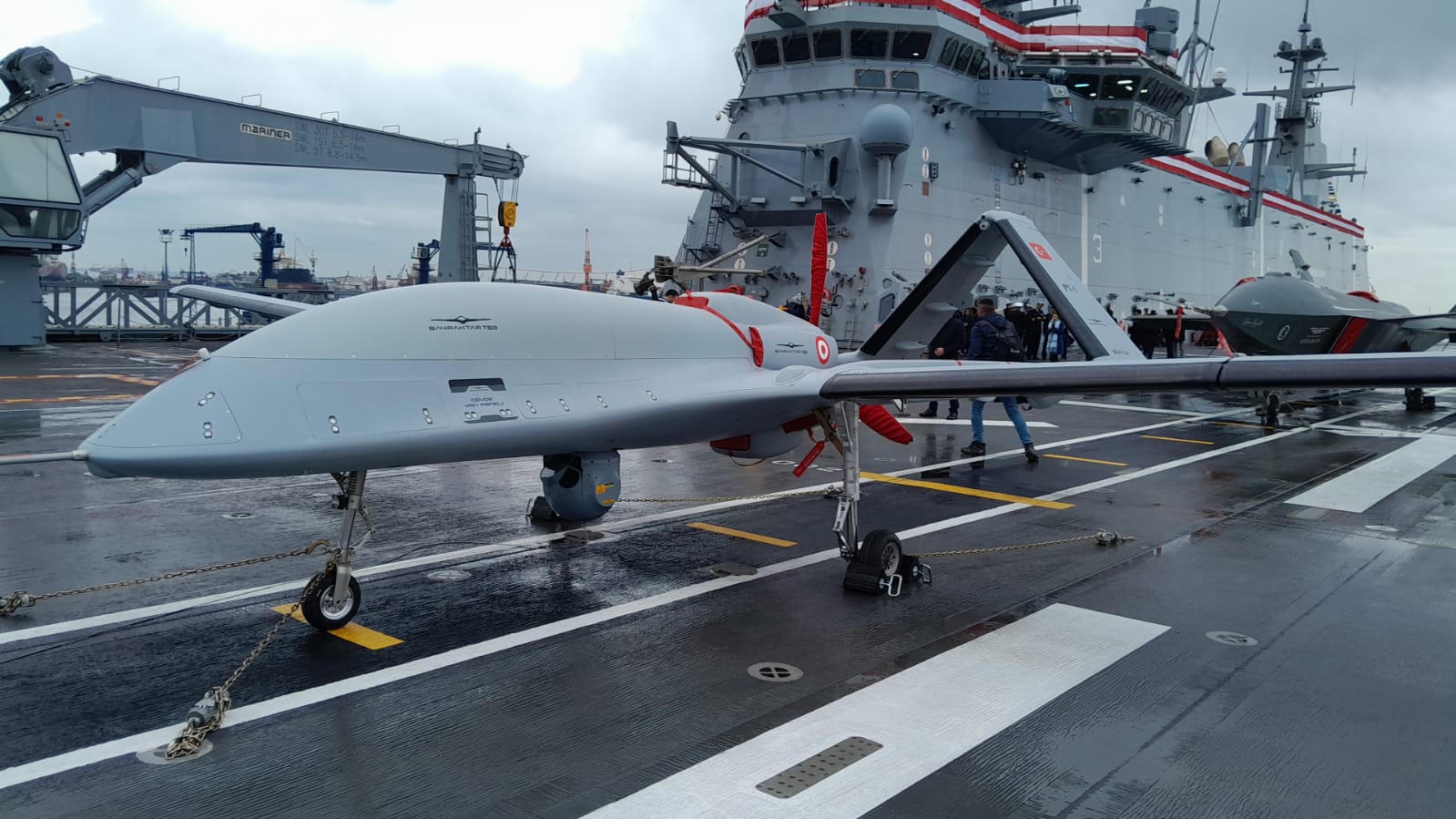
You probably missed it between election noise and celebrity meltdowns, but Turkey just rolled out something that ought to rattle every admiral’s coffee cup from Norfolk to Yokosuka. The TCG Anadolu isn’t just another warship. It’s the world’s first operational drone carrier — and it works.
Not “concept art in a defense contractor’s brochure” works. Not “in six years if the budget holds” works. It’s already launching and landing Bayraktar TB3 unmanned combat aerial vehicles, the folding-wing, carrier-capable cousins of the drones that have been wrecking tanks in Ukraine and making generals in Moscow lose sleep. And while it’s tossing drones into the sky, it can also haul hundreds of troops and their gear straight into the fight.
Born from Getting Kicked Out of the Club
The Anadolu was supposed to haul shiny new F-35B jets. Turkey had its pilots in U.S. training programs, its factories making parts, and its flag planted in the multinational program. Then 2019 happened. Ankara bought the Russian S-400 air defense system, ignoring months of warnings from Washington. The Pentagon called it a security risk — said the S-400 could snoop on the F-35’s stealth profile — and slammed the door. Pilots sent home. Contracts yanked. Access revoked.
That could’ve been the end of the big-deck dream. But the Turks didn’t sulk. They looked at their homegrown drone industry — the same folks who turned the tide in Nagorno-Karabakh and Libya — and said, “Fine. We’ll make our own air wing. And it won’t need pilots.”
Now the Anadolu can carry 30 to 50 TB3s. Eleven can sit on deck, ready to go. The rest are folded up in the hangar, waiting for their turn. Each can stay up for over 24 hours, drop smart bombs like the MAM-L and MAM-T, and beam back targeting data from hundreds of miles away. All while the ship’s cavernous well deck and vehicle bays can move Marines, landing craft, and armored vehicles straight to shore.
It’s not just “eyes in the sky.” It’s eyes, ears, claws — and boots on the beach.
Cheap, Persistent, and Disposable
Here’s the dirty little secret: losing a drone isn’t losing a pilot. You don’t have to write condolence letters or hold flag-draped funerals. You just launch another one. That changes the math. A U.S. supercarrier might have 70 high-performance jets, but every loss is a million-dollar headache and a trained-aviator shortage. Anadolu’s air wing is cheap enough to be aggressive and persistent enough to never give you a break.
They can fly constant patrols, keep sensors pointed at your coastline, and hit your ships before you even know they’re there. And if you manage to shoot one down, congratulations — you just spent more on the missile than they did on the target.
Now add in the troop-hauling capability, and you’ve got a ship that can soften the beachhead from over the horizon, then send its own landing force in behind the drones. That’s a one-stop amphibious invasion kit.
The Neighborhood Just Got Noisier
Park this thing in the eastern Mediterranean and Turkey can watch half the region without asking anyone’s permission. Same goes for the Black Sea or the Red Sea. Any disputed patch of water or gas field suddenly has an unblinking eye overhead, a set of claws ready to rake it, and the ability to put armed troops ashore without warning.
And unlike traditional carriers, the Anadolu doesn’t have to steam into the danger zone to do it. Those TB3s can fly hundreds of miles out, sniff around, and come back with more than pictures — they can come back with kill confirmations.
Copycats Are Coming
This isn’t a one-off stunt. Medium-sized powers from Brazil to Indonesia are going to look at this and see a way to play in the big leagues without selling the farm. Build one ship. Stock it with drones. Fill the hold with troops and gear—project power in your neighborhood.
It’s naval aviation for countries that can’t or won’t spend $13 billion on a nuclear carrier and another billion a year to keep it running. And don’t think for a second that the big boys won’t copy the idea for their own purposes — a drone carrier makes a fine sidekick to a traditional flattop.
The Counterpunch Problem
Sure, the Anadolu isn’t invincible. Long-range missiles, submarines, and electronic warfare can ruin its day. However, defense planners need to stop thinking about it in terms of ship vs. ship. The real problem is what happens when dozens of drones come at you from different directions at once while landing craft are inbound. Your interceptors run out before their drones do. Your radars get saturated. Your budget bleeds faster than theirs.
Ask anyone who’s faced down massed cheap drones in Ukraine: it’s not the big one you see coming, it’s the swarm you can’t stop.
The New Deck Boss
We’ve been here before. In the 1920s, carriers were sideshows to the battleship. Two decades later, Pearl Harbor and Midway proved them decisive. The Anadolu might just be the Midway moment for unmanned naval aviation — the point where the conversation shifts from “if” to “how many.”
For Turkey, it’s a statement: we’re not waiting for hand-me-downs from Washington or Moscow. For everyone else, it’s a warning shot: the definition of “carrier” just changed, and the first one to field it isn’t flying a Union Jack, Stars and Stripes, or Rising Sun.
If you’re wearing a uniform with anchors on it, you ought to be taking notes. And maybe calling your budget office. Because the next time you hear “drone carrier,” it might not be Turkey we’re talking about. It might be your neighbor. Or your rival.