

The United States isn’t moving into Greenland for the first time. It is going back.
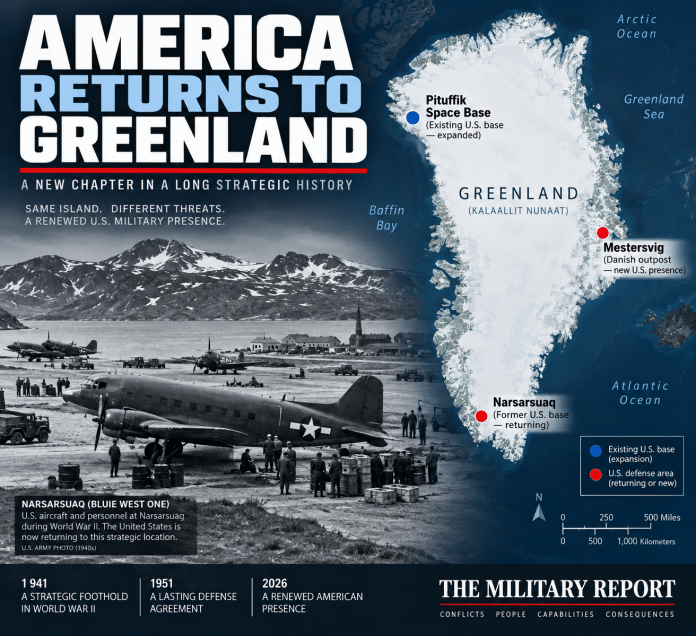
Under a security agreement signed Tuesday by the United States, Denmark and Greenland, American forces will return to Narsarsuaq, where the United States operated a military air base beginning in World War II and into the Cold War, while establishing a new military presence at Mestersvig on Greenland’s east coast.
The agreement also allows an expansion of operations at Pituffik Space Base, the sole remaining U.S. military installation in Greenland.
The move marks a partial return to an American military network that once stretched across the world’s largest island but was steadily dismantled as the Cold War ended. The United States operated 17 military installations in Greenland during the Cold War, according to the Congressional Research Service.
The flags have changed, the aircraft have changed and the threat has changed.
The map hasn’t.
Back to Narsarsuaq
Narsarsuaq has been part of American military history since before the United States formally entered World War II.
American forces arrived there in 1941 and constructed a major Army and Navy installation code-named Bluie West One. By the end of September that year, U.S. troops had already erected 85 buildings at the base. (history.army.mil)
Its airfield became an important stop on the North Atlantic route used to ferry aircraft and personnel between North America and Europe.
When the war ended, Greenland did not lose its strategic importance.
It became more important.
The Soviet Union was on the other side of the Arctic, and the shortest routes between Soviet territory and much of North America ran across the polar region.
In 1951, the United States and Denmark signed a new agreement governing the defense of Greenland. A secret technical schedule designated three principal areas for American military use: Narsarsuaq, Sondrestrom and Thule. (nsarchive.gwu.edu)
The agreement gave American forces broad authority to develop and operate military facilities in those areas while recognizing Danish sovereignty over Greenland.
Narsarsuaq eventually ceased operating as an American base.
Now the United States is coming back.
A New Position on the East Coast
Mestersvig has a different history.
It was not one of the major American Cold War bases. Today the remote outpost on Greenland’s east coast is used by Denmark’s Sirius Dog Sled Patrol.
Under the new agreement, the United States will establish a military presence there, giving American forces another position on the opposite side of the island from most of Greenland’s population and infrastructure.
That makes the two locations significantly different.
At Narsarsuaq, the United States is returning to old ground.
At Mestersvig, it is establishing a new American defense position.
The agreement also provides for expanded American operations at Pituffik Space Base, formerly Thule Air Base, in northwestern Greenland. Pituffik already plays an important role in missile warning, missile defense and space surveillance.
The agreement allows the United States to establish additional defense areas in the future through consultation with Denmark and Greenland.
It also provides broad access for U.S. military aircraft, ships, vehicles, and personnel moving between American defense areas in Greenland.
The agreement specifically contemplates Greenland supporting the proposed Golden Dome missile defense system, tying the island more directly to the defense of the North American continent.
The Geography Never Went Away
The reasons Washington wanted bases in Greenland 80 years ago aren’t identical to the reasons it wants them today.
But the geography is.
During World War II, Greenland helped bridge the North Atlantic.
During the Cold War, it sat beneath the shortest approaches between the Soviet Union and North America.
A declassified 1955 Joint Chiefs of Staff memorandum described Greenland as lying across the most direct air routes between the United States and the Soviet Union. The Pentagon saw the island as useful both for early warning and for military operations across the Arctic. (nsarchive.gwu.edu)
And there is an extraordinary historical echo in that document.
The Pentagon was considering the military value of the United States acquiring Greenland.
The Joint Chiefs concluded that American ownership of Greenland would provide military advantages. But they also concluded that buying the island was not necessary to meet U.S. defense requirements.
The reason was the agreement Washington already had.
The Joint Chiefs determined that the 1951 defense agreement with Denmark provided the United States with the military rights it needed, as long as Denmark remained a cooperative NATO ally. In effect, Washington could obtain the strategic benefits of Greenland without owning Greenland. (nsarchive.gwu.edu)
That was 1955.
Seventy-one years later, Washington has arrived at something similar.
President Donald Trump spent much of the past year talking publicly about the United States acquiring Greenland and arguing that control of the island was necessary for American national security.
The agreement signed Tuesday takes another route.
Denmark retains sovereignty. Greenland retains its right of self-determination.
The United States gets expanded military access.
The new agreement also bars non-NATO countries from establishing military installations or a persistent military presence in Greenland and establishes safeguards concerning foreign investment in sensitive infrastructure and resources.
It comes after more than a year of political tension over Trump’s repeated statements that the United States needed Greenland for national security and his earlier interest in acquiring the territory.
Greenland remains part of the Kingdom of Denmark, and both Danish Prime Minister Mette Frederiksen and Greenland Prime Minister Jens-Frederik Nielsen emphasized Greenlandic self-determination when they signed the agreement with Trump in New York.
What Washington gets instead is something it has relied upon before: access.
And this time, the agreement has no expiration date.
An Old Strategy Returns
There is a historical symmetry to the deal.
In 1941, the United States began building bases in Greenland because control of the North Atlantic approaches had become essential to American security.
In 1951, Washington and Copenhagen formalized a network of defense areas as the Cold War intensified.
In 1955, the Joint Chiefs considered the advantages of American ownership and concluded that the United States could obtain the military access it needed without acquiring Greenland.
As the Cold War ended, the American military footprint contracted until Pituffik was essentially what remained.
Now it is expanding again.
Narsarsuaq, one of the original American defense areas designated 75 years ago, is returning to the map.
Mestersvig adds another position on Greenland’s east coast.
Pituffik remains in the north.
Trump spent much of the past year talking about acquiring Greenland.
The agreement signed Tuesday does something different.
America isn’t acquiring Greenland. The U.S. military is moving back into it.