

The Atlantic has released the full Signal chat among senior Trump administration national security officials, revealing that Defense Secretary Pete Hegseth disclosed details of imminent military operations against Yemen’s Houthis before U.S. pilots were airborne. The controversy intensified as senior Cabinet members, responsible for U.S. intelligence and defense, scrambled to explain how sensitive information, typically deemed classified, was shared on an unclassified chat that included The Atlantic’s Editor-in-Chief, Jeffrey Goldberg.
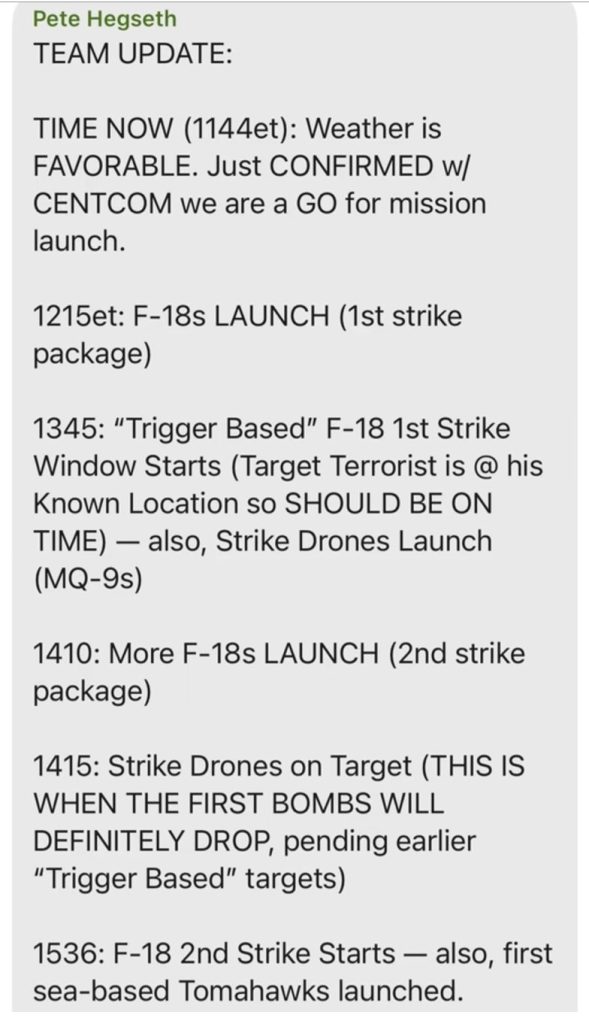 Despite White House Press Secretary Karoline Leavitt’s claims and Hegseth’s own assertions that no classified plans were disclosed, the chat transcripts suggest they were at least sensitive and not for public dissemination. Hegseth provided specific timings for warplane launches and bomb drops, which are generally classified:
-
“1215et: F-18s LAUNCH (1st strike package)”
-
“1345: ‘Trigger Based’ F-18 1st Strike Window Starts (Target Terrorist is @ his Known Location so SHOULD BE ON TIME – also, Strike Drones Launch (MQ-9s)”
-
“1410: More F-18s LAUNCH (2nd strike package)”
-
“1415: Strike Drones on Target (THIS IS WHEN THE FIRST BOMBS WILL DEFINITELY DROP, pending earlier ‘Trigger Based’ targets)”
-
“1536: F-18 2nd Strike Starts – also, first sea-based Tomahawks launched.”
-
“MORE TO FOLLOW (per timeline)”
-
“We are currently clean on OPSEC” — that is, operational security.
-
“Godspeed to our Warriors.”
Director of National Intelligence Tulsi Gabbard and CIA Director John Ratcliffe shifted responsibility to Hegseth during a Senate Intelligence Committee hearing, with Gabbard misleading Congress by echoing Hegseth’s claim that no classified information was shared. This has raised questions about the transparency and integrity of these officials’ testimonies.
Adding to the controversy, former Rep. Michael Waltz, identified in the chat logs as the person who invited the journalist, claimed on national TV that he had no idea how the journalist gained access to the chat, despite clear evidence to the contrary.
This leak, now known as “Signalgate,” raises serious concerns about the adequacy of security measures for sensitive communications and the judgment of those at the highest levels of American national security. The incident underscores potential vulnerabilities within communication platforms like Signal, which was flagged by the Defense Department as susceptible to hacking, particularly from Russian efforts to intercept communications.