

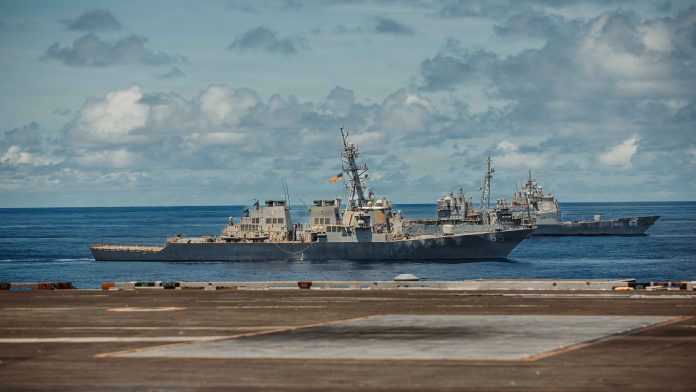
The USS George Washington is heading toward a combat theater. One of the destroyers that started the patrol with her isn’t.
That matters.
When the George Washington Carrier Strike Group began its 2026 patrol, its surface combatants included the cruiser USS Robert Smalls and the guided-missile destroyers USS Shoup and USS Benfold. Together they formed much of the surface screen around the carrier and Carrier Air Wing 5.
On July 24, that screen lost a ship.
Benfold suffered what the Navy called an engineering casualty involving its generators while operating in the South China Sea. The casualty knocked out electrical power and left the destroyer without normal galley service, air conditioning and functioning toilets, while also affecting potable water.
For four days, the roughly 300 sailors aboard fought the casualty while the rest of the strike group helped keep them going. Robert Smalls provided meals.
Eventually, Benfold had to be towed to Subic Bay in the Philippines.
The Navy says repairs were completed and Benfold departed Subic Bay Aug. 8 with its engineering, combat and crew-support systems operating normally. The destroyer subsequently returned to Yokosuka and departed there again Aug. 17.
But there is an operational detail buried underneath the engineering story.
Benfold did not accompany the George Washington strike group through the Strait of Malacca as the carrier headed west toward the Middle East.
Its publicly reported destination after leaving Yokosuka has not been announced.
That leaves a question considerably bigger than four days without power aboard a destroyer:
What happens when a carrier strike group loses one of its escorts just before heading toward a combat zone?
A Destroyer Is More Than an Escort
The ships surrounding an aircraft carrier are not ceremonial bodyguards.
An Arleigh Burke-class destroyer is an independent combat system carrying the Aegis weapon system, sophisticated radar and sonar, helicopters and vertical-launch cells capable of carrying combinations of surface-to-air, anti-submarine and strike weapons.
Its job can change by the hour.
A destroyer can help defend the carrier against aircraft and missiles. It can hunt submarines. It can engage surface ships. It can launch Tomahawks against targets ashore. Its sensors expand the strike group’s picture of what is happening hundreds of miles around the carrier.
Perhaps most importantly, another destroyer gives the strike group commander another place to put weapons and sensors.
That becomes particularly important in waters where attacks can arrive from several directions at once.
The Navy does not simply park its escorts in a neat circle around an aircraft carrier. Ships can operate tens or hundreds of miles apart depending upon the mission, geography and threat. A destroyer can be pushed forward, sent to investigate a contact, assigned to protect another ship or positioned along an expected missile or aircraft threat axis.
Take away one destroyer and the other ships don’t suddenly become incapable of doing the job.
But there is one fewer ship available to do all those jobs.
The Mathematics of the Screen
Before the casualty, the George Washington group was publicly identified as the carrier, Robert Smalls, Shoup and Benfold, along with Carrier Air Wing 5.
That was already a compact surface force.
Now consider what happens if Benfold does not accompany the carrier into the U.S. 5th Fleet operating area.
The commander still has Robert Smalls and Shoup. Other U.S. destroyers already operating in the Middle East could also be assigned to the carrier once it arrives, and the Navy routinely moves ships between task groups as operational requirements change.
But until that happens, losing Benfold removes one Aegis combatant from the formation.
One fewer radar.
One fewer sonar.
One fewer helicopter-capable surface combatant.
One fewer battery of vertical-launch cells.
And one fewer crew capable of being sent away from the carrier to handle another mission while the rest of the group continues protecting the flattop.
That last point may be the most important.
Warships create options.
Fewer warships mean fewer options.
The Middle East Changes the Equation
This isn’t an ordinary Pacific patrol anymore.
The George Washington has been moving west as the Navy prepares to relieve the USS Abraham Lincoln, whose deployment has stretched far beyond a normal carrier cruise during combat operations involving Iran.
The threat environment awaiting George Washington is very different from routine presence operations.
Missiles, drones, submarines, small boats and shore-based weapons can force a carrier strike group to defend itself across several warfare areas simultaneously.
Every escort becomes another shooter and another sensor.
That doesn’t mean the carrier cannot operate without Benfold. Carrier strike groups have never been fixed formations. Ships come and go. Destroyers conduct independent missions. Additional ships can be chopped into a strike group when required.
The Navy has other surface combatants operating in the region.
But those ships aren’t sitting around waiting for work.
They have assignments of their own.
Moving one destroyer to reinforce George Washington means that destroyer is no longer doing something somewhere else.
That is how a mechanical casualty aboard one ship becomes a fleet-level problem.
The Bigger Warning
There is another reason Benfold matters.
The Navy is already stretching ships across two enormously demanding theaters.
The George Washington‘s move toward the Middle East pulls America’s only forward-deployed aircraft carrier away from the Western Pacific at a time when Chinese naval and coast guard forces remain increasingly active around Taiwan, the Philippines and the South China Sea.
Now one of the destroyers that began the patrol with the carrier has remained behind.
That doesn’t cripple the George Washington strike group.
But it illustrates something the Navy has been wrestling with for years.
Ships aren’t interchangeable pieces on a PowerPoint slide.
They break.
They require maintenance.
Crews get tired.
Parts fail.
And when a fleet is stretched across the globe, there isn’t always another ship sitting at the pier waiting to take its place.
Benfold returned to sea after its casualty. Its crew got the ship running again.
That is the good news.
The harder question is where the destroyer goes next—and whether another warship fills the hole it left behind as George Washington sails toward a shooting war.
Because a carrier may be the centerpiece of a carrier strike group.
But the carrier doesn’t fight alone.
And every time one of the ships around it disappears from the formation, somebody else has to pick up the watch.