

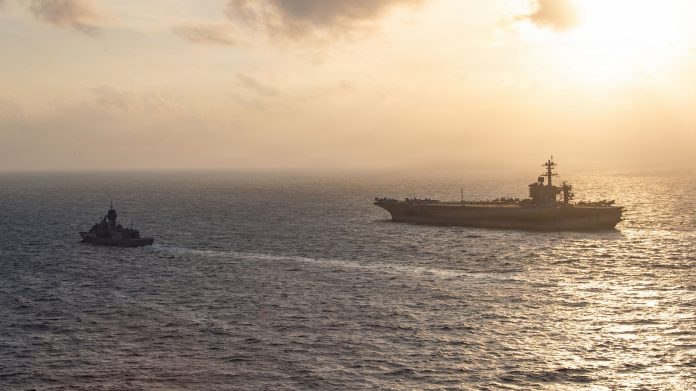
USS George Washington has arrived in the Middle East.
For the sailors aboard USS Abraham Lincoln (CVN-72), that may be the best news they have heard in months.
The George Washington Carrier Strike Group entered the U.S. Central Command area of responsibility Thursday, bringing the Navy one step closer to relieving a carrier and crew that have been grinding away at sea through one of the toughest deployments in recent memory.
George Washington (CVN-73), accompanied by cruiser USS Robert Smalls (CG-62) and destroyer USS Shoup (DDG-86), was operating in the Arabian Sea, according to CENTCOM.
Exactly where the carrier is in relation to Lincoln has not been disclosed. Nor has the Navy announced when Lincoln and her escorts will finally turn east for the long voyage home.
But the relief force is now in theater.
And that matters.
Lincoln Held the Line
There has been plenty written about conditions aboard Abraham Lincoln. Some of it is justified. Some of it misses the larger story.
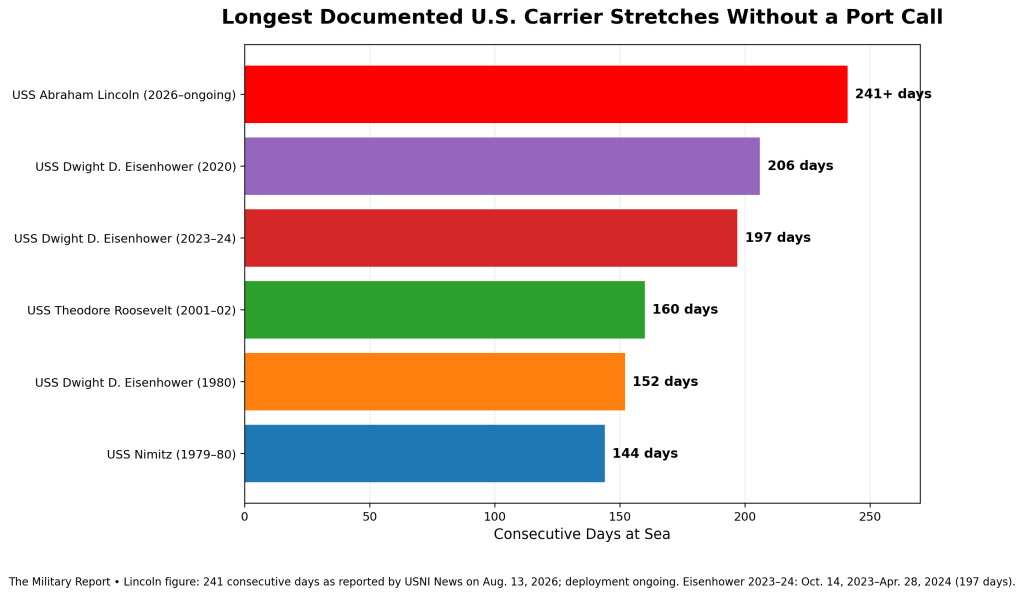
The carrier has now been deployed for 272 days and has gone 252 days without a genuine port call and shore leave — the longest such stretch since the extraordinary deployments of the COVID era.
During that time, Lincoln did not sit at anchor waiting for somebody in Washington to figure things out.
She operated.
Her air wing flew. Her engineering plant kept running. Her escorts remained on station. Sailors stood watches, maintained aircraft, worked flight decks, cooked thousands of meals every day, repaired equipment and did the thousand other jobs required to keep a carrier strike group combat-capable.
And they did it while the logistics pipeline feeding the force grew longer and more complicated.
Iranian attacks and the threat to traditional logistics routes forced the Navy to adjust how it supplied the force. Replenishment ships had farther to travel. Deliveries took longer. The comfortable rhythm of regular port calls and predictable replenishment disappeared.
Lincoln kept operating anyway.
That deserves more than a footnote.
A nuclear-powered carrier may not need bunker fuel for its reactors, but nearly everything else aboard eventually runs out. Jet fuel. Food. Spare parts. Ordnance. Aviation components. Mail. Consumables.
And Lincoln wasn’t operating alone. Her conventionally powered escorts still needed fuel.
Every extra mile traveled by the Military Sealift Command ships supporting the strike group meant more time between replenishments.
Yet the carrier remained on station.
There is an old tendency in Washington to look at a carrier as a weapons system measured in sorties, missiles and reactor endurance.
Sailors know better.
A carrier is more than 5,000 people keeping a small floating city — and a very large airfield — alive around the clock.
Those people aboard Lincoln have been doing it for nine months.
They deserve the salute.
The Relief Has Arrived
Now George Washington has made the long run west from the Indo-Pacific.
The carrier’s movement became apparent last week as the strike group headed through Southeast Asian waters and toward the Indian Ocean.
The deployment represents more than a routine carrier swap.
The Navy moved a forward-deployed carrier out of the Western Pacific to reinforce CENTCOM while another carrier, USS Theodore Roosevelt (CVN-71), continues preparations on the West Coast following its participation in Rim of the Pacific 2026.
That makes George Washington something of a bridge.
It can relieve Lincoln while the Navy prepares the next carrier force.
George Washington also joins an already substantial American naval force in the region, including USS George H.W. Bush (CVN-77), its escorts, and the Boxer Amphibious Ready Group with the embarked 11th Marine Expeditionary Unit.
That is a lot of American naval power concentrated in one theater.
It also comes at a price.
Every carrier sent toward the Middle East is a carrier that isn’t somewhere else.
In George Washington’s case, that somewhere else is the Western Pacific.
One Escort Is Still Missing
There is another wrinkle.
USS Benfold (DDG-65) had been operating with the George Washington strike group, but the destroyer did not make the Malacca Strait transit with the carrier.
In late July, Benfold suffered an engineering casualty that left the destroyer without power for four days in the South China Sea. The ship eventually had to be towed to Subic Bay in the Philippines for repairs.
After repairs, Benfold sailed to Yokosuka and departed Japan earlier this week.
Whether the destroyer will catch up with George Washington in the Arabian Sea remains unclear.
The carrier did not wait.
It went west with Robert Smalls and Shoup.
That, too, says something about the demands being placed on the fleet. Ships break. Repairs take time. Schedules change. Combatant commanders still want forces on station.
The Navy moves what it has.
Now Bring Lincoln Home
Acting Secretary of the Navy Hung Cao said last week that Abraham Lincoln would soon be heading home.
Soon cannot come soon enough for her crew.
Even after George Washington assumes the mission, Lincoln’s sailors still face the long Pacific transit back to the West Coast. Previous carrier movements suggest that voyage could take a month or more.
So their deployment isn’t over when the relief arrives.
It is over when the brow goes across and sailors walk off that ship at home.
There will be plenty of time afterward to examine why the deployment became so long, why shore leave disappeared, how strained logistics affected the strike group and whether the Navy is asking too much of too few ships.
Those are legitimate questions. They need answers.
But there is another part of the story that shouldn’t get lost in them.
For 272 days, USS Abraham Lincoln has been deployed.
For 252 days, her sailors have gone without real liberty ashore.
The supply line stretched.
The deployment stretched.
The sailors kept standing watch.
And Lincoln kept fighting.
Now the relief is finally in theater.
Bring them home.