

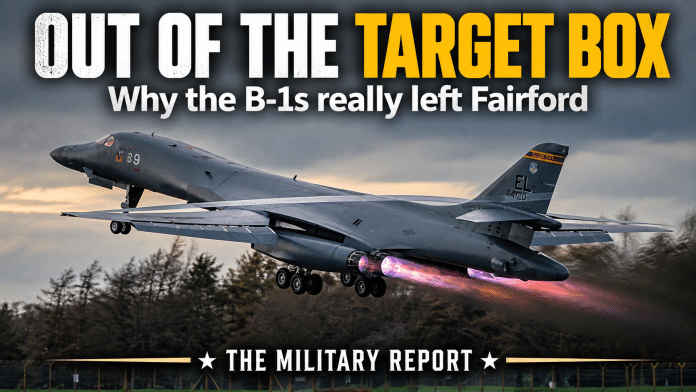
The New York Times has now supplied the question that should have been asked before anybody decided that American B-1 bombers leaving Britain meant trouble in the 75-year military relationship between the United States and the United Kingdom.
Why did the bombers leave?
According to the Times, American commanders received intelligence about a possible drone attack against RAF Fairford, where 12 B-1B Lancers and several hundred American personnel were located.
The potential attack was allegedly connected to Iran’s Islamic Revolutionary Guard Corps.
British police had already arrested suspects in an investigation involving a possible plot against the base. British authorities were examining possible foreign-state involvement.
Iran has denied involvement, and the investigation has not publicly established that Tehran directed the alleged plot.
That distinction matters.
So does another one.
Military commanders don’t need a criminal conviction before they protect their people and aircraft.
They had a potential threat.
They had 12 strategic bombers sitting at a known location.
They had hundreds of American personnel there with them.
So they moved the bombers.
That isn’t terribly mysterious.
It’s force protection.
And it illustrates something I’ve been writing about lately.
Sometimes the biggest problem with reporting on the military isn’t getting a fact wrong.
It’s looking at the right facts through the wrong lens.
Raw Story saw politics
Raw Story reported on the sudden withdrawal of the B-1s from RAF Fairford and framed it as part of damage to the U.S.-UK military relationship — a partnership stretching back to the early years of the Cold War.
That’s a significant conclusion.
And there certainly are political disagreements between Washington and London worth reporting.
Allies disagree.
They have for decades.
But the movement of those B-1s doesn’t establish that the alliance was being dismantled.
We now have substantial evidence explaining why the aircraft moved.
There was a threat.
President Donald Trump said so publicly.
The New York Times has now reported that American commanders received information about a possible drone attack.
And Britain’s own military-oriented news organization approached the story from a very different direction.
Forces News asked the military question
Forces News covers Britain’s armed forces community in much the same territory Stars and Stripes occupies for American military readers.
It asked the British government about the B-1 withdrawal.
Veterans and People Minister Calvin Bailey called it “a military position.”
That’s worth reading again.
A military position.
Bailey said the United States would make such a decision based on its own military analysis and could possess information that Britain itself did not have.
That was an extraordinarily important point.
Because military commanders frequently know things reporters don’t.
Sometimes allied governments don’t have exactly the same information at exactly the same time.
Intelligence arrives.
Threat assessments change.
Commanders make decisions.
Aircraft move.
That doesn’t necessarily mean somebody in Washington has decided to tear up 75 years of military cooperation.
Sometimes it means somebody in a command post has decided he doesn’t want 12 B-1s sitting inside somebody else’s target box.
Twelve bombers make a very inviting target
Put yourself in that commander’s chair.
You’ve got 12 B-1B Lancers concentrated at RAF Fairford.
You’ve got several hundred American personnel supporting them.
You’ve got information indicating someone may be considering an attack on the base.
And now you’re worried about drones.
What exactly are you supposed to do?
Leave the bombers there?
Wait?
Hope the intelligence is wrong?
Keep 12 strategic aircraft lined up at a known location because moving them might create bad political optics?
Of course not.
You move the damn airplanes.
The B-1 is a strategic bomber. The Air Force has a limited number of them. The aircraft, their crews, maintainers and support structure represent an enormous military capability.
You don’t risk that capability unnecessarily.
There is also nothing particularly revolutionary about the concept.
Military commanders have dispersed aircraft when airfields were threatened almost as long as aircraft have been capable of attacking airfields.
The technology changes.
The principle doesn’t.
Don’t give the enemy a lucrative target if you don’t have to.
Today a drone makes that lesson even more important.
An attacker doesn’t necessarily have to destroy a dozen B-1s.
Hit an aircraft.
Hit fuel storage.
Hit maintenance facilities.
Damage a runway.
Kill personnel.
Force operations to stop while commanders determine whether another attack is coming.
That’s enough to create a serious operational problem.
So the Americans moved the B-1s.
They weren’t running from Britain.
They were moving the bombers out of the target box.
Fairford is not Britain
Here’s another place where beat knowledge matters.
RAF Fairford is enormously important to American airpower in Europe.
But RAF Fairford is not the American military presence in Britain.
It is a British installation that serves as a critical forward operating location for American strategic bombers.
B-1s can deploy there.
B-52s can deploy there.
B-2s can deploy there.
They arrive.
They operate.
They leave.
That’s what a forward operating location is supposed to allow them to do.
The departure of temporarily deployed bombers therefore tells you very little, by itself, about the overall American military relationship with Britain.
If you want to know whether that relationship is actually being dismantled like Raw Story claims, you have to look beyond Fairford.
Start at RAF Lakenheath.
American F-35A Lightning IIs and F-15E Strike Eagles remain there.
Then look at RAF Mildenhall.
American tankers and other support missions remain there.
Then keep looking.
American forces use British installations for intelligence, communications, logistics, munitions, command and other missions.
Fairford itself remains available for American operations.
Nobody rolled up the runway.
Nobody dismantled the facilities.
Nobody terminated the basing arrangements.
Nobody sent the entire American military presence home.
Twelve bombers moved.
That’s an important story.
But it isn’t the same story.
And we’re still solid with Britain
The United States and Britain have one of the deepest military relationships in the world.
It wasn’t created by B-1s arriving at Fairford.
And it doesn’t disappear when those B-1s leave.
The relationship stretches across airpower, intelligence, nuclear cooperation, naval operations, NATO, logistics, training and decades of fighting alongside one another.
The two countries can disagree about a particular operation.
Britain can restrict how its territory is used.
Washington can dislike that decision.
Political leaders can argue.
None of those things automatically means the underlying military relationship has been broken.
Anyone who has covered alliances for very long should understand this.
The question isn’t whether London and Washington have disagreements.
The question is whether the institutional military relationship is being dismantled.
Look at the bases.
Look at the aircraft.
They’re still there.
This is a journalism story
And that’s what interests me more than the politics.
I’ve spent a good chunk of my life covering the military.
There are habits you develop on a beat.
You learn not to make too much of one movement until you understand the larger picture.
A carrier sails toward the Middle East.
Fine.
Where is the carrier already there?
Is it staying?
Is it leaving?
Is the incoming carrier reinforcement — or relief?
Why?
Those questions aren’t political.
They’re reporting.
And we’ve just watched this same problem occur with aircraft carriers.
Political reporters saw another carrier heading toward the Middle East and counted ships.
One.
Two.
Three.
Three carriers!
A snapshot isn’t a deployment schedule.
Follow the damn ships.
Now we’ve got the airborne version.
Twelve B-1s leave Fairford.
Before writing the geopolitical obituary of the U.S.-UK military relationship, perhaps somebody ought to ask:
Why did they leave?
The answer now appears rather important.
Somebody may have been planning to attack them.
What didn’t move?
There’s another question military beat reporters learn to ask.
Sometimes it’s more useful than asking what moved.
What didn’t move?
The B-1s moved.
Lakenheath didn’t.
Mildenhall didn’t.
The American intelligence presence didn’t.
The communications infrastructure didn’t.
The logistics network didn’t.
The broader U.S. military presence didn’t.
Fairford didn’t close.
The U.S.-UK defense relationship didn’t disappear.
That’s an awful lot of military infrastructure to overlook while interpreting the departure of 12 airplanes.
And this is precisely why specialized reporting still matters.
The beat matters
There was a time when newspapers had reporters who spent years covering the same institution.
Cops.
Courts.
City Hall.
The Pentagon.
Business.
You learned the language.
You learned the bureaucracy.
You learned who actually made decisions.
Most importantly, you learned what was normal.
That’s invaluable.
Because you can’t recognize something unusual unless you know what usual looks like.
A reporter unfamiliar with military operations can see aircraft leaving a country and reasonably wonder whether something politically significant has happened.
That’s a perfectly good question.
The mistake comes when the question becomes the conclusion before the military reporting has been done.
Ask the next question.
Why were the B-1s at Fairford?
Were they permanently based there?
No.
Why did they leave?
There was a threat.
Did the Americans abandon Fairford?
No.
Did they leave Lakenheath?
No.
Mildenhall?
No.
The other facilities?
No.
Did Britain terminate the American basing relationship?
No.
Can American bombers return to Fairford?
Yes.
Now you’ve got enough information to start talking about what the movement means politically.
Not before.
Political meaning comes after the reporting
None of this means political reporters shouldn’t cover the military.
Of course they should.
Presidents command militaries.
Congress pays for them.
Wars are political.
Alliances are political.
Military decisions can carry enormous diplomatic consequences.
But that’s precisely why understanding the underlying military action is so important.
Otherwise you risk mistaking an operational decision for a political signal.
Or a rotation for a buildup.
Or a withdrawal from one airfield for a rupture between two nations.
The New York Times reporting now gives us an unusually clear example.
American commanders reportedly received intelligence concerning a potential attack on RAF Fairford.
Britain’s military-oriented press asked about it.
A British minister described the withdrawal as a military decision.
Meanwhile, the enormous U.S. military infrastructure elsewhere in Britain remains.
Those are the facts you establish first.
Then argue about the politics.
Know the damn beat
Journalism doesn’t require reporters to know everything.
Nobody does.
It requires us to know what we don’t know and keep reporting until we understand enough to tell readers what happened.
That’s especially important on specialized beats.
The bombers left.
That’s military prudence.
There is a journalism lesson in all of this.
Actually, there are two.
Follow the damn bombers.
And before you tell readers what their movement means:
Know the damn beat.