

TMR Deep Dive: Follow the Ships
Prefer to listen? This 17-minute Deep Dive explores the reporting and analysis behind this column — why carrier rotations can be mistaken for reinforcements, and why following the ships matters more than simply counting them.
The discussion was generated from The Military Report’s original reporting and analysis by Isaac Cubillos.
The Associated Press has a big story.
The United States is sending a third aircraft carrier to the Middle East.
About 9,000 sailors and Marines are headed that way. President Trump is warning Iran. More strikes may be coming.
And somehow the midterm elections made it into the story.
Welcome to Washington.
There’s just one problem.
We’ve been watching these ships move for days.
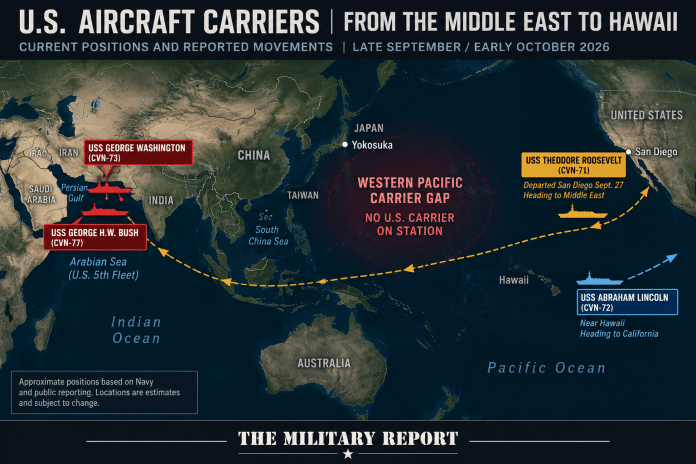
USS Theodore Roosevelt left San Diego Sept. 27.
The Makin Island Amphibious Ready Group followed.
They’re going to the Middle East.
That’s news.
But before everybody starts drawing three little carrier symbols on a map and declaring a massive new naval buildup, somebody ought to ask a basic military question:
Who’s getting relieved?
Because ships don’t stay deployed forever.
At least they’re not supposed to.
Know the beat
This is what happens when a military movement gets covered primarily as a political story.
Political reporters watch the White House.
Military reporters watch the ships.
And right now, the ships tell a more complicated story.
Two American carriers are already in the Middle East:
USS George Washington.
USS George H.W. Bush.
The Boxer Amphibious Ready Group is there too.
Coming from San Diego are Theodore Roosevelt and the Makin Island ARG.
So, yes, when Roosevelt arrives there could be three American carriers in the Middle East.
But here’s what the AP story doesn’t adequately explain:
We already had reporting that Roosevelt was expected to relieve George Washington.
USNI News reported that Sept. 28.
That’s before the Washington crowd discovered the “third carrier.”
Now look at Bush
USS George H.W. Bush left Norfolk March 31.
Do the math.
She’s been deployed more than six months.
By the time Roosevelt gets to the Middle East, Bush will be pushing seven months away from Norfolk.
That’s when an old military reporter starts scratching his head.
Maybe Roosevelt relieves Washington, as previously reported.
Maybe Bush goes home.
Maybe all three stay.
Maybe all three operate together for several weeks, and then somebody turns for home.
Those are the questions that matter.
Because there’s a hell of a difference between having three carriers in the Middle East for a few weeks during a turnover and maintaining three carrier strike groups there indefinitely.
One is an overlap.
The other is a major military buildup.
We don’t know which it is yet.
That’s the story.
Now count the amphibs
Same deal.
The Boxer ARG deployed in March.
Now the Makin Island ARG is steaming toward the Middle East.
Coincidence?
Maybe.
Reinforcement?
Maybe.
Relief?
Maybe.
Ask the damn question.
Is Makin Island joining Boxer?
Or replacing her?
How long will both ARGs remain in theater?
When does Boxer come home?
Those aren’t minor details.
They’re the difference between telling readers that the Pentagon is adding forces and telling them that the Navy is rotating exhausted ships and crews out of a combat theater.
Ships aren’t campaign props
The AP story puts Trump, Iran and the approaching midterm elections near the top.
Fine.
That’s Washington reporting.
But an aircraft carrier doesn’t leave San Diego because somebody suddenly needs a headline in Washington.
A carrier strike group spends months getting ready to deploy.
Ships go through maintenance.
Crews train.
Air wings work up.
Strike groups certify.
Families prepare.
Then several thousand sailors kiss their husbands, wives and kids goodbye and disappear over the horizon.
That’s the military story.
Theodore Roosevelt was already moving.
Makin Island was already moving.
Bush has been gone since March.
Boxer has been gone since March.
George Washington is the Navy’s forward-deployed carrier in Japan and eventually has another ocean to worry about.
Those facts matter more than the phrase “third carrier.”
And who’s covering the Pacific?
There’s another question.
Maybe the biggest one.
If Theodore Roosevelt joins George Washington and George H.W. Bush in the Middle East, where’s the American carrier in the Western Pacific?
Look at the map.
George Washington is supposed to be there.
She’s the Navy’s forward-deployed carrier, homeported in Yokosuka, Japan.
Instead, she’s in the Arabian Sea.
Theodore Roosevelt is crossing the Pacific toward the Middle East.
And Abraham Lincoln, after one of the longest and hardest deployments we’ve seen in years, is crossing the Pacific in the other direction — going home to California.
That leaves a rather important stretch of ocean without a deployed American aircraft carrier.
You may have heard of it.
China is there.
Taiwan is there.
North Korea is there.
The South China Sea is there.
This is what happens when you keep counting carriers.
Move one someplace, and you take it away from someplace else.
So if Washington, Bush and Roosevelt are all going to remain in the Middle East, the Pentagon hasn’t merely created a three-carrier force against Iran.
It has made a strategic choice about where those carriers aren’t.
The Western Pacific.
Maybe George Washington heads back to Japan when Roosevelt arrives.
Maybe Bush heads home.
Maybe all three stay in the Middle East for a while.
We don’t know.
But if all three stay, the story isn’t simply:
America has three carriers in the Middle East.
There’s another half to that sentence.
America doesn’t have one deployed where George Washington normally stands watch in the Western Pacific.
Now that’s a military story.
Follow the ships
This is why military beat reporters matter.
You learn the units.
You learn the equipment.
You learn deployment cycles.
You remember when the ship left.
You know where she was last week.
And when somebody at the Pentagon tells you another carrier is headed for the Middle East, you don’t just write:
THIRD CARRIER SENT TO WAR.
You ask:
Which carrier?
Where is she now?
Who is she relieving?
Who’s been out there longest?
When are they coming home?
And most important:
Is this really another carrier — or just the next carrier?
If Roosevelt arrives and Bush or Washington sails home, we’ve got a rotation with a temporary three-carrier overlap.
If Roosevelt arrives and nobody leaves, then we’ve got something else.
We’ve got three carrier strike groups committed to the Middle East.
That’s a serious escalation of American naval power.
And The Military Report will call it that when it happens.
Until then, we’ll do something terribly old-fashioned.
We’ll follow the damn ships.