

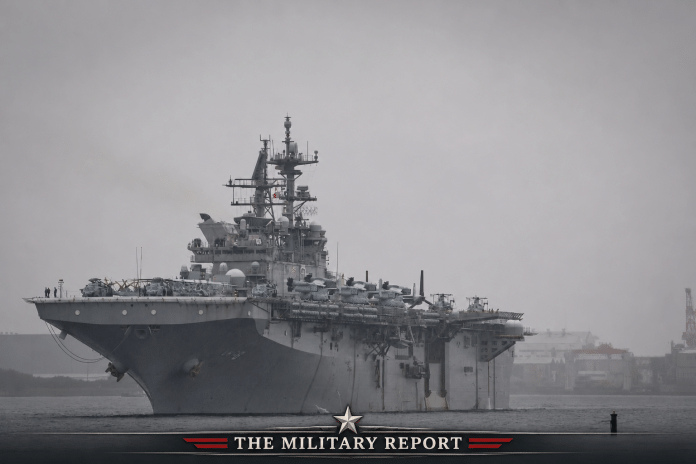
The Navy is rotating its amphibious forces in the Middle East, and the next team is on the move.
The amphibious assault ship USS Makin Island (LHD-8) departed Yokosuka, Japan, on Nov. 7, following a maintenance and resupply stop that began Oct. 26, according to ship-spotting imagery and tracking reports.
Makin Island leads an amphibious ready group that includes the amphibious transport docks USS Anchorage (LPD-23) and USS John P. Murtha (LPD-26).
The group is reportedly heading toward the U.S. Central Command area of responsibility to relieve the USS Boxer Amphibious Ready Group.
This is a rotation, not an additional amphibious force being rushed into the region.
The Boxer group has been deployed since March 18, more than seven and a half months. By Nov. 7, its sailors and Marines had been away from San Diego for 234 days.
And their deployment isn’t over.
By the time Makin Island arrives, the turnover is completed and Boxer makes the long voyage home, its sailors and Marines could be approaching nine months away from home.
That’s a long haul for any crew, particularly one operating in a region where tensions can turn into combat without much warning.
Amphibious ready groups give combatant commanders something aircraft carriers cannot: Marines who can operate ashore, supported by helicopters, landing craft and the ships that carry their equipment.
They can conduct raids, evacuate civilians, reinforce threatened positions or respond to a crisis without waiting for permission to establish a base ashore.
For the sailors and Marines aboard Boxer and its accompanying ships, the arrival of Makin Island should bring their deployment one step closer to home.
The Navy has not publicly confirmed the precise turnover date or location.
The mission continues. The ships and crews change. But after nearly eight months at sea, the sailors and Marines aboard Boxer have earned their trip home.