

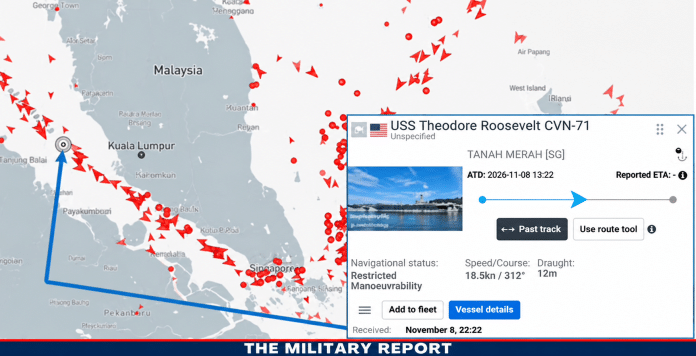
The USS Theodore Roosevelt has disappeared from public on ship-tracking screens—and that is almost certainly the way the Navy wants it.
The carrier transmitted its position while leaving Singapore and moving through the crowded Strait of Malacca. As it cleared the western end of the strait and entered the Andaman Sea, the signal stopped.
No mystery. No mechanical failure. The carrier simply quit telling the world exactly where it was on Nov. 9.
Automatic Identification System, or AIS, broadcasts a ship’s position, course and speed. It helps vessels avoid running into one another in congested waters. It also allows anybody with an internet connection—including potential enemies—to follow participating ships.
Warships are not required to advertise their positions continuously. They may transmit near ports and narrow waterways, then shut down the public signal when security takes priority.
The Roosevelt is accompanied by the cruiser USS Chosin and destroyers USS Paul Hamilton and USS Decatur. The strike group is expected to relieve the USS George Washington group, although the Pentagon has not publicly disclosed the carrier’s current position or arrival date.
The Roosevelt has not vanished. The Navy knows where it is. American and allied forces can communicate with it. Satellites, aircraft and other sensors may still detect it.
What disappeared was the electronic trail available on Marine Traffic.
The carrier has cleared the world’s busiest maritime choke point. Now the curtains are closed.