

For more than 30 years, Washington has asked a shrinking fleet and depleted air wings to do more. Now the ships, sailors and families are paying the bill.
ANALYSIS
I have been writing about an overworked Navy since Bill Clinton was president.
Back then, Washington was collecting its post-Cold War peace dividend. Ships were retired, squadrons disappeared and the fleet shrank.
The missions did not.
The Navy was still expected to keep carriers forward, patrol the Persian Gulf, watch the western Pacific, reassure allies, enforce sanctions and respond whenever a president wanted a warship parked off somebody’s coast.
Fewer ships. Same oceans. More missions.
I saw the strain aboard USS Kitty Hawk during the Clinton administration. It was already visible in the equipment, the maintenance schedule and the sailors being asked to keep everything running.
More than 30 years later, the Navy is still treating a structural shortage like a temporary emergency.
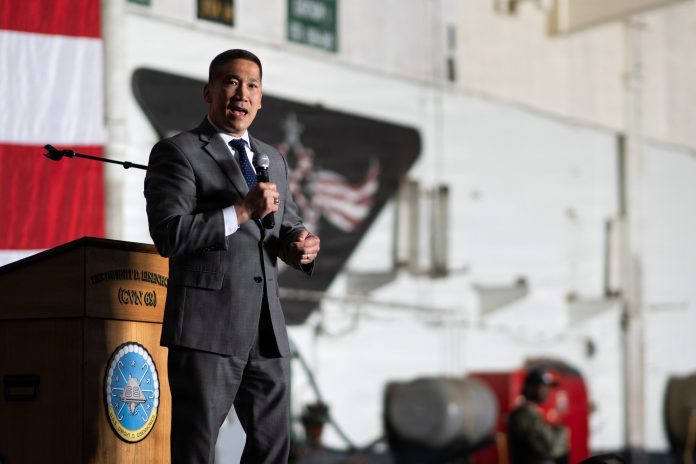
On Tuesday, Acting Navy Secretary Hung Cao finally said the quiet part out loud.
“The reason why we had to have these extended deployments is really because we only have 286 ships today,” Cao told the Senate Armed Services Committee during his confirmation hearing.
Cao said the Navy needs 355 ships. He acknowledged that extended deployments keep sailors away from their families and create additional maintenance problems for the ships.
That was not a revelation.
It was an admission.
The Navy does not have enough ships for the missions Washington keeps assigning it.
Where are the carriers?
American presidents have been asking some version of that question for generations.
During the Clinton administration, the familiar phrase was: “Where’s the nearest carrier?”
Clinton used those words aboard USS Theodore Roosevelt in March 1993:
“When word of a crisis breaks out in Washington, it’s no accident that the first question that comes to everyone’s lips is: ‘Where’s the nearest carrier?’”
The expression was older than Clinton. A version appeared in the Congressional Record in 1978 in an article based on conversations with naval analyst Norman Polmar.
But Clinton’s use of it captured the contradiction of the post-Cold War Navy.
Washington kept asking for carriers while reducing the fleet required to keep them forward.
Today, the answer in the Pacific is stark:
There isn’t one.
As of Nov. 18, the United States has no deployed aircraft carrier in the Pacific. USS George Washington, the carrier permanently forward-deployed to Japan, is operating in the Arabian Sea.
So are USS Theodore Roosevelt and USS George H.W. Bush.
Three American carriers are concentrated in one region. None is deployed in the Pacific theater, even though China is identified as America’s principal military competitor.
That is what a 286-ship Navy looks like when strategy collides with arithmetic.
Washington can publish all the global strategies it wants. It cannot place the same carrier in the Arabian Sea and the western Pacific at the same time.
For decades, presidents have asked, “Where are the carriers?”
Today, Beijing already knows the answer.
The bill has come due
USS Abraham Lincoln recently returned from a 321-day deployment. Its sailors spent 286 days without a port call.
USS Spruance spent 357 days deployed, setting what is believed to be a post-World War II record for a Navy destroyer. USS Michael Murphy was gone 346 days.
Families of sailors aboard George H.W. Bush have been warned to prepare for a deployment lasting roughly a year.
These are not isolated scheduling problems. They are warning lights on the same control panel.
A ship stays out longer because another ship is not ready. The extended deployment delays maintenance. The delay allows additional problems to develop. The eventual yard period takes longer and costs more.
That leaves fewer ships available for the next crisis, so another crew stays out longer.
Round and round it goes.
The Navy has spent three decades eating its seed corn and calling it readiness.
Cao’s written responses to advance questions from the Senate Armed Services Committee show that he understands the cycle.
He identified maintenance delays, deferred maintenance, and constrained industrial capacity as the Navy’s most significant readiness risks.
He acknowledged that sustained operational demand puts pressure on deployment and dwell-time ratios, affecting maintenance, training, personnel readiness and retention.
Cao also wrote that immediate force availability must not be achieved at the expense of maintenance, training, people or future capability.
That is precisely what the Navy has been doing.
It meets today’s deployment order by borrowing from tomorrow’s readiness.
The question Cao did not answer
The committee asked Cao directly whether the Navy and Marine Corps are achieving sustainable deployment and dwell-time ratios.
He did not answer yes or no.
Instead, Cao wrote:
“Sustained operational demand can place pressure on deployment and dwell-time ratios, with potential effects on maintenance, training, personnel readiness, and retention.”
Strip away the Pentagon language and the answer is clear.
No. The present pace is not sustainable.
The committee also asked what Cao would do to prevent naval forces from facing overextended deployments during the Iran war.
Cao said the Navy must strengthen the industrial base, increase repair capacity, improve maintenance performance and make more ships available. He promised to advocate for sailors facing deployment extensions and to give families greater transparency when schedules change.
Those are worthwhile steps.
But Cao did not say which missions would be reduced.
Better maintenance can return ships to service sooner. It cannot make 286 ships perform the work of 355.
Transparency can tell families why a deployment has been extended. It cannot bring their sailors home.
That is the decision Navy leaders and civilian policymakers keep avoiding.
The United States must either build a fleet large enough to support its commitments or reduce those commitments to fit the fleet it actually has.
There is no third choice hidden in a PowerPoint slide.
A carrier without aircraft is an empty deck
The problem does not end with the number of ships.
A carrier is useless without a trained, equipped and combat-ready air wing.
In April 2017, President Donald Trump announced that the United States was sending an “armada” toward North Korea. He was referring to the Carl Vinson Carrier Strike Group.
At the time of the announcement, however, Carl Vinson was sailing in the opposite direction toward a scheduled exercise in the Indian Ocean.
Later that year, three carriers briefly converged in the western Pacific amid increasing tension with North Korea.
USS Nimitz was finishing its deployment before returning to Bremerton. USS Theodore Roosevelt was arriving in the region. USS Ronald Reagan was already forward-deployed in Japan.
On a map, it looked like American naval power massing for war.
Behind the map was a shell game.
In November 2017, Vice Adm. Troy “Mike” Shoemaker, then commander of Naval Air Forces, told Congress that only about half of the Navy’s 542 Super Hornets could fly.
Only one-third were fully mission-capable and ready to fight.
To equip the air wings deploying aboard Carl Vinson, Nimitz and Theodore Roosevelt, the Navy had transferred 94 strike fighters among squadrons and maintenance depots.
It borrowed approximately 300 sailors from other squadrons and cannibalized aircraft for parts.
Shoemaker called it what it was: a shell game.
The deployed air wings were ready because the Navy had stripped aircraft, parts and people from the squadrons left behind.
Shoemaker said the Navy had 41 fewer ships and 90,000 fewer sailors than it had on Sept. 11, 2001, while the missions had increased.
“The demand for Naval Aviation forces greatly exceeds our ability to supply those forces,” he told Congress.
That was nine years ago.
The geography has changed, but the trick has not.
Concentrate the working ships, aircraft, spare parts and people at the point of crisis. Meet the immediate deployment order. Then accept the holes created elsewhere.
Cao’s written responses say aircraft mission-capable rates must be considered when measuring sustainable readiness. He also acknowledged the dangers of relying on a small number of highly capable aircraft, including cost, maintenance demands, limited capacity, supply-chain vulnerability and the risk of attrition.
Again, he knows the problem.
Drones will not rescue next week’s deployment schedule
Cao told senators the Navy is trying to accelerate the deployment of unmanned surface vessels to relieve the 17 destroyers supporting the blockade in the Strait of Hormuz.
Unmanned ships may eventually help. But they are not magic hulls.
The Navy is still determining how to employ them, arm them, maintain them, communicate with them and protect them from electronic attack or capture.
A prototype cannot stand tomorrow’s watch simply because the deployment schedule is broken.
Nor can an unmanned vessel replace every function performed by a crewed destroyer.
A destroyer provides air and missile defense, antisubmarine warfare, surface warfare, long-range strike capability, command-and-control capacity and a trained crew capable of responding when equipment fails or circumstances change.
The Navy should develop unmanned systems. It should not use them as a talking point to hide a shortage of deployable warships.
The immediate burden still falls on sailors aboard the fleet America has—not the fleet promised in another 30-year plan.
The strain is human
The Navy talks about operational tempo in sterile terms: force generation, presence requirements, deployment models and maintenance availability.
Sailors experience it differently.
They miss births, funerals, anniversaries and holidays. Spouses run households alone. Children grow while a parent watches through an unreliable video connection—when a connection is available.
Equipment breaks. Sleep disappears. Another promised return date slips to the right.
Then the Navy wonders why sailors leave.
In his written responses, Cao called family readiness part of warfighter readiness. He said sailors deployed far from home need reasonable assurance that their families have adequate health care, safe housing, affordable child care and other essential support.
He also acknowledged personally experiencing the pressure that military absences place on families.
But some of Cao’s answers during Tuesday’s hearing sounded less like a former sailor and more like a Pentagon spokesman defending the machinery.
When senators raised eight suicide attempts among members of the Lincoln strike group, Cao described them as eight “suicide mitigations” because none resulted in death.
No.
They were suicide attempts.
The fact that chaplains, counselors, medical personnel or shipmates prevented eight deaths deserves recognition. But preventing the final act does not erase the crisis that brought eight service members to that point.
Sen. Kirsten Gillibrand called Cao’s wording insulting and inadequate.
She was right.
When Sen. Mark Kelly cited reports of sailors losing substantial weight because of inadequate food—including one reported loss of more than 45 pounds—Cao compared the complaints to his children opening the refrigerator and saying there was nothing to eat.
That answer will not sit well with sailors or their families.
A sailor losing 45 pounds is not a picky child staring into a refrigerator.
It is a warning that something aboard ship may be badly wrong.
Investigate it. Establish the facts. Fix it.
Do not wave it away.
Cao said deployed ships had never completely run out of food.
That is hardly the standard.
A warship should not have to reach zero before Navy leadership admits there may be a supply problem.
This did not happen overnight
Every administration since the Clinton years has contributed to this mess.
Presidents and Congresses demanded global presence without consistently paying for the fleet required to sustain it.
Navy leaders assured civilian leaders they could meet the demand.
Shipbuilding programs ran late and over budget. Maintenance backlogs grew. Shipyard capacity declined. Skilled workers became harder to find. Aircraft sat waiting for repairs and spare parts.
When the numbers did not work, sailors supplied the difference.
They worked longer hours. Ships stayed deployed. Aircraft were cannibalized. Maintenance was deferred. Families were told to be patient.
The Navy cannot surge its way out of a permanent shortage.
A surge is supposed to be temporary. When exceptional deployments become routine, the service is no longer surging.
It is consuming itself.
Cao deserves credit for acknowledging the central problem. There are only 286 ships, and that is not enough.
His written answers show that he understands the consequences: deferred maintenance, disrupted training, pressure on families, declining retention, strained air wings and reduced capacity to respond to the next crisis.
Recognizing the problem is the easy part.
The harder part is telling presidents, defense secretaries and combatant commanders that every request cannot be filled.
Until the fleet grows, missions must be reduced or deployments will continue stretching toward a year.
No unmanned vessel, maintenance initiative or optimistic shipbuilding projection can change that arithmetic today.
Cao says the country needs a larger Navy.
He is right.
Building one will take years.
The sailors are deployed now.
Washington must either provide the ships, aircraft, people, munitions and shipyards required for its commitments—or reduce those commitments to fit the Navy it actually has.
For more than three decades, it has refused to do either.
The fleet—and the people keeping it at sea—cannot keep paying that bill forever.