

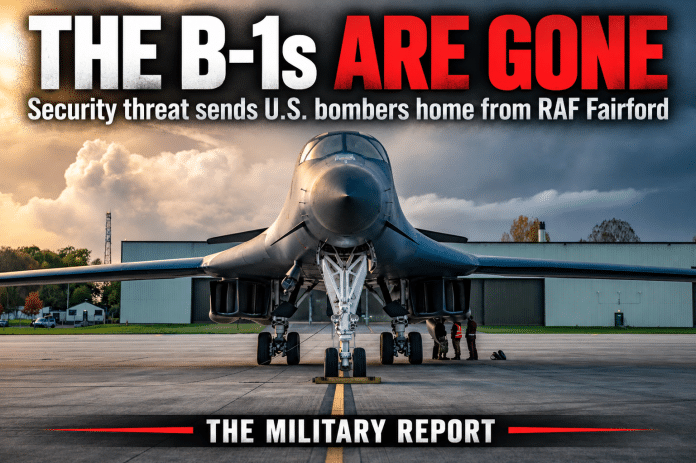
Earlier Sunday, B-1B Lancers began lifting out of RAF Fairford in England, heading west across the Atlantic under MAYAN call signs.
At the time, it looked like a drawdown.
Now we know better.
The Pentagon confirmed Sunday evening that all U.S. bombers deployed to RAF Fairford have been returned to their home stations in the United States following security concerns surrounding a suspected terrorist plot against the base.
There were a dozen B-1s at Fairford.
They are gone.
The aircraft had not simply been sitting in England. They had been flying combat missions against Iran. Britain had authorized the United States to use Fairford-based bombers to strike Iranian missile sites involved in attacks on shipping in the Strait of Hormuz.
That makes Sunday’s movement considerably more important than an ordinary bomber rotation.
A Pentagon spokesman acknowledged the movement only after the aircraft were safely away.
“While operational security precluded us from confirming the movement of our assets and forces in real-time,” the spokesman told Reuters, the Pentagon could now confirm that all U.S. bombers deployed to Fairford had returned to their home stations.
That explains what aircraft watchers were seeing Sunday.
The Military Report had been following the B-1 departures as aircraft using MAYAN call signs left Fairford with tanker support from RAF Mildenhall. At that point there was no official explanation for why the bombers were leaving or whether replacements were coming.
Now there is.
A plot against the bomber base
The withdrawal follows a suspected terrorist plot targeting RAF Fairford.
Six people have been arrested during the British investigation, including a 25-year-old dual British-Iranian national arrested in London. All six have subsequently been released on bail while the investigation continues.
British authorities say there are strong indications of Iranian involvement.
Iran denies it.
No viable explosives were found, according to British authorities, although gasoline was recovered from vans associated with the suspects. The incident was serious enough to force the evacuation of nearby residents and trigger a major counterterrorism investigation.
Secretary of State Marco Rubio has pointed to the involvement of a foreign actor, while President Donald Trump said the suspects had intended to cause major damage.
Whatever investigators ultimately establish about the plot, the military response is no longer in doubt.
The bombers were moved.
Fairford mattered
RAF Fairford isn’t just another European airfield.
For decades it has provided the United States with a forward operating location for its heavy bombers. In the current war, it shortened the distance between American bombers and targets in and around Iran.
A B-1 launching from England is considerably closer to the Middle East than one launching from its home station in the United States.
That matters in a war where tanker availability, flight time, crew endurance and the ability to generate another sortie all count.
Moving the B-1s home doesn’t take them out of the fight. American bombers routinely conduct long-range missions from the continental United States.
But it makes those missions harder.
And that may be the more important story.
An alleged Iranian-linked plot did not have to destroy a single bomber to affect American military operations.
If the purpose was to threaten a base being used to attack Iran, the threat alone was enough to make the United States move a dozen B-1s thousands of miles away.
Now watch where the bombers go
Now one of the Air Force’s forward bomber operating locations has effectively been emptied of its deployed bomber force.
The B-1s can come back. Other bombers can replace them. They can operate from another forward base. Or the Air Force can rely more heavily on extraordinarily long missions launched from the United States.
But Sunday’s MAYAN flights tell us something important.
Those B-1s weren’t simply finishing a deployment.
Somebody decided they shouldn’t be sitting at Fairford anymore.
And they got them out.