

Adm. Brad Cooper says he has enough ammunition.
The Pentagon’s own inspector general says America has a shortage.
Welcome to war, where both things can be true.
Cooper, commander of U.S. Central Command, went on CBS’s 60 Minutes Sunday and was asked by Norah O’Donnell about the number of Patriot and THAAD missiles the United States has fired in the war with Iran.
Was he worried?
No.
Not a little?
No.
“We’re well-armed and ready for any contingency,” Cooper said.
That’s what you want to hear from the four-star running the fight.
It is also not the whole story.
The next day, retired Army Lt. Gen. Mark Hertling, a former commander of U.S. Army Europe, looked beyond the ammunition dumps in Cooper’s part of the world. In television commentary on MS NOW and CNN, Hertling has been talking about something less dramatic than missiles streaking across the night sky but every bit as important:
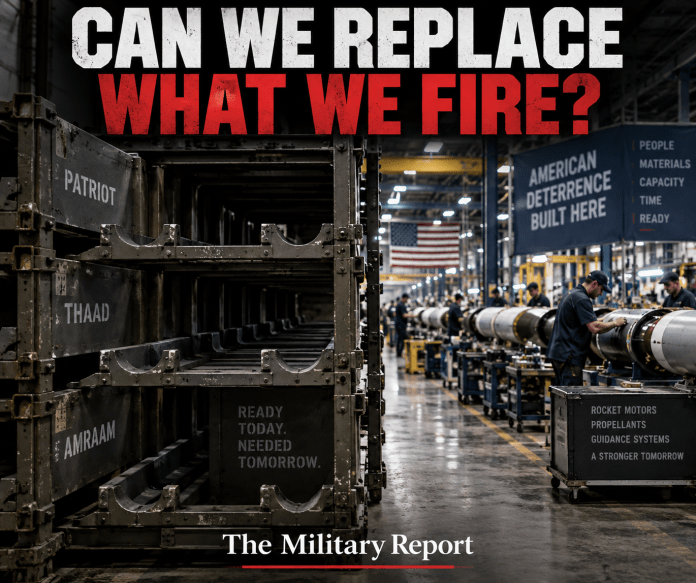
The factories that have to build another one.
Then Tuesday morning, the Pentagon’s inspector general dropped a 44-page report on Operation Epic Fury.
And buried beneath all the acronyms, charts and bureaucratic prose is one sentence every member of Congress ought to read:
The ammunition fired during the Iran war has resulted in “strategic inventory shortfalls and revealed industrial base bottlenecks for munitions resupply.”
Strip off the Pentagon wrapping and here’s what it means:
We’ve fired a hell of a lot of ammunition, and we’re having trouble replacing some of it fast enough.
That doesn’t mean Cooper is wrong.
If the commander of CENTCOM says he has enough weapons to fight the war he’s been ordered to fight, I’ll take him at his word unless somebody produces evidence otherwise.
But Cooper commands CENTCOM.
He doesn’t command the American industrial base.
And the missiles sitting in his magazines didn’t grow there.
Somebody has to build replacements.
That’s where Hertling’s argument comes in.
Wars don’t run on PowerPoint presentations. They run on steel, explosives, electronics, rocket motors, fuel, spare parts, and people who know how to put the whole damned thing together.
The inspector general found bottlenecks in solid rocket motors. It found problems obtaining high-grade explosives and propellants. And it found another commodity Washington cannot manufacture by writing a check: skilled workers.
The Pentagon says increasing production capacity requires “significant lead time.”
There’s another way of saying that.
You can’t surge a factory the way you surge a carrier.
And America has been doing plenty of surging.
The inspector general says Operation Epic Fury had cost the Pentagon an estimated $33.4 billion by June 29.
Of that, $22.3 billion was the replacement value of ammunition already expended.
Twenty-two billion dollars’ worth of stuff went bang.
Now somebody has to make another $22 billion worth of stuff.
Washington knows it.
When the White House asked Congress for another $67.1 billion for the Pentagon, the biggest item wasn’t aircraft.
It wasn’t ships.
It wasn’t personnel.
It was $21 billion for munitions.
Defense Secretary Pete Hegseth told Congress in July that without supplemental money, the Pentagon could face critical shortfalls in its ability to replenish ammunition and equipment while continuing military operations around the globe.
There are three words in that warning worth remembering:
Around the globe.
Because Iran isn’t the only square on the chessboard.
China hasn’t gone anywhere.
Neither has North Korea.
Neither has Russia.
And the United States doesn’t keep a separate ammunition factory in a closet marked BREAK GLASS IN CASE OF SECOND WAR.
The Navy is already demonstrating what happens when one theater starts eating resources intended for another.
The inspector general says at least six American warships were moved from the Pacific to support the Middle East fight. That included the USS Abraham Lincoln carrier strike group and elements of the Japan-based Tripoli amphibious group.
That’s six warships CENTCOM gained.
It’s also six warships the Pacific lost.
Ships aren’t the only things being stretched.
So is the supply line.
Bahrain had been the Navy’s main logistics hub in the Persian Gulf. Then Iran started shooting at Bahrain.
CENTCOM moved supplies to other locations and went hunting for the tankers, oilers, aircraft and ports necessary to keep the fleet supplied with fuel, ammunition and repair parts.
Diego Garcia helped.
There’s just one problem.
It’s a long haul.
The inspector general says the trip created supply cycles running 14 to 18 days.
Fourteen to eighteen days.
Try putting that on a Pentagon briefing slide titled JUST IN TIME DELIVERY.
This is the part of war Americans rarely see.
We see the missile launch.
We don’t see the machinist making the rocket motor that replaces it.
We see the fighter take off.
We don’t see the tanker that refuels it.
We see the carrier.
We don’t see the supply ship steaming toward it.
And we certainly don’t see the factory worker three states away waiting for a component from another factory so a missile can eventually make its way onto a Navy ship or into an Army launcher.
That’s logistics.
Washington has been forgetting since Alexander the Great:
Amateurs talk about weapons. Professionals worry about whether the truck shows up.
Nothing in this inspector general’s report says CENTCOM is about to run dry.
Nothing says Cooper cannot accomplish his mission.
What it says is more troubling because it reaches far beyond CENTCOM.
The Pentagon itself acknowledges that the war has created strategic inventory shortfalls and exposed manufacturing bottlenecks that take time to fix.
So don’t turn this into Cooper versus Hertling.
That’s the easy television argument.
The harder question is whether a military built around exquisite, expensive precision weapons has an industrial base capable of replacing those weapons at the rate a real war consumes them.
Cooper looked at his magazines and answered the question every commander must answer:
Can I fight tonight?
Yes.
Hertling looked back toward America’s factories and asked:
Can we keep doing this tomorrow?
Now the Pentagon’s inspector general has looked at those same factories and ammunition inventories.
The answer isn’t nearly as comfortable.
Cooper was answering the commander’s question.
The inspector general is answering the nation’s question.