

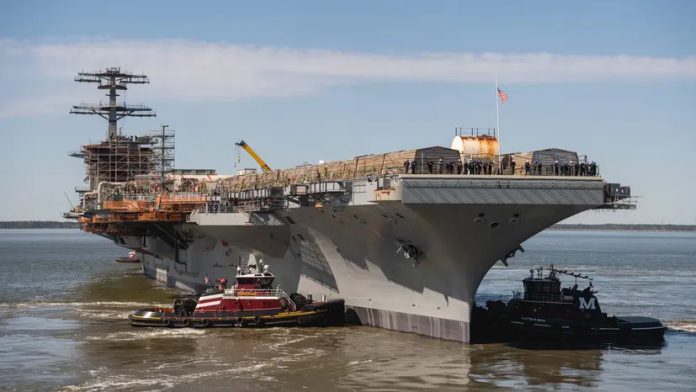
The Navy’s carrier problem begins with a damaged generator in a Virginia shipyard. It ends with sailors missing Christmas—and families being told not to expect them home anytime soon.
USS John C. Stennis entered Newport News Shipbuilding in May 2021 for its midlife refueling and overhaul. The Navy expected to get the carrier back in 2025.
It didn’t happen.
Workers opened the ship and found more trouble than planners expected. One of its eight steam-turbine generators had significant damage beyond normal wear. Materials arrived late. Supply chains failed. Newport News did not have enough experienced workers to handle the growing pile of work.
Then came the familiar explanation: lingering disruption from COVID.
There is truth in that. Skilled shipyard workers left. Suppliers weakened. Experience built over decades disappeared. A nuclear carrier cannot be repaired by handing a new worker a wrench and pointing toward the engine room.
But COVID did not create the Navy’s thin shipyard capacity. It exposed it.
The Navy first pushed Stennis’ delivery to October 2026. Now budget documents put completion in November 2027.
That would keep the carrier in overhaul for roughly six and a half years—more than two years beyond its original delivery schedule.
And delivery will not make it ready for war.
After leaving the yard, Stennis must complete sea trials, train its crew, certify its flight deck and rebuild the carrier-air-wing team needed for deployment. The ship may leave Newport News in 2027, but it will not sail straight from the shipyard into combat.
This is not just another late maintenance job.
The delay is spreading through the carrier force.
One yard, one line
Newport News is the only American shipyard that builds nuclear-powered aircraft carriers and performs their massive midlife refueling overhauls.
The same specialized workers finishing Stennis are needed for USS Harry S. Truman, the next carrier waiting for its own refueling and overhaul.
When Stennis slips, Truman slips.
When Truman slips, the Navy has fewer carriers moving through the maintenance, training and deployment cycle.
When fewer carriers are available, the ships already at sea stay there longer.
The immediate cause of today’s deployment extensions is the continuing operational demand in the Middle East. The secretary of defense—not the Stennis shipyard—decides whether a carrier remains on station.
But a Navy with more available carriers has choices. It can send a relief on time, bring the deployed ship home and begin its scheduled maintenance.
A Navy without that depth keeps using whatever flight deck it has until another one can take its place.
The families get the word
USS George H.W. Bush left Norfolk on March 31. Its families expected a deployment of six or seven months.
The return date moved once. Then it moved again.
At a Nov. 9 town hall, senior Navy leaders finally gave families the only answer they could: Bush would not be home for the holidays.
They were told to prepare for the possibility of a full-year deployment. That could keep the carrier away until March 2027.
Even that was not a guaranteed homecoming date.
The Navy says USS Dwight D. Eisenhower is being prepared to relieve Bush. It has not announced when that handoff will occur.
Until the replacement is ready—and until civilian leaders decide the mission permits it—Bush stays.
The admirals can move dates across a planning chart. Families cannot move Christmas.
USS Abraham Lincoln returned Oct. 8 after roughly 321 days away, much of it supporting operations in the Middle East. Its sailors came home, but the ship now owes the maintenance bill accumulated during that deployment.
Navy leaders are warning sailors that deployments of 10 or 11 months, rather than the standard seven, may remain normal for the next couple of years.
There is nothing normal about that.
Keeping the oldest carrier alive
The Navy’s shortage is so tight that it has kept USS Nimitz in service after the carrier was supposed to begin leaving the fleet.
Nimitz was scheduled for deactivation in May 2026. It had served for more than 50 years and completed what was expected to be its final deployment.
But the new carrier USS John F. Kennedy is late.
So the Navy extended Nimitz until March 2027 and shifted it from Bremerton to Norfolk.
The ship is not being prepared for another normal combat deployment. It is being used primarily as a floating flight school.
In November, Nimitz took new and returning naval aviators to sea for carrier qualifications. More qualification periods are planned before the ship is deactivated.
The training is necessary. Young aviators cannot learn to land on a carrier by watching a video or sitting in a simulator.
But the assignment also reveals the depth of the problem.
The Navy is keeping a 51-year-old carrier alive to provide a flight deck while newer carriers remain trapped in construction, overhaul or post-deployment maintenance.
That is not reserve capacity. That is using the last available tool in the box.
The cycle feeds itself
Long deployments create more than exhausted sailors and angry families. They produce additional wear on ships and aircraft.
That means more repairs when the carrier finally returns. More repairs mean longer maintenance periods. Longer maintenance reduces the number of available carriers. That places greater pressure on the ships still able to deploy.
The cycle feeds itself:
Stennis remains in overhaul.
Truman waits behind it.
Kennedy arrives late.
Nimitz stays alive as a training deck.
Lincoln returns after 321 days.
Bush remains at sea waiting for relief.
On a Pentagon briefing slide, those are separate programs, schedules and commands.
They are not separate to the fleet.
The Navy cannot blame the whole mess on a damaged turbine generator, late materials or COVID. Those explain why the Stennis overhaul fell behind. They do not excuse decades of thin shipyard capacity, brittle suppliers, workforce losses and carrier plans containing almost no room for failure.
America officially has 11 aircraft carriers.
The number that can answer the bell is always smaller. Some are deployed. Some are training. Some are undergoing repairs. Others disappear into shipyards for years.
Washington nevertheless continues assigning missions as though all 11 are ready to sail.
The difference is being made up by time—more time at sea, more time away from home and more time waiting for overdue repairs.
The Stennis delay began inside the ship. It grew inside the shipyard. Now it is moving through the entire carrier fleet.
The ships are paying in wear.
The sailors are paying in months.
Their families are paying in Christmases.