

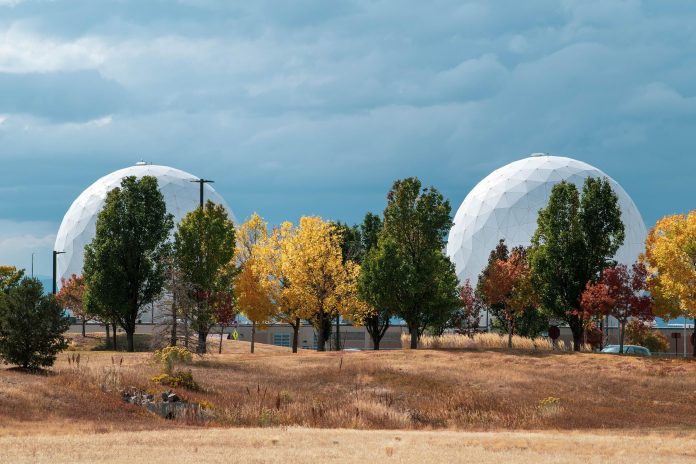
Back in the early 1980s, I lived in Aurora, Colo., just down the road from Buckley.
You couldn’t miss the place.
Sitting out there on the Colorado prairie were these enormous white domes covering satellite receivers. Nobody I knew called them radomes.
They were the Golf Balls.
Everybody knew they had something to do with satellites and national security. Beyond that, most of us figured Uncle Sam knew what he was doing and went about our business.
It was the Cold War.
The Soviets had missiles.
We had satellites.
And Buckley had Golf Balls.
Forty-some years later, the Golf Balls are still there, Buckley is now a Space Force base, and somebody at the Pentagon has apparently discovered something that every sailor standing next to a dead piece of machinery has known since the invention of electricity:
The damn thing doesn’t work without power.
So Buckley is getting a nuclear reactor.
Not the Three Mile Island variety. Not something with a cooling tower looming over Aurora.
A microreactor.
California-based Radiant Industries has been selected by the Department of the Air Force to develop and operate one of its Kaleidos nuclear microreactors at Buckley.
And Buckley isn’t alone.
The Army just announced that it wants microreactors at five of its installations under something called the Janus Program.
Fort Bragg gets Antares Nuclear.
Fort Campbell gets BWXT.
Fort Hood gets General Atomics.
Fort Benning gets Radiant.
Fort Drum gets Westinghouse.
The Pentagon eventually wants more than 20 of these things scattered around military installations.
Now we’re talking.
Because this isn’t really a story about nuclear power.
It’s a story about somebody finally looking beyond the front gate.
You don’t have to bomb the base
For generations, we’ve spent billions hardening military installations.
Protect the runway.
Protect the aircraft.
Protect the command center.
Protect the fuel farm.
Put guards at the gate.
Build another fence.
Add some cameras.
Wonderful.
Then follow the power line outside the fence.
There’s your problem.
The United States military operates some of the most sophisticated equipment mankind has ever built, much of it connected to an electrical grid that also powers Walmart, your neighbor’s swimming-pool pump, and the refrigerator at the corner 7-Eleven.
That arrangement works just fine.
Until it doesn’t.
An enemy trying to shut down a military installation doesn’t necessarily have to send a missile over Colorado.
Take out a few substations.
Hit the grid with a cyberattack.
Sabotage transmission equipment.
Interrupt natural-gas supplies.
Or simply wait for an already strained civilian electrical system to develop problems of its own.
Congratulations.
You have just attacked an American military installation without putting a crater inside the fence.
Which brings us back to Buckley
Buckley isn’t exactly Fort Nowhere.
Those Golf Balls are there for a reason.
The installation supports missile warning, satellite communications, intelligence and other national-security missions — precisely the sorts of things we’d desperately want working if somebody decided to start World War III.
You really don’t want the people watching for incoming missiles hearing:
Sorry, we’re experiencing a local power outage. Estimated restoration time is 3:30 p.m.
Hence the reactor.
The idea isn’t to disconnect Buckley from Colorado’s civilian electrical grid.
Most of the time the base will continue drawing electricity like everybody else.
The microreactor is there because military planners are paid to worry about “that day.”
Keep the important stuff running.
That’s the mission.
The Army figured it out, too
The Army’s Janus Program makes clear that this is becoming Pentagon policy rather than somebody’s science project.
The service plans to put as much as $2.2 billion into the effort between fiscal 2027 and 2031.
At least one reactor is supposed to be operating by Sept. 30, 2028.
These are relatively small reactors, producing roughly 1 to 20 megawatts depending upon the design.
They won’t necessarily run everything on the installation.
They don’t have to.
Nobody particularly cares whether the bowling alley stays open during World War III.
Keep the command center operating.
Keep the communications working.
Keep the computers running.
Keep the intelligence flowing.
Keep the mission alive.
That’s what matters.
And there’s another reason the Pentagon suddenly finds nuclear power attractive.
Fuel.
Or, more precisely, not having to constantly haul it around.
Every old military hand understands logistics.
Generators need diesel.
Diesel needs trucks.
Trucks need drivers.
Drivers need roads.
Roads need to remain open.
And somebody eventually has to get the fuel from Point A to Point B while Murphy and the enemy are both working overtime to make sure it doesn’t happen.
A nuclear microreactor carries years’ worth of energy in its fuel.
No daily parade of tanker trucks.
No wondering whether the next fuel delivery gets through.
The military has spent a couple thousand years learning that the fellow who controls the supply line usually gets the last laugh.
Then AI showed up
There’s another elephant wandering around the electrical substation.
Artificial intelligence.
America is building enormous data centers, and those facilities consume electricity by the megawatt.
Utilities are suddenly being asked to provide power for computing campuses whose appetite can resemble that of small cities.
Guess who shares those grids?
The Pentagon.
Military installations aren’t exactly becoming less electronic.
Radar.
Satellites.
Intelligence processing.
Communications.
Cyber operations.
Computers.
And increasingly, AI.
All of it wants electricity.
Lots of it.
So the Pentagon has two problems.
The civilian grid might be attacked.
And even when nobody is attacking it, everybody wants more juice.
The generals appear to have reached the perfectly reasonable conclusion that perhaps they ought to make some of their own.
The Golf Balls are still listening
When I lived in Colorado, Ronald Reagan was president and the Soviet Union was the enemy.
Those enormous white Golf Balls sitting at Buckley were part of the machinery of the Cold War.
They listened.
They watched.
And somewhere behind all that secrecy was one decidedly unclassified requirement.
Electricity.
Four decades later, the enemies have changed. The technology has changed. The Air Force installation became a Space Force base.
The Golf Balls remain.
And somewhere nearby, if the Pentagon’s plans work out, a small nuclear reactor will eventually sit there quietly making electricity.
Most days it won’t seem terribly important.
That’s the thing about military preparedness.
The equipment you desperately need in a war usually looks unnecessarily expensive right up until the shooting starts.
The Pentagon isn’t putting nuclear reactors on military bases because the lights are going out today.
It’s putting them there because somebody finally asked the right question:
What happens when they do?
And if that day comes, those old Golf Balls at Buckley had damn well better still be listening.