

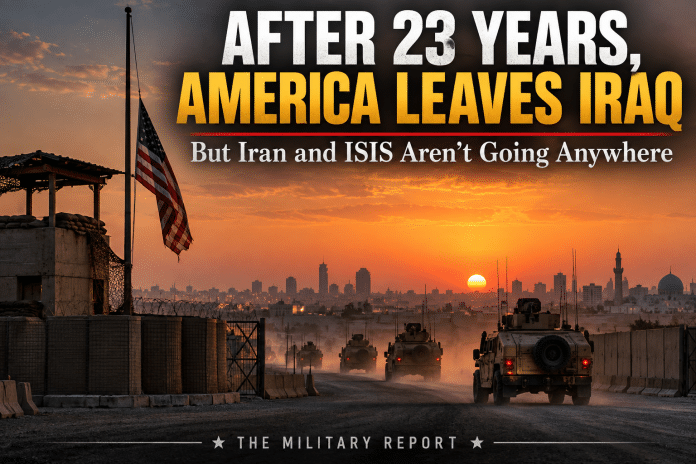
Twenty-three years after American tanks rolled toward Baghdad, the last U.S. forces are leaving Iraq.
They aren’t leaving the Middle East in peace.
They’re leaving in the middle of another war.
The United States is completing the withdrawal of its remaining forces from Iraq by Sept. 30, bringing to an end a military presence whose roots go back to the 2003 invasion that overthrew Saddam Hussein.
There have been endings before.
American combat troops left Iraq in 2011.
Three years later, they came back.
ISIS had swept across Syria and Iraq, captured Mosul and declared a caliphate. Iraqi security forces collapsed in places, and the United States returned as part of an international coalition to help Iraq fight its way back.
ISIS eventually lost its territorial caliphate.
Now Americans are leaving again.
But look at the neighborhood they’re leaving behind.
The United States is fighting Iran. Iran-backed armed groups remain deeply embedded in Iraq. ISIS has not disappeared. And Iraq still sits in the middle of the strategic fault line running from Iran through Iraq and Syria toward the Mediterranean.
This withdrawal did not suddenly begin with the current war.
Washington and Baghdad negotiated the timetable in 2024 under President Joe Biden. The agreement called for ending the coalition’s military mission in Iraq and transitioning toward bilateral security relationships, while allowing operations supporting the fight against ISIS in Syria to continue from Iraq through September 2026, depending on conditions and consultations between the governments.
That timetable has now reached its end under President Donald Trump.
So this is neither simply a Biden withdrawal nor a Trump withdrawal.
It is an American withdrawal.
And it closes one of the longest chapters in modern American military history.
Twenty-three years
The American relationship with Iraq since 2003 can almost be told by the names of places.
Baghdad.
Fallujah.
Ramadi.
Mosul.
Tikrit.
Those names became familiar to Americans who had never heard of them before the war.
They became something else to the soldiers and Marines who fought there.
More than 4,000 Americans died in the Iraq war. Tens of thousands more came home wounded, some carrying injuries that could not be seen.
Then came 2011 and the withdrawal.
Then came ISIS.
Then came another American deployment.
By 2021, Washington and Baghdad were already describing the remaining U.S. mission as training, advising, assisting and intelligence sharing rather than a combat mission. The Iraqi government repeatedly emphasized that coalition troops were there at its invitation.
That distinction mattered diplomatically.
It mattered less to the Americans who could still be attacked.
Iran-backed militias repeatedly targeted American positions in Iraq. And during this year’s war with Iran, Iraq again became dangerous ground for U.S. forces.
Reuters reports that seven of the 18 American service members killed in the war with Iran this year died in Iraq.
So the final withdrawal comes with an uncomfortable bit of timing.
The United States is removing its military presence from Iraq while fighting the country with perhaps the greatest outside influence there.
Iran doesn’t have to invade Iraq
That may be the most important part of this story.
Iran does not need columns of tanks crossing the Iraqi border to exercise influence in Iraq.
Tehran has spent years building relationships with Iraqi political organizations and armed groups. Some Iran-aligned militias operate within or alongside Iraq’s political and security system.
Those groups have also attacked American forces.
Iran and allied Iraqi militias are portraying the American departure as a strategic victory. Iraqi analysts cited by Reuters warn that some of those groups could try to expand their political and security influence once the American military presence disappears.
That doesn’t mean Iraq becomes an Iranian satellite the morning after the last American leaves.
Iraq has its own government, security forces, political factions and national interests. Baghdad has spent years trying to maintain relationships with both Washington and Tehran.
But one counterweight is being removed.
That changes the balance.
Then there is ISIS
ISIS is no longer the army that once drove Iraqi forces from Mosul and controlled territory containing millions of people.
But it isn’t dead.
The United States and its coalition partners have said that repeatedly.
Even when the withdrawal arrangement was announced in 2024, American officials cautioned that although ISIS had been greatly diminished, it continued to pose a threat. The purpose of the transition was supposed to be an Iraqi-led effort capable of preventing the organization from rebuilding itself.
Now that proposition gets tested.
Reuters reports concerns among Iraqi and Kurdish security officials that ISIS sleeper cells could exploit the departure of American forces and the loss of some U.S. intelligence, logistics and drone support. Kurdish commander Sirwan Barzani told Reuters that ISIS activity had increased as the withdrawal approached.
That does not mean another Mosul is around the corner.
But history ought to make everybody cautious about declaring ISIS finished.
America has done that once already.
The second departure
There is something almost circular about it.
In 2003, American forces entered Iraq to overthrow Saddam Hussein.
In 2011, they left.
In 2014, they returned because ISIS had filled a security vacuum and threatened the Iraqi state.
In 2026, they are leaving again.
This time Iraq has stronger security forces than it did when ISIS swept across the country in 2014. The United States and Iraq also aren’t ending their relationship. Washington has long described the military transition as movement toward a broader bilateral security partnership rather than abandonment of Iraq.
But something very real ends when the last American military units depart.
For an entire generation of American troops, Iraq was part of the map.
Young soldiers who crossed the Kuwaiti border in 2003 are now approaching retirement.
Children who watched Baghdad burn on television are middle-aged.
Some Americans served there two, three, four times.
Some never came home.
And now, 23 years after the invasion, the United States is finally closing the gate behind the last of its troops.
The question isn’t whether America won Iraq or lost Iraq.
History will argue about that for a very long time.
The immediate question is much simpler.
Who fills the space after the Americans leave?
Iraq?
Iran?
ISIS?
Probably some combination of competing Iraqi and regional forces that Washington can influence but no longer directly oversee from bases inside the country.
That responsibility increasingly belongs to Iraq.
And for the United States, perhaps that is the real meaning of the last convoy leaving the gate.
The Iraq war is finally becoming something America can no longer manage from inside Iraq.