

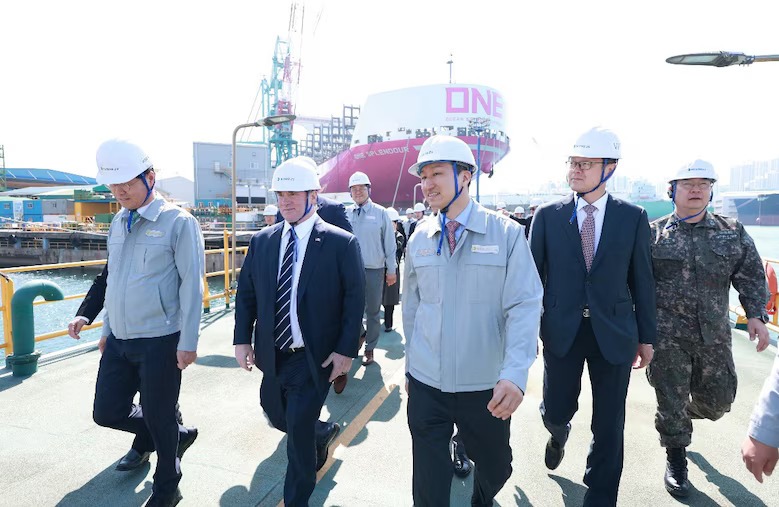
Secretary of the Navy John C. Phelan tours Hyundai Heavy Industries in the Republic of Korea on Apr. 30, 2025.
When the Secretary of the Navy makes a trip halfway across the globe to walk the decks of foreign shipyards, it’s not tourism. It’s triage.
This week, Navy Secretary John Phelan landed in South Korea and toured two of the region’s industrial giants—Hanwha Ocean Shipbuilding and HD Hyundai Heavy Industries. On the surface, the visit read like a polite diplomatic exchange about interoperability and partnership. But below deck, it was something far more urgent: a quiet admission that American shipyards are overwhelmed and outpaced.
U.S. shipbuilding capacity is stretched to the breaking point. Dry docks are full, timelines are slipping, and the backlog is growing like barnacles on a forgotten hull. Even the Navy’s workhorse—its Arleigh Burke-class destroyers—are now being eyed for repairs in South Korean yards because there simply isn’t enough room or skilled labor to fix them here at home.
Secretary Phelan, a man who chooses his words like he’s laying minefields, called the cooperation “essential” for maintaining U.S. readiness in the Indo-Pacific. Translation: We can’t keep the ships running without help. And in the Indo-Pacific, “running” means ready to fight.
South Korea, meanwhile, isn’t just doing us a favor. They’re cashing in on competence. Hanwha recently completed repairs on the USNS Wally Schirra—the first-ever U.S. Military Sealift Command ship fixed in a South Korean yard. The Yukon is already next in line. And HD Hyundai signed a memo with America’s top builder, Huntington Ingalls, signaling even tighter integration to come.
It’s a smart move by the Koreans—and a necessary one for the Americans.
But this isn’t just about welding and workforce. It’s about strategic geometry. In an era when maritime logistics is the real warfighting edge, the U.S. is turning to its allies not just for basing and bullets—but for bolts, beams, and drydock space.
And the trend is going both ways. In December, Hanwha dropped $100 million to acquire Philly Shipyard, becoming the first Korean shipbuilder to set up shop on U.S. soil. That’s not a partnership—it’s a foothold. A strategic, steel-clad investment in the future of American maritime manufacturing.
The Trump administration, for all its bluster about “America First,” is now neck-deep in a global reality: you don’t rebuild an industrial base in a vacuum. You do it with help. The Koreans know how to build ships—fast, on time, and at scale. And right now, the U.S. Navy needs that more than it needs another speech about American shipyard pride.
Secretary Phelan called the partnership a “cornerstone” of the U.S.-Korea alliance. That’s true. But it’s also a lifeline. Because without serious outside help, the Navy risks showing up to tomorrow’s fight with half its fleet in the shop—and no one to fix it.