

Three sailors aboard USS Constellation understood the hidden cost of nuclear-powered carriers 25 years ago. USS Abraham Lincoln is living it now.
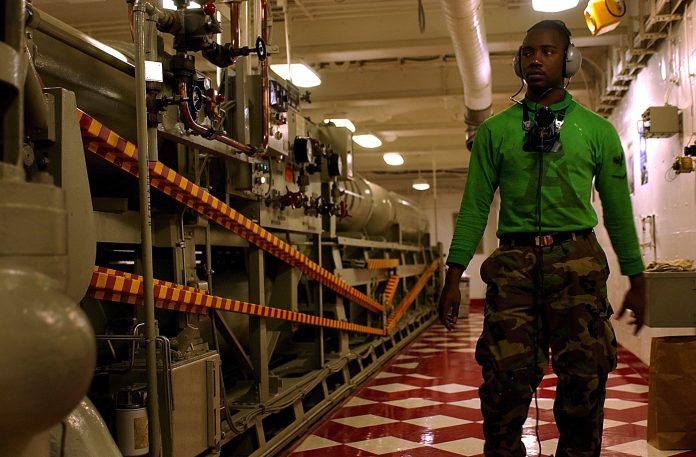
Around 2000, I was aboard USS Constellation, interviewing three sailors who worked below the flight deck in the carrier’s arresting-gear machinery room.
The room was quiet when I entered. Flight operations had stopped, and the men were enjoying a stretch of downtime.
It would have been a different place during aircraft recoveries.
When a jet caught a wire on the flight deck above, the arresting machinery absorbed the force of an aircraft traveling at more than 100 knots and brought it to a stop in a few seconds. Down in that compartment, the machinery was deafening when it operated.
But at that moment, the engines were still. The room belonged to the three sailors who maintained them.
I took their photograph. I still have the print somewhere and intend to find it.
During our conversation, I asked whether they would rather serve aboard one of the Navy’s newer nuclear-powered carriers, such as USS Abraham Lincoln.
All three looked at one another.
They shook their heads and smiled.
“We have to go into port for replenishment,” one of them told me. “Those nukes can stay out at sea and never see port.”
I remember that answer more than 25 years later.
Today, USS Abraham Lincoln has spent more than 240 consecutive days at sea without a port call—the longest documented stretch for a modern American aircraft carrier.
Those three sailors aboard Constellation saw it coming.
A limitation that protected the crew
USS Constellation was a conventionally powered carrier. It burned fuel to drive its boilers, which produced the steam that moved the ship.
It could be refueled at sea, just as carriers receive aviation fuel, food, ammunition, spare parts and mail from supply ships. But conventional propulsion imposed another limit that commanders had to consider. Eventually, the ship had to replenish its own fuel supply, more than a replenishment ship could supply.
Nuclear propulsion changed that calculation.
The reactors aboard a Nimitz-class carrier can power the ship for decades between nuclear refuelings. The carrier still needs aviation fuel for its aircraft. It still needs food for thousands of people, replacement parts, ammunition and maintenance. Those supplies can be transferred while underway.
But the ship does not have to enter port because it is running out of propulsion fuel.
That is a tremendous military advantage.
It also removed a natural restraint.
A conventionally powered carrier eventually forced the Navy to consider the ship’s oil fuel. A nuclear carrier allows the Navy to focus on the mission and postpone nearly everything else.
Including the sailors.
The machine is still working
There is no public indication that Lincoln has lost its ability to fight.
Its reactors are producing power. Its shafts are turning. Aircraft continue to launch and recover. The carrier remains on station in the Arabian Sea supporting operations against Iran.
Measured by machinery and mission capability, the carrier is still doing its job.
But a carrier is not merely 100,000 tons of steel, electronics, aircraft and nuclear propulsion.
Its crew is part of the weapons system.
Families of Lincoln sailors have reported exhaustion, declining morale and deteriorating living conditions. They have described moldy showers, broken toilets, laundry facilities unavailable for weeks, periods without hot water and shortages of food and basic hygiene supplies.
At least two apparent suicide or self-harm incidents have been described publicly by family members. CNN has reported another incident in which a sailor went overboard and was rescued.
The Navy says it has not identified an increase in reported suicidal thoughts or suicide attempts aboard the carrier. It has not released the numbers needed to evaluate that statement.
Defense Secretary Pete Hegseth says reports about conditions aboard Lincoln have been “completely misrepresented.”
Perhaps some conditions have been overstated. That happens when information must pass from sailors to spouses and then to reporters because the Navy will not release detailed figures.
But more than 240 days without a port call is not an allegation.
It is a fact.
Port calls are not vacations
People ashore sometimes describe port calls as though they were taxpayer-funded vacations for sailors.
They are not.
A sailor may stand duty while others go ashore. Maintenance continues. Supplies arrive. Repairs have to be made. Liberty can be short, restricted or canceled.
But a port call allows sailors to walk on ground that does not move beneath them. They can eat a meal that did not come through the ship’s supply system. They can find privacy, silence and a few hours in which they are not sleeping, working and living inside the same steel structure.
Most important, a port call breaks time into manageable pieces.
A sailor knows the next stop is coming. Then another. Eventually, the ship turns toward home.
The crew aboard Lincoln expected to return to San Diego in May. The deployment was extended, and no new return date was publicly announced.
That is a different kind of pressure.
It is one thing to endure a hard deployment while counting down the days. It is another to be told to keep going without knowing where the finish line is.
The human endurance problem
The Navy knows how to replenish a carrier at sea.
Oilers bring fuel. Supply ships bring food, parts and ammunition. Helicopters and carrier-onboard-delivery aircraft bring personnel and mail. Broken components can sometimes be repaired or replaced without the ship leaving station.
What the Navy has not learned to replenish at sea is human endurance.
Sleep cannot always be restored between watches. Isolation cannot be repaired with an underway replenishment. A care package delivered months late does not replace the family milestone that was missed.
Chaplains and mental-health professionals can help. Good chiefs and officers can recognize sailors in distress. Shipmates can intervene, as one reportedly did when he stopped another sailor from going overboard.
But there comes a point when resilience becomes a word leaders use to justify asking people to absorb conditions the institution should have prevented.
Sailors are trained to endure hardship. That does not make hardship limitless.
The bill comes due
USS George Washington is now moving toward the Indian Ocean to relieve Lincoln. To do it, the Navy is pulling its only forward-deployed carrier away from the western Pacific.
The carrier movements reveal the problem.
The Navy did not keep Lincoln at sea because admirals forgot the ship was there. It kept the carrier there because the mission remained and an immediately available replacement carried strategic consequences elsewhere.
That is the burden of maintaining global commitments with a carrier force that has little margin left.
The nuclear carrier makes it possible to conceal that shortage for a while. The ship keeps operating. Supply ships keep arriving. Aircraft keep flying.
Then the toilets fail. Laundry backs up. Food and hygiene supplies run short. Sailors stop sleeping well. Families begin calling reporters. Someone goes over the side.
The machinery can outlast the people operating it.
The sailors were right
I want to find that old photograph.
I remember the three sailors standing in the arresting-gear space aboard Constellation. I remember their expressions when I mentioned serving on a nuclear carrier.
They were not making a strategic argument. They were not criticizing the Navy. It was the kind of observation sailors make after living inside ships and understanding realities that do not appear in briefing slides.
Their carrier needed fuel.
That meant it eventually had to stop.
They understood that a limitation imposed by the machinery could become a form of protection for the crew.
“Those nukes can stay out at sea and never see port.”
They were smiling when they said it.
It does not sound funny anymore.