

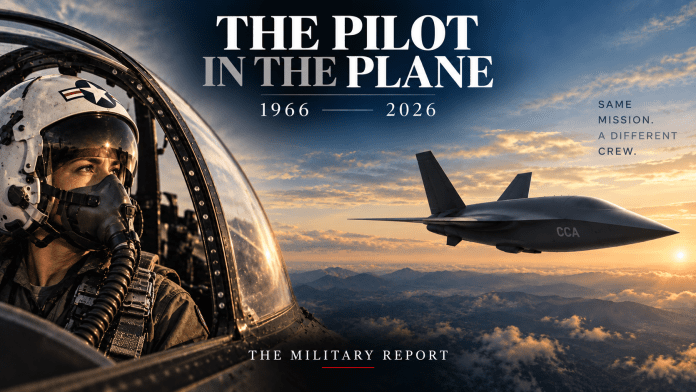
More than half a century ago, the American military was already arguing about whether the pilot belonged in the airplane.
Missiles were getting smarter. Computers were getting smaller. Guidance systems were improving. Unmanned aircraft were no longer entirely science fiction.
If a machine could fly the mission, why put a man inside it?
The military’s answer was simple.
Because the man could think.
In 1966, Vice Adm. Paul H. Ramsey, the Navy’s deputy chief of naval operations for air, put the argument succinctly while testifying before Congress:
“In robots, you can’t build judgment.”
That was the dividing line.
A machine could follow instructions. A pilot could look through the canopy, understand that something wasn’t right and change the plan.
For decades, that distinction helped keep the man in the cockpit.
Then, in 2012, I sat in a convention hall in San Diego and heard retired Marine Gen. James “Hoss” Cartwright argue that it was time to reconsider the whole proposition.
Cartwright had been vice chairman of the Joint Chiefs of Staff. He was a pilot. He understood airplanes, missiles and the business of sending people into combat.
And what I remember him saying was remarkably simple:
Take the human out of the plane.
His argument went further.
Why continually fly these aircraft and wear them out simply because pilots have to maintain proficiency?
Build unmanned combat aircraft.
Park them somewhere.
When you need them, fire them up.
But I remember the argument.
It stayed with me because it seemed radical to many in the room.
It doesn’t anymore.
The airplanes are here
On Sept. 14, Air Force Secretary Troy Meink announced that the service intends to have at least 500 Collaborative Combat Aircraft, or CCAs, in service by 2032.
It also intends to have another 500 Massed Modular Aircraft, cheaper autonomous aircraft designed for reconnaissance and strike missions.
The first CCAs — General Atomics‘ FQ-42A Vengeance and Anduril‘s FQ-44A Fury — are already coming off production lines. Their initial mission will be air-to-air combat. Later versions could perform strike, reconnaissance and electronic warfare missions.
By 2032, Meink said, the Air Force expects CCAs to be performing many of the missions now performed by crewed fighters.
That’s at least 1,000 autonomous combat aircraft.
And that’s just part of the plan.
Meink said special operations forces are expected to have thousands of autonomous one-way attack systems, while the Air Force plans to acquire tens of thousands of relatively inexpensive new munitions.
The idea is what Meink calls “combat power at scale.”
The Air Force isn’t merely talking about it.
In December, CCAs are scheduled to fly alongside fourth- and fifth-generation fighters during the Emerald Flag exercise at Eglin Air Force Base in Florida.
Lt. Col. Lyndon Bartlett, commander of the CCA Experimental Operations Unit, says the exercise will put the aircraft through an end-to-end combat kill chain for the first time during a large-force engagement.
Sixty years after the military argued about whether a robot could exercise judgment, autonomous combat aircraft are joining the formation.
The pilot was never just a passenger
Taking the man out of an airplane does considerably more than eliminate a seat.
A pilot needs oxygen.
He needs an ejection system.
He needs displays and controls.
The aircraft has to protect him.
His body limits how violently the aircraft can maneuver.
He needs years of training before going to war.
And then he has to keep flying.
That last part was important to Cartwright’s argument as I remember it.
A fighter aircraft doesn’t simply sit in a warehouse waiting for World War III.
Pilots must maintain proficiency. They fly training missions. They practice weapons delivery. They maintain carrier qualifications or aerial-refueling proficiency. Every flight puts hours on engines and airframes.
Then there is the pilot himself.
Training a fighter pilot represents an enormous investment that can’t be replaced by ordering another one from the factory.
Remove the pilot and the equation begins to change.
Now the airplane can become something different.
Not quite a traditional fighter.
Not quite a missile.
Something in between.
And you can afford to lose one
That may be the most profound change.
Military aviation has spent more than a century trying to accomplish two things simultaneously:
Complete the mission.
Bring the pilot home.
With an autonomous aircraft, commanders have another option.
There is nobody to bring home.
That doesn’t make today’s CCA a disposable airplane. At roughly $20 million for the air vehicle, the Air Force certainly doesn’t intend to throw them away casually. The planned Massed Modular Aircraft is supposed to be cheaper still, at roughly $10 million before sensors and other equipment.
But the risk calculation changes.
A commander can send an unmanned aircraft somewhere he might hesitate to send an F-35 carrying an American pilot.
It can scout ahead.
It can carry weapons.
It can jam.
It can draw enemy fire.
And if the tactical situation demands it, the commander can risk the machine without risking the person who otherwise would have been sitting inside it.
That is not simply a new aircraft.
It is a different way of thinking about air power.
But Ramsey’s question never went away
Here is where the story gets interesting.
Vice Adm. Ramsey’s 1966 objection hasn’t actually been answered.
The vocabulary changed.
Today we talk about artificial intelligence, machine learning, autonomy, human-machine teaming and keeping a human “in the loop.”
But underneath all those terms is the same question the military was asking in the 1960s:
Can a machine exercise judgment?
It can certainly do things the computers of 1966 couldn’t.
An autonomous aircraft can navigate, communicate, share information, recognize objects, respond to threats and coordinate with other aircraft.
But war has an irritating habit of refusing to follow the program.
Targets change.
Communications disappear.
Civilians appear where they aren’t supposed to be.
Friendly troops move.
Intelligence turns out to be wrong.
An adversary does something nobody anticipated.
That was the argument for the man in the cockpit.
He could see something the engineers hadn’t programmed into the machine and say:
No.
Or:
Wait.
Or:
Something isn’t right here.
Today’s CCAs are therefore not being turned loose to wage war on their own. The Air Force describes them as semi-autonomous aircraft operating with human direction. The service is also testing portable command-and-control systems specifically for directing CCAs in the field.
We have taken the man out of the cockpit.
We haven’t taken him out of the fight.
At least not yet.
Then came Ukraine
What neither Ramsey in 1966 nor Cartwright in 2012 could fully anticipate was how cheap this technology would eventually become.
The revolution in unmanned warfare didn’t arrive as a gleaming robot fighter sweeping across the sky.
It arrived much closer to the ground.
Ukraine demonstrated what happens when inexpensive drones, commercial electronics, digital communications, software and mass production collide with industrial warfare.
Drones became scouts.
Then artillery spotters.
Then bombers.
Then one-way attack weapons.
Then hunters of other drones.
Now artificial intelligence can allow some drones to continue toward targets even after GPS or communications links are lost.
That’s why Chairman of the Joint Chiefs Gen. Dan Caine’s warning this week deserves attention.
“We have to assume from now on that our formations will be hunted by autonomous systems,” Caine said, adding that American forces should also expect to be jammed and tracked in real time.
There are now two sides to the argument I heard Cartwright make fourteen years ago.
One is what happens when we take the person out of the airplane.
The other is what happens when the enemy does it.
A 60-year argument
There is something almost circular about all of this.
In the 1960s, military leaders were being asked whether technology might eliminate the combat pilot.
Their answer was essentially:
Not so fast. Machines can’t exercise human judgment.
By 2012, Cartwright was arguing that technology had advanced far enough that the military should reconsider whether a human needed to physically occupy the airplane at all.
Now it is 2026.
The first generation of Air Force autonomous fighters is coming off the production line.
Units are learning how to operate them.
Pilots are learning how to fight alongside them.
In December, they will fly with American fighters through a combat scenario at Eglin.
And by 2032, if the Air Force’s plan holds, at least 1,000 CCA and MMA autonomous aircraft will be in service.
So we have finally reached the future Cartwright was talking about in that San Diego convention hall.
But the old admiral from 1966 still gets the last word.
We figured out how to take the man out of the plane.
We haven’t yet settled the question of how much judgment we are willing to take out with him.