

Geoffrey Hinton has been warning us for several years that artificial intelligence could go very badly.
Not badly as in your computer crashes.
Badly as in we do.
Hinton, one of the pioneers of modern artificial intelligence and winner of the 2024 Nobel Prize in Physics, has estimated there is a 10 to 20 percent chance that advanced AI eventually leads to human extinction.
There is an important footnote to that number.
Hinton himself has acknowledged there is no scientific calculation behind it. Asked in January 2025 to explain the estimate, he said predicting something humanity has never experienced is extraordinarily difficult. Ten to 20 percent simply seemed reasonable to him.
That doesn’t make the warning meaningless.
It makes it a forecast.
And forecasts eventually have to meet evidence.
On one piece of Hinton’s argument, we are beginning to get some.
It is coming from Ukraine.
The robot army
Last November, Hinton sat down with Sen. Bernie Sanders at Georgetown University and talked about where artificial intelligence might take us.
One of his warnings concerned warfare.
If wealthy countries could send autonomous drones and robots into battle instead of their own soldiers, Hinton reasoned, one of the great political restraints on war would disappear.
No body bags.
No grieving families.
No casualty lists on the evening news.
A powerful country could send machines to invade a smaller country without risking the lives of its own soldiers.
It’s not a foolish argument.
But something interesting happened when the machines actually reached the battlefield.
They didn’t belong exclusively to the rich country.
The little guy got them, too.
And he discovered they were pretty good at killing the invader.
That is the central argument made by Dino Garner in an Oct. 2 essay for SOFX titled “The Fog at Two Hundred Yards.” Garner takes Hinton’s predictions and compares them with what has actually happened since they were made.
The battlefield results deserve attention.
Russia has suffered an estimated 1.4 million battlefield casualties since invading Ukraine in February 2022, including as many as 450,000 dead, according to a July analysis by the Center for Strategic and International Studies.
During the first half of 2026, CSIS estimated the casualty ratio had climbed to nearly eight Russian casualties for every Ukrainian casualty, attributing that change in significant part to Ukraine’s increasingly effective use of drones, including AI-enabled systems.
CSIS also reported that, according to some estimates, more than 90 percent of Russian casualties in the drone-saturated kill zone are being caused by drone attacks rather than direct human-to-human engagements.
That 90-percent figure deserves the qualifier. It is not a comprehensive CSIS count of every Russian casualty; CSIS itself describes it as coming from “some estimates.”
But the larger battlefield development is difficult to miss.
The cheap machine has made attacking harder.
We’ve seen this coming
This is where the story begins to sound familiar.
In July 2025, The Military Report argued that it was time to rewrite the infantry manual.
The traditional infantry problem was fairly straightforward.
Somebody shoots at you.
You find cover.
You locate the enemy.
You maneuver against him.
But what happens when nobody fires a rifle?
What happens when the first indication that you’ve been discovered is the buzzing overhead?
Last year, Army Lt. Col. Antonio Salinas and Maj. Kyle LeVay warned that ground forces without drones would become extraordinarily vulnerable. Soldiers would be hunted from above, detected by sensors and attacked by machines that didn’t care whether anyone shot back.
Then, this September, Chairman of the Joint Chiefs Gen. Dan Caine delivered essentially the same warning to the force.
American formations, he said, must assume they will be hunted by autonomous systems.
The prediction had become doctrine’s problem.
And that brought me back even further.
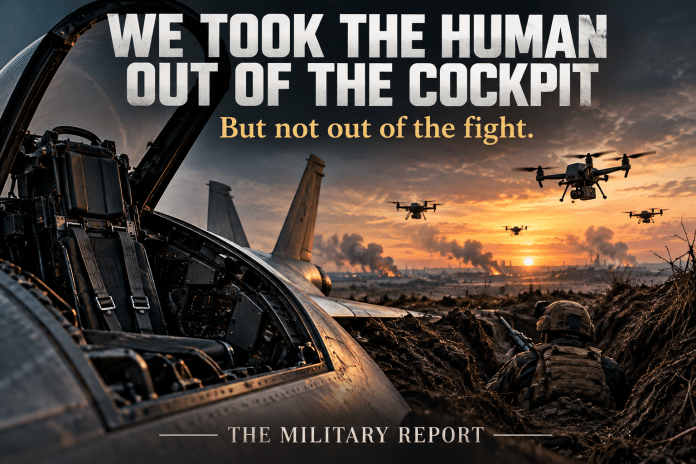
Take the human out of the plane
At a military conference in San Diego in 2012, I listened to retired Gen. James “Hoss” Cartwright make an argument that stayed with me.
Take the human out of the plane.
Why build a combat aircraft around a pilot if the pilot doesn’t have to be there?
A pilot needs oxygen.
Displays.
Controls.
An ejection seat.
Protection.
Years of training.
Then he has to keep flying simply to remain proficient, putting hours on aircraft and engines whether the country is at war or not.
Cartwright’s idea was wonderfully simple.
Build unmanned combat aircraft.
Park them.
When you need them, fire them up.
Fourteen years later, the Air Force is doing essentially that with Collaborative Combat Aircraft and other increasingly autonomous systems.
But the argument is actually older than Cartwright.
Much older.
I remember reading versions of it as a kid in the 1960s.
Even then, military thinkers were debating whether advances in missiles, electronics and computers would eventually eliminate the fighter pilot.
The answer from many military leaders was essentially: not so fast.
There was something in that cockpit that electronics couldn’t reproduce.
Judgment.
The pilot could see something unexpected.
He could say no.
He could say wait.
He could decide that something wasn’t right.
Sixty years later, we finally figured out how to take the human out of the airplane.
What we haven’t figured out is how to take the human out of war.
Ukraine changed the equation
The revolution didn’t arrive as the sleek robotic fighter imagined by futurists.
It arrived buzzing a few hundred feet over a muddy trench.
Ukraine combined inexpensive drones, commercial electronics, software, digital communications and mass production and turned them into weapons on an industrial scale.
Drones became scouts.
Then artillery spotters.
Then bombers.
Then one-way attack weapons.
Then drone hunters.
Now increasingly autonomous systems can identify or continue tracking targets even when communications or satellite navigation are disrupted.
And the price matters.
CSIS describes Ukraine’s Hornet as an autonomous one-way attack drone costing roughly $6,000, with a range of as much as 150 kilometers. It uses onboard artificial intelligence to help identify targets and distinguish decoys, reducing its dependence on communications links that can be jammed.
That changes warfare in a way the Pentagon’s traditional procurement system isn’t particularly well designed to handle.
A $6,000 weapon doesn’t require a great power.
It doesn’t require an aircraft carrier.
It doesn’t require an air base.
It doesn’t require a pilot.
It doesn’t even necessarily require a conventional military.
And therein lies the problem with the robot-army prediction.
The robot isn’t necessarily on the attacker’s side.
Machines can kill. They can’t occupy.
There is another problem with the idea that autonomous armies make invasion painless.
Winning a firefight and winning a war are not the same thing.
A drone can find a soldier.
It can follow him.
It can kill him.
It can destroy a truck, tank, artillery piece or command post.
But a drone cannot stand on a street corner and tell the population who is now in charge.
It cannot search a building and then reassure the family next door.
It cannot police a city.
It cannot administer a province.
It cannot convince millions of people that the government imposed upon them is legitimate.
And it cannot occupy a country by itself.
Eventually somebody has to stand on the ground.
That somebody can still be shot.
Ukraine has demonstrated the other side of autonomous warfare: cheap machines can make occupying territory more expensive because the defender gets machines, too.
Hinton may still be right
None of this proves Hinton wrong about artificial intelligence.
That’s important.
His broader warning concerns systems that could eventually become more intelligent and more autonomous than anything operating on today’s battlefield. Ukraine cannot tell us what an artificial superintelligence might do in 2040.
Hinton himself has offered perhaps the best metaphor for that uncertainty.
He compared predicting AI to driving through fog. Close ahead, you can see reasonably well. Farther down the road, you can’t.
Fair enough.
So look at the road we can see.
The evidence so far doesn’t show autonomous weapons eliminating the human cost of invasion.
It shows inexpensive machines spreading to both sides.
It shows soldiers hiding from drones.
It shows armored formations struggling to mass without being detected.
It shows supply lines under constant surveillance.
It shows a battlefield extending dozens of kilometers behind what we once called the front line.
And it shows something we wrote about at The Military Report more than a year ago:
The infantry manual needs rewriting.
The soldier isn’t disappearing.
The battlefield around him is.
That may ultimately be the lesson from sixty years of trying to remove humans from warfare.
We took the pilot out of the airplane.
We put algorithms into the weapons.
We built machines that can search, track and increasingly make decisions for themselves.
And after all that technological progress, somebody still has to take the ground.
Somebody still has to hold it.
Somebody still has to decide when not to shoot.
We finally took the human out of the cockpit.
We haven’t taken the human out of the fight.