

President Donald Trump has been complaining about the Navy’s electromagnetic aircraft catapults for almost a decade.
In 2017, during his first administration, Trump said the new system aboard the USS Gerald R. Ford was too complicated and too expensive. He wanted the Navy to go back to steam.
Two years later, speaking to sailors and Marines aboard USS Wasp, Trump was still at it.
“What was wrong with steam?” he asked.
Now Trump has gone beyond complaining about it.
On Aug. 13, he directed the Pentagon and Navy to come up with a plan within 60 days to replace the Electromagnetic Aircraft Launch System, known as EMALS, and the Advanced Weapons Elevators planned for the future USS Doris Miller, CVN-81. The replacements would be steam catapults and hydraulic elevators—the kind of technology used aboard the older Nimitz-class carriers.
Trump has not ordered workers to start ripping equipment out of the ship. The 60-day order is for a plan, including timelines and the resources required to do it.
That distinction matters.
Because going back to steam sounds a lot easier than it is.
Trump wasn’t wrong about the problems
There is a reason Trump became fixated on Ford’s new technology.
The Navy tried to introduce a remarkable number of new systems at the same time aboard its newest class of aircraft carrier. Some did not work as advertised.
EMALS replaces the steam catapults that have launched Navy aircraft for generations.
A steam catapult essentially uses steam pressure to drive a piston down a track beneath the flight deck. That piston pulls an aircraft forward until it reaches flying speed.
EMALS does the same job with electricity and magnetic fields.
The advantage is control.
An electromagnetic catapult can tailor the amount of force applied to different aircraft. That is increasingly important as the Navy puts lighter unmanned aircraft on the same flight decks as heavily loaded fighters.
But EMALS had serious reliability problems.
The Navy’s requirement was 4,166 launches between operational mission failures.
During testing in fiscal 2021, EMALS achieved 460. During testing from March through June 2022, it improved to 614.
Better, but still nowhere near the requirement.
The Pentagon’s own Director, Operational Test and Evaluation reported that the reliability of the catapults, arresting gear and other systems was hurting flight operations.
Trump’s criticism, in other words, did not come from nowhere.
However, during it’s last deployment, there was another part of the equation that gets lost in the argument over steam versus electromagnetic catapults. The Navy says the Ford conducted more than 11,000 aircraft launches using its electromagnetic launch system, demonstrating a launch tempo that steam-powered systems could not match. But the bigger advantage may be below decks: EMALS was designed to require fewer sailors to operate and maintain, while reducing the long-term cost and manpower burden of the old steam system.
The Advanced Weapons Elevators had problems of their own. The Ford was commissioned in 2017, but the last of its 11 elevators wasn’t certified until December 2021.
These were real problems. They cost money and time.
But there is another side to that story.
The Navy has spent years fixing them.
The Ford that exists today isn’t the Ford Trump visited during his first administration.
And that is where the question gets harder.
Steam worked. That doesn’t make it simple.
Steam catapults have been launching Navy aircraft for more than half a century.
They work.
They are rugged.
Sailors understand them.
And they have one important advantage over EMALS: the individual catapults are largely independent. One can be taken out of service for repairs while the others continue operating.
That is no small advantage on a warship.
But steam catapults aren’t simple machines.
They require a network of steam pipes, cylinders, pistons, accumulators, seals, water brakes, cooling equipment and freshwater.
That machinery takes up space below the flight deck.
It adds weight.
It produces heat.
And it requires sailors to operate and maintain it.
None of that is necessarily a problem aboard a Nimitz-class carrier.
Those ships were designed for it.
The Ford class wasn’t.
Doris Miller is a ship without catapult steam
This is the part that gets lost in an argument over whether steam is better than electromagnetic power.
USS Doris Miller wasn’t designed to use steam catapults.
The Ford class was designed around electrical power from the beginning. Its A1B nuclear reactors generate considerably more electrical power than the older Nimitz-class plant.
That extra electrical capacity is part of the basic design of the ship.
So the Navy didn’t simply install electric catapults where steam catapults used to be.
It designed the ship around them.
There isn’t an unused steam-catapult system sitting inside Doris Miller, waiting for somebody to reconnect the pipes.
To go back, naval architects would have to find room for the steam-generating and distribution equipment, run piping to four catapult positions, install the cylinders and water brakes and provide the cooling and freshwater capacity the machinery requires.
Every pipe has to go somewhere.
Every machine has to fit somewhere.
Every additional ton affects something else.
That means going back to steam isn’t simply taking something out of Doris Miller.
It means putting an entire supporting system into a carrier that was deliberately designed without it.
One defense analyst estimates that replumbing the carrier for steam could take years and cost billions of dollars.
But they haven’t laid the keel yet
That sounds like the obvious answer.
If the keel hasn’t been laid, just change the plans.
Modern warships don’t work that way.
Large sections of a carrier are fabricated separately and later assembled. Steel is being cut and equipment is being manufactured long before the traditional keel-laying ceremony.
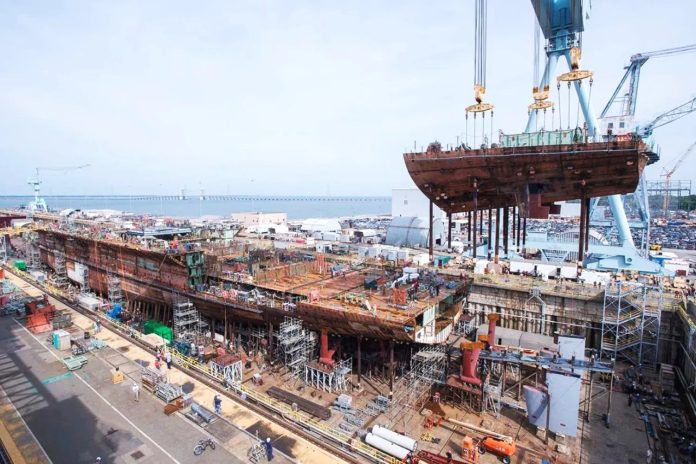
And work on Doris Miller is already underway.
General Atomics received a roughly $1.2 billion Navy contract modification in June for EMALS and Advanced Arresting Gear work for CVN-81. The company has said production of the launch-and-recovery equipment is approaching the halfway point.
There is another problem.
The Ford-class design is supposed to be reused.
That is one of the ways the Navy is supposed to get the cost of later ships under control. Engineers don’t start with a blank sheet of paper every time Newport News builds another carrier.
CVN-80, Enterprise, and CVN-81, Doris Miller, were even purchased under a two-ship block-buy arrangement intended to generate savings.
Redesigning the fourth carrier around steam and hydraulic systems starts giving some of those savings back.
And the carrier program can ill afford another delay.
The carriers are already late
The Navy has a shipbuilding problem much larger than EMALS.
The second Ford-class carrier, the future USS John F. Kennedy, was originally supposed to be delivered in September 2022.
It is now scheduled for March 2027.
That is a four-and-a-half-year delay.
The future USS Enterprise was originally scheduled for September 2027. Its delivery has moved to July 2030, almost three years later.
And now Doris Miller is slipping.
Last year’s Navy budget projected delivery in February 2032.
The Navy’s fiscal 2027 budget documents now put delivery in February 2034.
The reason the Navy gave wasn’t EMALS.
It wasn’t the weapons elevators.
It was the shipyard.
The Navy said construction-space constraints at the shipbuilder were limiting its ability to build Doris Miller modules.
That is important.
If the purpose of changing the technology is to make carrier construction more reliable, the Navy still has to deal with the problems that are delaying carriers regardless of what kind of catapult is installed.
Workforce.
Suppliers.
Shipyard capacity.
Materials.
Those problems don’t disappear when steam enters the picture.
An old carrier waits for the new one
And a late aircraft carrier doesn’t exist by itself on a construction chart.
Somewhere else in the fleet, another clock is running.
The Ford class is being built to replace the Nimitz-class carriers as those ships reach the end of roughly 50-year service lives. The Navy explicitly describes the Ford class as the replacement for the Nimitz class.
That replacement schedule is already under pressure.
USS Nimitz, CVN-68, entered service in 1975.
The Navy planned to deactivate the carrier in May 2026.
Then John F. Kennedy slipped.
In March, the Navy extended Nimitz another 10 months, moving its deactivation to March 2027—the same month Kennedy is currently scheduled for delivery.
The Navy even awarded a $96 million contract for the additional planning and materials associated with Nimitz’s later inactivation.
Nimitz is now in Norfolk and will spend its remaining months primarily as a training carrier before its reactors are defueled.
The same connection exists farther down the line.
The Navy has identified Enterprise, CVN-80, as the replacement for USS Dwight D. Eisenhower, CVN-69. The Ford-class ships are specifically intended to replace Nimitz-class carriers over time.
That is the domino effect.
When the new carrier arrives late, the Navy has two choices.
Keep the old carrier around longer.
Or live with fewer carriers.
Neither is free.
An aging nuclear-powered carrier requires maintenance, sailors, shipyard work and money. And there is only so much additional service life that can be squeezed out of a ship designed around a roughly 50-year lifespan.
The Navy is already doing it with Nimitz.
A major redesign that pushes Doris Miller farther to the right could push the same problem farther down the carrier line.
The industrial base can’t simply go backward either
There is one more problem with returning to steam.
The United States hasn’t built a steam-catapult aircraft carrier in years.
USS George H.W. Bush, CVN-77, was the last Nimitz-class carrier built. It was commissioned in 2009.
Manufacturing lines close.
Tooling disappears.
Suppliers move to other work.
Experienced workers retire.
The people who knew how to manufacture a specialized piece of equipment aren’t necessarily standing around waiting 20 years for another order.
The Navy would therefore have to determine not only how to put steam catapults into Doris Miller, but how to recreate the industrial capability needed to manufacture them.
That takes us back to the larger problem.
America is already struggling to build warships fast enough.
Recreating an old production line while redesigning a new carrier doesn’t automatically solve that problem.
It may add another one.
The Navy has 60 days to answer the right question
The Ford program tried to introduce too much immature technology at once.
EMALS had serious reliability problems.
The weapons elevators became an embarrassment.
The Ford cost more and took longer than originally expected.
Those facts shouldn’t be waved away simply because the technology is new.
But neither should the last decade be erased.
The Navy spent billions of dollars and years working through those problems. EMALS and the elevators have matured. The carrier’s electrical architecture has been built around them. Suppliers are manufacturing them. Future aircraft are being designed for a carrier fleet built around more electrical power, not less.
Now the Navy is being asked to determine whether it should reverse course.
That is what the 60-day study should actually answer.
Not whether steam catapults work.
We already know they work.
The question is whether returning to steam now makes the Navy stronger.
How much will the redesign cost?
How many years could it add to Doris Miller’s schedule?
Can the old industrial base be rebuilt?
How many additional sailors would be required?
What happens to the weight and internal arrangement of the ship?
What happens to the Ford-class carriers that come after CVN-81?
And perhaps most importantly:
What happens to the old carrier waiting for the new one to arrive?
The Navy has already extended the life of Nimitz while waiting for Kennedy.
That should be the warning.
Changing the catapult aboard Doris Miller isn’t just about Doris Miller.
Every additional year spent building the next carrier can become another year the Navy has to squeeze out of the carrier it was supposed to replace.
Trump has given the Navy 60 days to figure out how to go back to steam.
The more important question is what going backward would do to the fleet moving forward.