

Shortages and deteriorating conditions aboard the USS Abraham Lincoln are not merely the result of one record deployment. They are the latest warning from a Navy that has spent three decades wearing out its ships, compressing maintenance and exhausting its people. Iran exposed the strain. China could exploit it.
The USS Abraham Lincoln is still in the fight.
Her aircraft are flying. Her escorts are operating. Her sailors are standing watches, repairing equipment, loading weapons and keeping one of the most complicated machines ever built moving through the water.
From the Pentagon, that looks like success.
From the deckplates, it may look very different.
The carrier has remained at sea through a prolonged deployment in the Middle East and Indian Ocean. Sailors and family members have described deteriorating conditions, broken equipment, shortages and collapsing morale. Reports of suicide attempts have deepened concern about what is happening aboard the ship.
The Navy’s answer, directly or indirectly, is that long deployments and long stretches without port calls are not unheard of.
That is true.
It is also beside the point.
The issue is not whether the Navy has kept carriers at sea for long periods before. It has. The issue is what the Navy is consuming—ships, aircraft, supplies and sailors—to keep the Lincoln on station now.
A nuclear-powered carrier can remain at sea for years without refueling its reactors. That technical fact has become an institutional temptation. Because the ship can stay at sea, commanders and policymakers begin to treat it as though the entire carrier strike group can do the same.
It cannot.
A nuclear reactor does not feed thousands of sailors. It does not manufacture spare parts, replenish jet fuel, reload missiles, repair aircraft or replace worn machinery. It does not give a sailor eight hours of sleep or reunite a family separated by an open-ended deployment.
The reactor can keep turning the screws.
Everything else must be carried to the ship.
That is where the real warning aboard the Lincoln begins.
The ships behind the carrier
The public sees the carrier. Naval aviation photographs reinforce the image: fighters launching from the bow, escorts cutting through the sea and a 100,000-ton symbol of American power at the center.
What the public rarely sees is the supply system behind it.
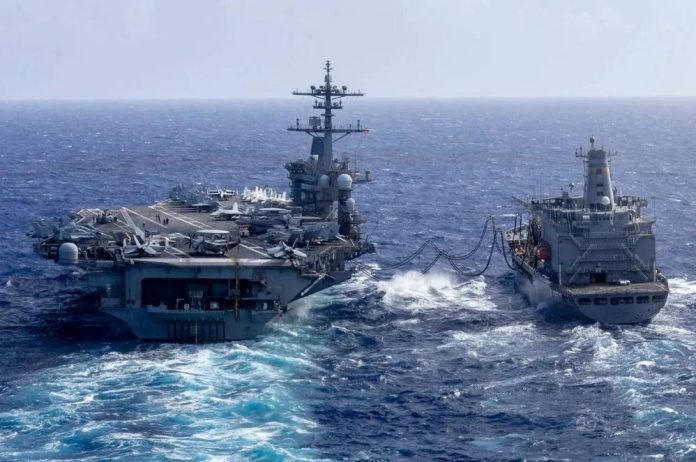
Every carrier strike group depends upon Military Sealift Command oilers, dry-cargo ships and ammunition ships. The carrier may be nuclear-powered, but its air wing is not. Its fighters, helicopters and other aircraft consume enormous quantities of jet fuel. The carrier’s Arleigh Burke-class destroyer escorts are powered by gas turbines and require marine diesel fuel.
The reactors allow the carrier itself to remain at sea without regularly refueling its propulsion plant. They do not make the carrier strike group independent of fuel.
Oilers therefore carry the jet fuel that keeps the carrier’s aircraft flying and the diesel fuel that keeps its escorts moving. Depending upon their class and load, they may also carry limited stores and other cargo, but fuel is their principal mission.
For food, mail, aircraft parts, repair components, ammunition and the countless consumable items required to operate a floating air base, the fleet depends heavily upon dry-cargo and ammunition ships. They carry everything from frozen food to aircraft engines and guided weapons.
Helicopters move priority cargo between decks while hoses and transfer rigs carry fuel and bulk material alongside. It is a practiced choreography known as underway replenishment.
This is the weakness hidden by the phrase “nuclear-powered carrier.” The carrier’s reactors can keep turning its screws, but the air wing and escorting warships still depend upon a steady procession of vulnerable logistics ships.
In peacetime, it can appear routine.
In a contested environment, every part of it becomes vulnerable.
The carrier must be in the right place. The replenishment ship must arrive on schedule. Weather must permit the evolution. The enemy must not interfere. The right cargo must have reached the supply ship at the right port before it ever heads to sea.
A breakdown anywhere in that chain eventually reaches the carrier.
The missing part does not arrive.
The aircraft remains down.
The temporary repair stays temporary.
The shortage moves from a warehouse to a ship and finally to a sailor trying to accomplish the mission without what he needs.
Iran changed the route
Iran does not need to sink a carrier to place pressure on the Navy.
Attacks and threats against commercial and military shipping have already changed how ships operate in the region. Supply ships cannot move casually through threatened waters. Fueling locations, routes and schedules must be adjusted. Oilers may remain farther from the danger area, requiring combatants to travel farther or other logistics ships to shuttle fuel forward.
This turns replenishment into a treadmill.
The oiler leaves a safer hub, sails to the rendezvous, transfers fuel and then returns to reload. Every additional mile consumes fuel and time. Every extra transfer creates another opportunity for mechanical failure, delay or enemy action.
The Navy can also use consolidated cargo operations, transferring fuel or supplies between logistics ships at sea. That extends the chain, but it does not create additional capacity. It moves the same fuel through more hands before it reaches the combatant.
If a regional supply hub is disrupted or becomes too dangerous to use, the effects spread rapidly. Ships must load elsewhere. Voyages become longer. Schedules slip. Available tankers must cover more water. Maintenance windows disappear.
What looks like a shortage aboard one carrier may have begun hundreds or thousands of miles away.
The Navy can manage those disruptions during a limited operation. It can surge ships, redirect cargo and order sailors to work longer.
But surge is supposed to be temporary.
The Navy has been surging, somewhere, for most of the past 30 years.
I saw a smaller version of this during the Clinton administration.
The USS Kitty Hawk was preparing for deployment but could not leave San Diego on schedule because equipment had not arrived. The delay lasted about a week.
A week may not sound important in the life of a carrier. It is.
A carrier deployment is synchronized long before the ship gets underway. Escorts, aircraft, cargo, port access, exercises and operational commitments are tied to that schedule. A missing piece of equipment at the pier can affect movements across the Pacific.
The immediate question was obvious: Why was the Kitty Hawk waiting?
The larger question stayed with me: If this delay was visible in port, what else had been delayed farther down the supply chain where no reporter could see it?
That was during the relative peace of the 1990s, before two decades of war, before the Navy’s maintenance crisis became impossible to conceal and before China built a missile force designed to attack American bases, ports and ships across the Western Pacific.
The Kitty Hawk eventually received what it needed and departed. The system worked, in the narrowest sense.
But it worked by absorbing another delay.
That has become the Navy’s standard method: absorb the delay, work around the shortage, extend the deployment, postpone the maintenance and ask sailors to carry the difference.
Three decades of borrowed readiness
The strain aboard the Lincoln did not begin when the carrier entered the Middle East.
After the Cold War, the fleet shrank, but the demands placed upon it did not shrink at the same rate. The Navy maintained global commitments with fewer ships. Then came the wars in Afghanistan and Iraq, counterterrorism operations, the campaign against ISIS, repeated Middle East crises, and a growing confrontation with China.
Ships deployed longer and more frequently.
Maintenance was deferred or compressed. Shipyards accumulated backlogs. Spare parts became harder to obtain. Cannibalization—taking working parts from one aircraft or ship to keep another operating—became an accepted management tool.
Sailors worked around equipment casualties because they had no other choice.
Every workaround preserved today’s readiness by borrowing from tomorrow.
Corrosion continues whether the ship is in combat or at the pier. Pumps, valves, cables, pipes and electronics age. Aircraft accumulate flight hours. Catapults and arresting gear absorb enormous physical forces. Elevators, ventilation systems, water systems and living spaces wear under constant use by thousands of people.
Maintenance postponed during one deployment does not disappear. It waits for the next crew.
Eventually, tomorrow arrives carrying the accumulated bill.
Tired sailors maintain tired ships
Equipment readiness and human readiness cannot be separated.
A tired crew makes more mistakes. A ship with more broken equipment demands more work from its crew. That additional work produces more fatigue, which increases the risk of mistakes and further equipment casualties.
It is a closed loop.
Aboard a carrier, much of the work is inherently dangerous. Sailors handle fuel, weapons, high-voltage electricity, powerful machinery and aircraft moving through confined spaces. Flight-deck operations are unforgiving even with a rested crew and fully functioning equipment.
Add months without a port call, disrupted sleep, unreliable systems and uncertainty about when the deployment will end, and the risk grows.
Morale is not a soft measure. It is part of combat readiness.
Sailors can endure extraordinary hardship when they believe the mission requires it and their leaders understand the cost. Trust begins to break when every emergency becomes routine, every extension becomes unavoidable and every complaint is dismissed with the observation that someone else once had it worse.
“It’s not unheard of” is not a readiness standard.
The Navy should be asking whether the conditions aboard the Lincoln are necessary, sustainable and acceptable—not merely whether they have precedent.
The success that conceals failure
The Navy’s sailors will almost always find a way to accomplish the mission.
That is their strength.
It can also conceal institutional failure.
A sailor will improvise a repair. A chief will reorganize the watch bill. A maintenance crew will cannibalize a part. A supply officer will locate cargo somewhere else. A commanding officer will report that the ship remains capable of executing its assigned task.
Up the chain of command, the carrier remains green on the chart.
But the color green can hide the cost.
The ship may be completing its missions while maintenance debt accumulates below decks. Aircraft may still fly while the number available declines. Sailors may continue standing watches while exhaustion and despair spread through the crew.
The institution sees the sortie.
It may not see the sailor holding the system together with baling wire.
Mission accomplishment becomes evidence that the demands were reasonable. Because the crew succeeded, the Navy concludes that the ship had sufficient resources. The extraordinary effort required disappears from the official assessment.
The maritime workforce underneath it
Military Sealift Command faces its own personnel and readiness problems.
Its ships are frequently operated by civilian mariners who spend long periods away from home. Manning shortages place more pressure on the people who remain. Ships may be technically available but lack sufficient crews to sustain extended operations.
A logistics ship tied to a pier because it lacks mariners is as unavailable as a ship undergoing repairs. Steel without crews does not deliver fuel.
The United States also has a limited commercial maritime base compared with the one it possessed during World War II. The number of American-flagged commercial ships and qualified mariners available for a major sealift operation has declined dramatically.
In a prolonged war, the Navy would need those ships and mariners to carry military cargo across the Pacific. It would also need shipyards capable of repairing damaged vessels and industry capable of replacing losses.
The United States does not possess that capacity at the scale a major war would demand.
China does.
The Pacific is not the Middle East
The Middle East is a difficult operating environment, but the United States has spent decades building access, bases, supply relationships and operational experience there.
The Pacific is measured on another scale.
Distances between ports and operating areas are vast. A logistics ship may spend days simply moving between the supply point and the fleet. Guam, Japan and other fixed facilities would be within range of Chinese missiles. Communications would be disrupted. Ports could be damaged. Airfields could be cratered. Fuel farms could burn.
The logistics ships themselves would be targets.
China would not need to defeat every American carrier strike group in a decisive fleet engagement. It is learning from Iran how to disrupt carrier operations. Hit the support systems.
Tankers are slower and less heavily defended than destroyers. Cargo ships cannot outrun missiles. Repair ships and tenders must operate somewhere. Fixed depots can be located by satellites. Port facilities cannot scatter when the shooting begins.
Remove enough oilers, and the destroyers run short of fuel.
Disrupt enough ammunition ships, and vertical-launch cells stay empty after their missiles are fired.
Damage the repair yards, and ships with manageable casualties become unavailable for months.
Destroy the fuel infrastructure on Guam, and every operational plan built around Guam must change overnight.
A nuclear carrier may keep moving, but its air wing burns enormous quantities of jet fuel. Its escorts need conventional fuel. Its aircraft need weapons and parts. Its sailors need food.
The carrier is nuclear-powered.
The strike group is not.
China can strike the connective tissue
American military planning often concentrates on the visible weapons: carriers, submarines, bombers, fighters and missiles.
China has studied the connective tissue.
Its anti-access strategy is designed not merely to attack individual platforms but to disrupt the bases, sensors, communications and logistics networks that allow American forces to operate as a system.
A carrier without reliable communications, sufficient escorts or a functioning supply line is not the same combat force it was on the day it sailed.
This is why the experience of the Lincoln matters beyond its present deployment.
Iran is applying pressure with drones, missiles and threats to maritime traffic. It has forced adjustments to a logistics system operating under American air and naval superiority.
China would attack that system deliberately, simultaneously and over a much larger area.
The Pacific would not offer a safe rear area. The logistics fleet would be in the war from the first hour.
The old lesson
None of this is new.
The United States defeated Japan in World War II because it could build, crew, supply and repair a fleet across the Pacific. Combat ships received the glory, but victory traveled aboard tankers, cargo ships, tenders, hospital ships, tugs and floating dry docks.
Advanced bases moved west as the fighting moved west. Damaged ships were patched, returned to service or replaced. Merchant mariners delivered fuel and ammunition into the combat zone.
Industrial capacity made operational courage sustainable.
The United States still has courageous sailors.
What it no longer has is the same depth behind them.
Naval writers such as Commander Salamander have warned for years that the Pacific logistics problem is not an obscure support issue. It is central to deterrence. An enemy who believes the United States cannot sustain its fleet through the opening months of a war may be more willing to begin one.
Credible combat power requires more than the ability to arrive.
It requires the ability to stay, fight, repair, reload and replace losses.
What Lincoln is telling us
The USS Abraham Lincoln has not failed.
Her crew has done what American sailors have always done: kept the ship operating under difficult conditions.
The danger is that their achievement will be used to justify the system that placed them under such strain.
If the Navy treats shortages, equipment failures and collapsing morale as isolated complaints, it will miss the strategic warning. The conditions aboard the carrier are the visible end of a much longer chain.
Behind every broken system is a maintenance decision.
Behind every missing part is a supply chain.
Behind every exhausted sailor is an operational demand that someone decided could not be reduced.
The Navy kept the Lincoln in the fight.
But keeping one carrier at sea during a regional crisis has placed stress on sailors, equipment and replenishment forces operating in an environment the United States largely controls.
A war with China would require the Navy to sustain several carrier strike groups, submarines, surface action groups and amphibious forces across the Pacific while bases, ports, communications and supply ships were under direct attack.
That is the comparison that matters.
The question is not whether a nuclear carrier can remain at sea.
The question is whether the nation behind it can keep everything else moving.
Right now, the USS Abraham Lincoln is providing the answer.
We should pay attention.