

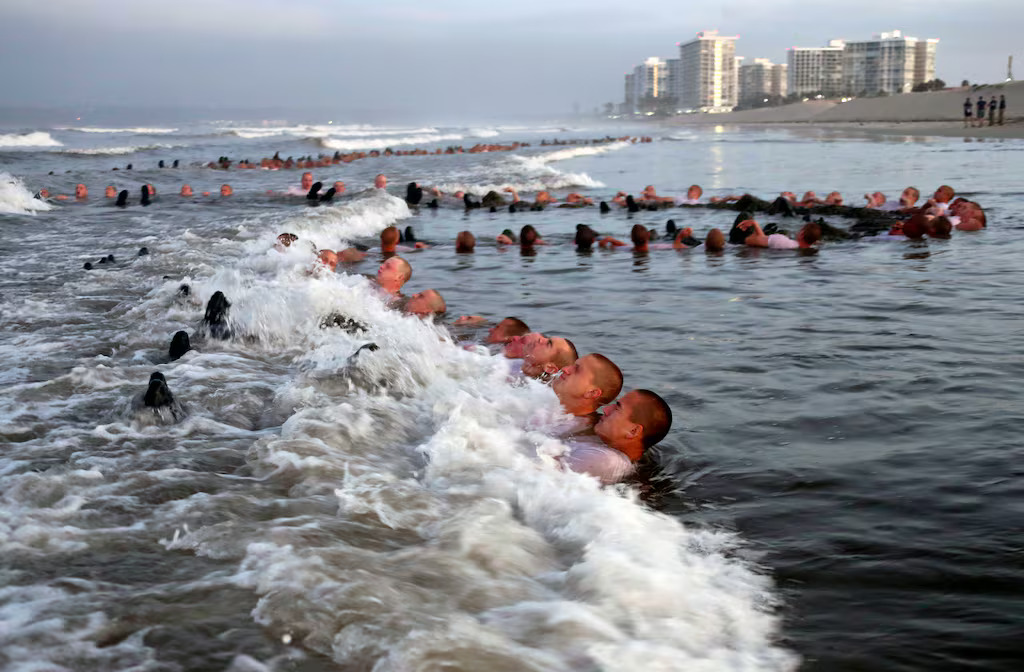
U.S. Navy SEAL candidates, participate in “surf immersion” during Basic Underwater Demolition/SEAL (BUD/S) training at the Naval Special Warfare (NSW) Center in Coronado, Calif., on May 4, 2020. The training program for Navy SEALs is plagued by widespread medical failures.
WASHINGTON — A government watchdog has found that Navy SEAL candidates frequently trained in sewage-contaminated waters off the coast of Southern California, exposing them to significant health risks, according to a report released Feb. 7 by the Department of Defense inspector general.
The report examined bacterial contamination levels in ocean waters near the Naval Amphibious Base in Coronado, where the Naval Special Warfare Command conducts training. From February to September 2024, inspectors found that 76% of 228 water quality tests showed bacteria levels exceeding state safety standards.
Despite ongoing pollution from sewage spills in Tijuana that regularly foul shorelines in San Diego County, the command relocated just 5% of 265 scheduled water training events during the seven-month period, the report said. It also noted that the command ignored county beach closure advisories for three training events during a September 2023 Hell Week.
“As a result of Navy SEAL candidate exposure to contaminated water during training, candidates are presented with increased health risks and NAVSPECWARCOM’s training mission could be impacted,” Bryan Clark, assistant inspector general for Evaluations Programs, Combatant Commands, and Operations, wrote in the report.
Between January 2019 and May 2023, the Naval Special Warfare Command reported 1,168 cases of acute gastrointestinal illnesses—such as nausea, diarrhea and vomiting—among SEAL and Special Warfare Combat Crewman candidates at the Coronado base. Nearly 40% of those cases were diagnosed within a week of exposure to polluted ocean water, the report found.
Clark recommended that the command establish a policy defining roles and responsibilities for monitoring water quality and deciding when to relocate, reschedule or cancel training due to unsafe conditions. He also advised that senior officials be informed of water quality results before making training decisions.
In response, the Naval Special Warfare Command agreed to implement the recommendations by the end of the year but emphasized that, as a federal entity, it “retains flexibility to determine SOP (standard operating procedures) independent from state requirements.”
The inspector general’s office said it would verify whether the changes were enacted.
Sewage contamination from Tijuana has plagued San Diego’s southern beaches for decades as Mexico’s infrastructure struggles to keep pace with population growth. Years of underinvestment in wastewater treatment facilities on both sides of the border have worsened the problem, though efforts to address the issue are ongoing.