

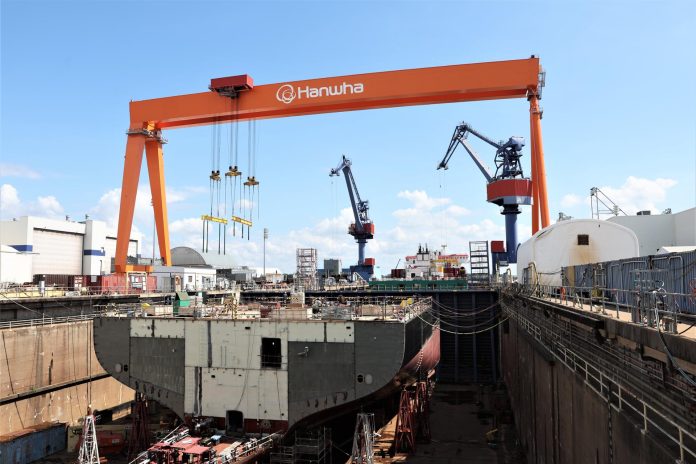
Last May, when John C. Phelan walked through South Korea’s shipyards, we said it wasn’t a courtesy call.
It was triage.
We were told to relax. Partnership. Interoperability. Alliance building. All the right words, polished up and sent out like a press release on a calm sea.
Now fast-forward a year. At Sea-Air-Space 2026, the Navy isn’t announcing a bold new plan.
It’s “studying the possibility” of using foreign shipbuilders.
That phrase matters.
Because you don’t study a lifeline unless you already know you might need it.
Let’s be clear about what’s actually being said—without the polish.
The Navy can’t build enough ships.
It can’t fix them fast enough.
And it’s starting to look outside the country for help.
Not doing it yet. Not officially.
Just… studying it.
We told you so.
This didn’t sneak up on anyone paying attention. The warning signs were already there—dry docks jammed, timelines slipping, and a workforce stretched thin. That’s why Phelan was halfway across the world touring HD Hyundai Heavy Industries and Hanwha Ocean.
Not to admire the view.
To see what capacity looks like when it still exists.
Because over there, it does.
They build fast. They build at scale. They train for it. And they’re already fixing U.S. ships tied to the United States Seventh Fleet while American yards struggle to keep pace.
And here’s the part Washington keeps dancing around.
This isn’t just about steel.
It’s about people.
We don’t have the workforce we used to.
There was a time when shipbuilding towns raised their own. Welders, pipefitters, electricians—skills passed down like family inheritance. You didn’t recruit them. They were already there, coming up behind the last generation.
That pipeline is gone.
Fewer young workers are entering the trades. Training programs are thin. The old hands are retiring. And the culture that sustained all of it has been fading for years.
Meanwhile, in South Korea, shipbuilding is still treated like a national priority. They invest in it. They build for scale. They plan for the long haul.
We don’t.
And here’s the hard truth no one can spin:
You can’t surge skilled labor.
You can throw money at contracts.
You can promise bonuses for beating deadlines.
But you can’t create thousands of experienced shipbuilders overnight.
That takes years. Sometimes decades.
Time we don’t have.
So now the Navy is “studying the possibility.”
That’s not a solution.
That’s a signal.
A signal that the gap between what we need and what we can do is getting harder to ignore.
And here’s where we circle back.
We used to build ships in numbers that made the world blink—Liberty ships rolling off the line, fast enough to matter. Not perfect, not pretty, but relentless.
We didn’t study possibilities.
We built.
Somewhere along the way, we traded that edge for process, paperwork, and the quiet assumption that the workforce would always be there when we needed it.
It isn’t.
So yes, the Navy is looking at allies. Smart move. Necessary move.
Even if they’re not ready to say it out loud yet.
Because when the United States—the country that once outbuilt the world—starts “studying” whether someone else can help carry the load…
That’s not just a policy discussion.
That’s a reckoning.
And we told you so.