

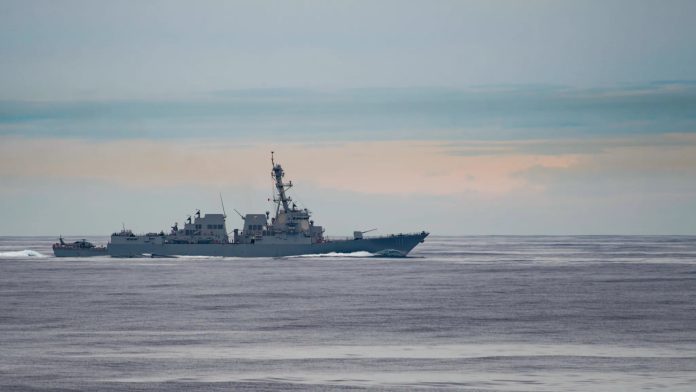
USS Spruance’s extraordinary deployment is exposing a problem far bigger than one warship. The Navy is pushing its destroyer fleet beyond normal deployment schedules, accumulating maintenance problems that could take years to resolve. Meanwhile, sailors and their families are paying a price no shipyard can repair.
When the aircraft carrier USS Abraham Lincoln sailed into San Diego on Oct. 8, the Navy rolled out the welcome mat.
Families gathered. Cameras clicked. Sailors embraced wives, husbands and children they hadn’t seen in nearly 11 months.
It was the kind of homecoming that reminds Americans what military service costs.
But one of Lincoln’s escorts wasn’t there.
The guided-missile destroyer USS Spruance remained deployed.
As of Oct. 29, Spruance had been gone 342 days. That’s more than 11 months, well beyond the seven-month deployment commonly used as a planning benchmark for ships based in the United States.
Published accounts describe it as the longest deployment by an American destroyer since World War II.
Either way, 342 days is a hell of a long time.
And the clock is still running.
But Spruance’s deployment isn’t simply a story about setting records.
It’s a warning about what is happening to the Navy’s destroyer fleet, the maintenance system struggling to support it, and the sailors and families being asked to absorb the consequences.
The Navy is borrowing readiness from tomorrow to meet operational demands today.
And the bill is coming due.
The workhorses are being worked to death
Aircraft carriers get the headlines. Destroyers do much of the dirty work.
The Navy’s Arleigh Burke-class guided-missile destroyers are among the most versatile warships afloat.
They protect aircraft carriers, defend against missiles and aircraft, hunt submarines, launch Tomahawk cruise missiles and conduct independent operations across the world’s oceans.
When a carrier strike group enters dangerous waters, destroyers help keep the carrier alive.
They’re indispensable.
They’re also finite.
The Navy had 75 destroyers in its fleet this summer. More than a dozen were deployed in the Red Sea and Arabian Sea as of Oct. 26.
And those ships aren’t just cruising around showing the flag.
They’re conducting demanding operations in a region where American warships have faced missiles, drones and other threats.
Spruance participated in the opening strikes of Operation Epic Fury against Iran earlier this year.
That means months of high operational tempo, long watches, demanding maintenance requirements and combat operations.
All while the machinery keeps turning and the deployment clock keeps running.
A destroyer may be built for war, but it wasn’t built to operate indefinitely without the maintenance, training and recovery periods needed to sustain its fighting capability.
Neither were its sailors.
The admirals know what’s coming
This isn’t some disgruntled sailor complaining about another month at sea.
The warning is coming from the Navy’s own leadership.
Chief of Naval Operations Adm. Daryl Caudle told an audience at the United States Navy Memorial on Oct. 26 that the Navy faces a potentially enormous maintenance problem as ships return from extended deployments.
Caudle warned that maintenance requirements, particularly for destroyers, could accumulate as ships return from deployments exceeding 300 days.
His conclusion was unmistakable.
“This is a years-long recovery,” Caudle said. “There is no workaround on that.”
Think about that.
The Navy’s top uniformed officer is warning that the consequences of these deployments could take years to resolve.
Not weeks.
Not months.
Years.
Vice Chief of Naval Operations Adm. James Kilby has raised another uncomfortable issue.
The Navy’s current combat readiness figures may look better than the underlying situation warrants because ships that should be entering maintenance remain deployed.
He described the situation as producing artificially high combat-surge readiness rates.
That’s a dangerous accounting problem.
A ship at sea may count as operationally available today. But that doesn’t tell us what maintenance awaits it tomorrow or how long it will remain unavailable once it finally returns.
And when enough destroyers come home needing repairs at roughly the same time, the Navy may discover that its shipyards cannot handle the workload.
Rear Adm. Kavon Hakimzadeh, commander of Norfolk Naval Shipyard, has warned about precisely that problem.
The issue isn’t simply whether the Navy can identify what needs repairing.
It’s whether there are enough dry docks, skilled workers, spare parts and available shipyard schedules to get the work done.
You can’t put three destroyers into one dry dock.
And you can’t wish another shipyard into existence.
A maintenance system already in trouble
The Navy didn’t enter this situation with a clean maintenance record.
Far from it.
The Government Accountability Office has documented years of delays, deferred repairs and problems maintaining the surface fleet.
A February 2025 GAO report found that private ship repair companies took nearly 10,000 days longer than planned, cumulatively, to complete destroyer repairs between fiscal years 2015 and 2022.
By August 2022, the Navy’s surface-ship maintenance backlog had reached $2.3 billion in deferred work.
Those problems existed before the latest extraordinary deployments.
Now add destroyers spending 300 days or more away from home.
Every additional month can disrupt a carefully planned sequence of operations, maintenance, training and preparation for the next deployment.
Under the Navy’s Optimized Fleet Response Plan, ships based in the United States generally operate within a 36-month cycle intended to balance those demands.
But when a ship remains deployed long past its anticipated return, that schedule starts coming apart.
Consider Spruance.
According to Navy budget documents examined by Defense News, the destroyer was originally scheduled to begin a maintenance period in July 2026.
The Navy’s fiscal 2027 budget shifted the planned start to January 2027 — 200 days later.
That doesn’t prove Spruance is mechanically unsound. Its actual condition and repair requirements won’t be known publicly until the Navy assesses the ship.
But it demonstrates how dramatically the schedule has changed.
And Spruance isn’t alone.
USS John Finn, USS Mustin and USS Rafael Peralta have also reportedly had anticipated return dates pushed into 2027, with some deployments potentially stretching beyond 14 months.
This is no longer an isolated problem.
It’s becoming a fleet-management problem.
You can’t overhaul a sailor
The Navy can calculate machinery hours, repair costs and maintenance delays.
It can estimate how many days a destroyer will spend in dry dock.
What it cannot calculate so neatly is the cost to the people aboard.
A destroyer is not an aircraft carrier.
Living spaces are tighter. Crews are smaller. Sailors often carry multiple responsibilities, and demanding watches continue regardless of how long the ship has been deployed.
The Navy likes to talk about its people being its greatest asset.
Fine.
Then treat them that way.
Because sailors aren’t spare parts.
You can’t replace another missed Christmas, another birthday or another wedding anniversary by ordering components from a supply depot.
You can’t put a marriage into dry dock.
And you can’t give a child back the months a parent spent halfway around the world.
Those aren’t arguments against deployments. Sailors understand that going to sea is part of the profession.
But there’s a difference between accepting the demands of military service and being subjected to repeated uncertainty about when those demands will end.
The families left waiting
For the families of Spruance sailors, the problem isn’t simply the length of the deployment.
It’s not knowing when it will end.
The uncertainty makes planning ordinary family life extraordinarily difficult.
A spouse cannot confidently schedule time off from work.
Children cannot know whether their parent will be home for an important event.
Families hesitate to make arrangements because the anticipated homecoming date may change again.
And every extension brings another round of disappointment.
This isn’t just an inconvenience.
It’s a leadership problem.
Military families understand that operational requirements change. They know that ships sometimes have to remain at sea because the mission demands it.
But repeated changes to anticipated homecoming dates can erode confidence in the system responsible for their loved ones.
The Navy cannot promise that every ship will return on a particular day.
It can, however, be candid about uncertainty, communicate consistently and avoid allowing tentative dates to become expectations that families repeatedly watch collapse.
Those families are part of the Navy’s operational strength.
When they struggle, sailors carry that burden with them.
And when sailors are worried about problems at home, those concerns don’t magically disappear when they report for watch.
The hidden readiness problem
There’s another consequence that deserves attention.
What happens to the next crisis?
The Navy’s destroyers are already spread across the globe.
They defend carrier strike groups, patrol contested waters, conduct missile-defense missions and support American forces operating far from home.
Those missions aren’t going away.
Neither are the maintenance requirements.
If too many destroyers return from extended deployments needing substantial repairs, the Navy could find itself with fewer ships available for the next emergency.
And if the remaining operational destroyers are required to fill the gap, their deployments could grow longer.
That creates a vicious cycle.
Longer deployments disrupt maintenance.
Delayed maintenance reduces future availability.
Reduced availability puts greater demands on the remaining ships.
And those ships, along with their crews, face the prospect of still more extended deployments.
That’s how a readiness problem can feed on itself.
The Navy’s leaders have not established that every destroyer returning from the Middle East will require extraordinary repairs.
But they’ve made clear that the accumulated maintenance burden is serious.
The danger isn’t that one destroyer has spent 342 days deployed.
It’s that the Navy may be building a system in which such deployments become increasingly difficult to avoid.
Congress needs to ask some questions
The Navy has legitimate missions to accomplish.
American warships cannot simply abandon their stations because a deployment has exceeded its planned length.
But that doesn’t excuse failing to account for the consequences.
Congress should be demanding answers.
How many destroyers have exceeded 300 days deployed during the past two years?
How many are currently operating beyond their original deployment schedules?
How much maintenance has been postponed?
How many destroyers are available for combat operations, and how many are undergoing or awaiting maintenance?
How much additional shipyard capacity will be required when the extended-deployment ships return?
And perhaps most importantly, what is the Navy doing to reduce the burden on sailors and their families?
These are not unreasonable questions.
They’re fundamental questions about the condition of the fleet and the welfare of the people who operate it.
The answers should not require another congressional investigation years after the damage has been done.
The price of keeping the fleet at sea
When USS Abraham Lincoln returned to San Diego, the Navy celebrated a successful deployment.
And rightly so.
Its sailors and Marines had earned that homecoming.
But the celebration also illustrated something the Navy and the American public need to remember.
A carrier strike group isn’t just an aircraft carrier.
It’s a collection of warships and thousands of sailors whose contributions often receive far less attention.
Spruance remained deployed after Lincoln came home.
Its sailors continued standing watch.
Its families continued waiting.
And somewhere in the Navy’s planning offices, maintenance schedules continued slipping as operational demands took precedence.