

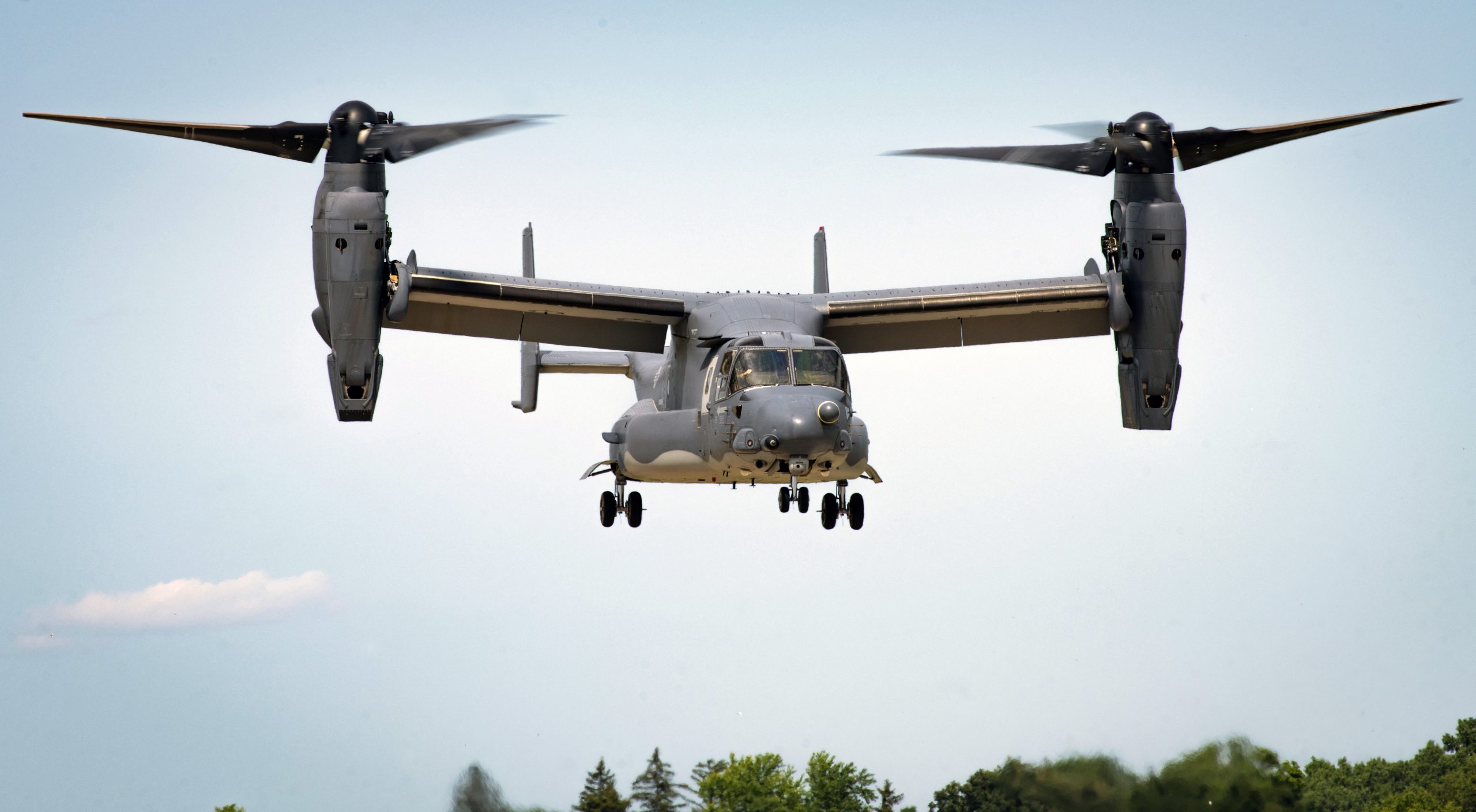
The Air Force announced on Tuesday that investigators have determined a parts failure as the cause of an Osprey crash in Japan last November, which tragically claimed the lives of all eight airmen aboard. However, the root cause of the crash remains elusive.
According to a statement from Air Force Special Operations Command, both the Safety Investigation Board probe and the Accident Investigation Board inquiry into the deadly crash are still ongoing.
Before this determination, the Osprey fleet had been under scrutiny due to previous deadly mishaps and a longstanding mechanical issue known as a “hard clutch engagement” in the V-22 gearbox, which has persisted for over a decade.
While the Pentagon reportedly believes it has identified the mechanical failure responsible for the Japan crash, investigations are also examining the aircraft’s propeller rotor gearbox as a potential cause. However, the Air Force statement did not explicitly confirm this as the issue.
The recent statement from Air Force Special Operations Command reaffirms the initial assessment shortly after the November 29 crash, suggesting a possible mechanical failure.
The Air Force Special Operations Osprey, identified as Gundam 22, was conducting a training mission off Japan’s Yakushima Island when the tragic incident occurred. The crash led to the grounding of all Air Force, Marine Corps, and Navy V-22s, with ongoing investigations into the mishap.
In addition to the Japan incident, three Marines were killed in August in an MV-22 Osprey crash during training in Australia, and five Marines died in 2022 when their Osprey experienced a catastrophic clutch failure during training in California, although the cause has yet to be publicly confirmed.
Efforts to locate the wreckage and remains from the November 29 crash involved a significant search operation, with more than 1,000 personnel, 46 aircraft, 23 maritime vessels, and 21 unmanned air and watercraft covering extensive areas of the ocean surface and floor, totaling over 37,000 square miles and 24 square miles, respectively, according to the Air Force.