

The headlines warned of a massive American naval buildup around Iran. There was just one problem: reporters were counting carriers without following the ships.
Two days ago, the headlines were flying.
Three American aircraft carriers were headed for the Middle East.
A massive naval buildup.
Another carrier was being dispatched toward Iran.
Social media did what social media does. Maps appeared. Arrows appeared. People started counting flight decks and predicting what the Pentagon was about to do.
There was just one problem.
They weren’t following the ships.
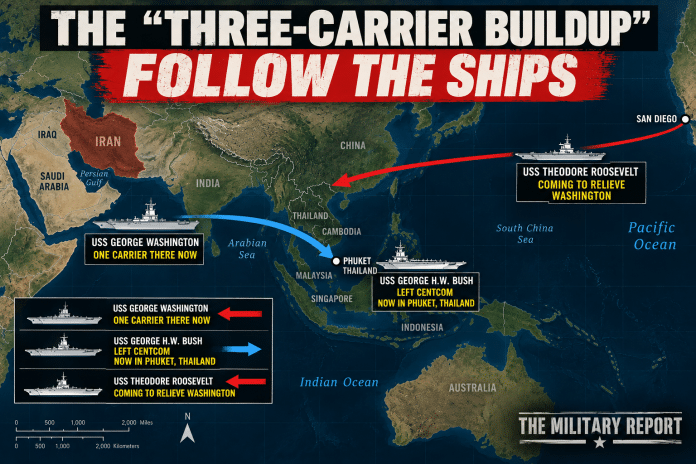
On Sunday, USS George H.W. Bush showed up in Phuket, Thailand.
The U.S. Embassy in Thailand confirmed Sunday that the George H.W. Bush Carrier Strike Group had arrived in Thailand.
Not Bahrain.
Not the Arabian Sea.
Thailand.
The carrier had quietly left the U.S. Central Command area of operations and moved into the 7th Fleet operating area. USS Delbert D. Black, an Arleigh Burke-class destroyer, pulled into Phuket with her.
Suddenly that great three-carrier buildup didn’t look quite so great.
It lasted about two days.
Count the ships. Then follow them.
This is the problem with covering military movements from Washington.
A Pentagon announcement says USS Theodore Roosevelt has deployed from San Diego.
Another report says Roosevelt is heading toward the Middle East.
Reporters look at the carriers already there — USS George Washington and USS George H.W. Bush — add Roosevelt and get three.
One plus one plus one equals three.
The arithmetic is fine.
The reporting isn’t.
Because aircraft carriers aren’t buildings.
They move.
And carrier deployments aren’t necessarily additions. Very often they are rotations.
USNI News reported Sept. 28 that Theodore Roosevelt was expected to sail to Central Command specifically to relieve USS George Washington. Washington had entered the 5th Fleet area in August after being pulled from its normal Western Pacific duties.
That’s a pretty important word:
Relieve.
It means one carrier comes in and another eventually goes out.
Meanwhile, Bush was already moving.
As recently as Sept. 28, the Navy’s publicly available fleet picture showed both George Washington and George H.W. Bush operating in the Arabian Sea. Theodore Roosevelt had just departed San Diego and was still in the Eastern Pacific.
Less than a week later, Bush was in Thailand.
That’s why you follow the ships.
The buildup that wasn’t
Today the carrier picture is considerably less dramatic.
USS George Washington is the only American aircraft carrier presently operating in the Middle East, according to Task & Purpose’s reporting Sunday.
USS George H.W. Bush is in Thailand after leaving Central Command.
USS Theodore Roosevelt is crossing the Pacific toward the Middle East.
And the previously reported plan is for Roosevelt to relieve George Washington.
And if you want another lesson in following ships instead of headlines, look east across the Pacific.
USS Abraham Lincoln, another carrier that only weeks ago was part of the American naval force in the Middle East, is expected back at North Island in San Diego on Thursday.
Lincoln left. Washington relieved her. Bush has now left. Roosevelt is coming.
These aren’t chess pieces piling up on one square.
They’re ships rotating and relieving each other.
Could those plans change?
Absolutely.
The Pentagon could order Bush back west. It could keep Washington in the Middle East after Roosevelt arrives. A war can turn yesterday’s deployment schedule into today’s scrap paper.
If that happens, report it.
But don’t report it before it happens.
That’s the difference.
Social media made it worse
The three-carrier narrative didn’t stay in newspaper headlines.
It exploded across social media.
Every carrier deployment became evidence of escalation. Every ship heading west became another piece of an enormous American armada gathering around Iran.
The trouble with those maps is that the arrows usually point only one direction.
Toward the crisis.
Nobody draws the arrow pointing away.
Bush just drew one.
The carrier spent months supporting operations in the Middle East after leaving Norfolk March 31. Now she has crossed out of the CENTCOM area and reached Phuket for her first port visit of the deployment.
That’s not speculation.
That’s where the ship is.
Military reporting requires more than counting hulls
There is a larger journalism lesson here.
Political reporters naturally look at decisions coming out of Washington.
Military reporters also have to look at what the force is actually doing.
Where is the carrier?
Where are its escorts?
Which fleet controls it?
How long has it been deployed?
Who is relieving whom?
Which ships are heading home?
Which ships are moving into another theater?
And perhaps most importantly:
What was the deployment schedule before everybody started screaming “buildup”?
Those questions aren’t glamorous.
But they matter.
Because without them, a routine carrier rotation can become an escalation story.
A relief can become a reinforcement.
And three carrier names on a reporter’s notebook can become three carriers massing against Iran.
Except there aren’t three carriers massing there.
There is one there today.
One has left.
One is coming.
And the carrier coming was already reported as the relief for the carrier that’s there.
Maybe tomorrow the Navy changes everything.
Then we’ll report that tomorrow.
Until then, there is an old-fashioned way of figuring out what the Navy is doing.
Follow the damn ships.