

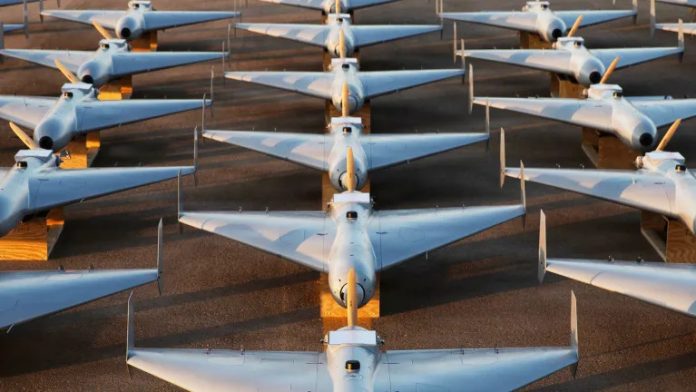
For years, Iran and Russia used cheap one-way drones to punch above their weight. Washington watched. Complained. Sanctioned.
Now the U.S. military has built its own.
U.S. Central Command confirmed that American forces used a new one-way attack drone called LUCAS — Low-Cost Uncrewed Combat Attack System — during Operation Epic Fury. The drones were launched by a brand-new outfit, Task Force Scorpion Strike, a unit that didn’t even exist until December.
Yes, December.
Four months later, they’re in combat.
“Modeled after Iran’s Shahed drones,” CENTCOM said, almost proudly.
Let that sink in.
If You Can’t Beat It, Build It
The Pentagon finally did the math.
Instead of pretending high-end stealth jets and gold-plated missiles solve every problem, they built their own disposable strike drone. Fly it once. Detonate. Move on.
No pilot. No return trip. No ceremony.
Just impact.
Welcome to the Age of Attrition
For 20 years, the U.S. military leaned into precision, speed, and technological overmatch. That era is fading.
Modern war is tilting back toward:
-
Mass
-
Cheap airframes
-
Saturation
-
Exhausting the enemy’s defenses
The drone wars in Ukraine proved it. So did repeated attacks on U.S. bases in the Middle East.
The old model — spend $2 million to knock down a $30,000 drone — doesn’t work for long.
LUCAS is the correction.
What We’re Not Being Told
CENTCOM didn’t release:
-
Unit cost
-
Range
-
Payload size
-
Production numbers
-
Launch platform
That silence matters.
Because if this system is truly “low-cost,” then production volume is the real story. One drone is a novelty. A thousand is doctrine.
And the speed here is telling. A unit stood up in December is already conducting combat strikes. That suggests this wasn’t some back-of-the-napkin idea after the latest headline. It was sitting in the pipeline.
The Irony
Iran built the template.
Russia weaponized it at scale.
Now Washington copies the design and calls it innovation.
That’s not criticism. That’s realism.
When your adversary finds a cheap way to hurt you, pride doesn’t matter. Adaptation does.
The United States has officially entered the one-way drone era — not as a target, but as a participant.
The next question isn’t whether these drones work.
It’s how many the Pentagon plans to build.
Because in modern war, quantity has a vote.