

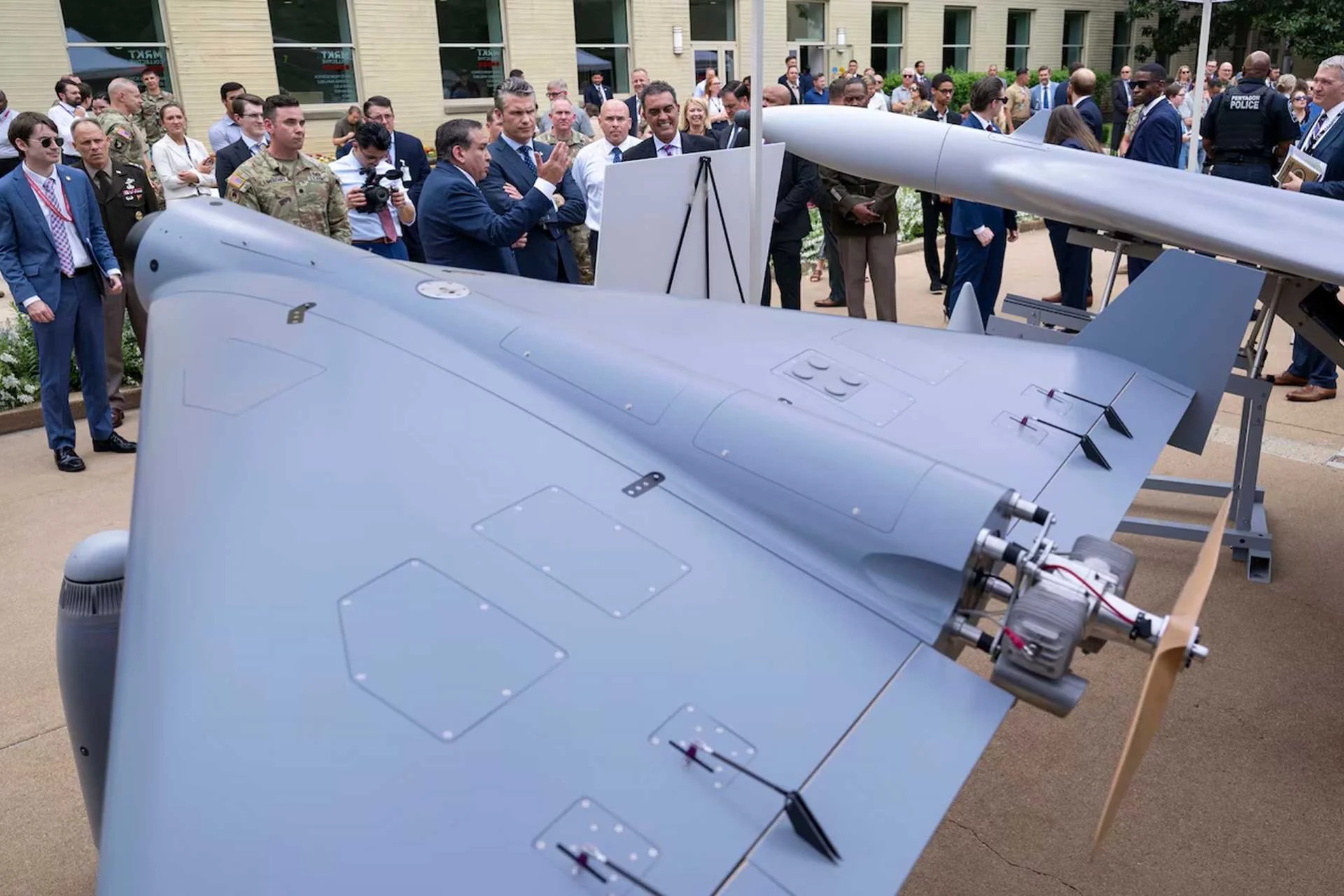
All drones displayed during the Pentagon’s July 2025 event, including LUCAS, were developed from concept to readiness in as little as 18 months, compared to the typical six-year cycle. (Picture source: US DoD)
Washington, D.C. — In a move that could reshape the character of 21st-century warfare, U.S. Secretary of Defense Pete Hegseth stood before a fleet of low-cost, American-made drones on display at the Pentagon this month and declared the start of what he called a new era of “U.S. military drone dominance.”
Flanked by engineers and junior officers, Hegseth pointed to one of the prototypes—a loitering munition with a price tag that’s less than a Humvee tire—and said plainly, “This is the future of war. Not next decade. Now.”
That future, as laid out in a July 10 policy memorandum titled “Unleashing U.S. Military Drone Dominance,” pivots the Department of Defense toward mass production, frontline fielding, and live-force drone training—all modeled after lessons drawn from Ukraine’s brutal drone war with Russia.
“Drones are the biggest battlefield innovation in a generation,” Hegseth said. “They’ve accounted for the majority of casualties in Ukraine this year. And our adversaries—Russia, Iran, China—are producing millions of them annually. We must outmatch them, not just with quality, but quantity.”
The Ukraine Wake-Up Call
Hegseth’s comments came as the Pentagon acknowledged a sobering fact: The United States, for all its technological sophistication, has fallen behind in fielding small, affordable drones at scale.
Ukraine’s drone forces, often built from commercial off-the-shelf parts or 3D-printed components, have outpaced traditional military timelines. Ukrainian units are flying up to 30,000 drones per month, with losses expected and built into the strategy. Meanwhile, Russian forces are deploying Iranian-made Shahed drones and adapting their own tactics accordingly.
The Pentagon’s Three-Part Strategy
According to Hegseth’s memorandum and briefing remarks, the Department of Defense will pursue three primary goals:
- Prioritize the procurement of American-made drones using private capital and fast-track development programs.
- Field thousands of low-cost, lethal drones to combat units, particularly those deployed in the Indo-Pacific and Eastern Europe.
- Train U.S. forces in realistic drone warfare scenarios, including force-on-force drone simulations, swarm engagements, and counter-swarm defenses.
These are not distant goals. In fact, the timeline is aggressive.
By the end of 2026, every Army division is expected to field 1,000 combat drones, replacing or supplementing manned helicopters and surveillance platforms. Within 60 days, the services must identify programs and platforms that can be replaced by uncrewed systems. Within 90 days, three U.S. training ranges—urban, forested, and over-water—will be designated for drone warfare training.
“This isn’t an R&D initiative,” a senior DoD official told The Military Report. “It’s warfighter now. We want sergeants flying these. We want drone tactics to be taught in squad-level planning. We want drone losses baked into logistics—because they’re meant to be expendable.”
Meet LUCAS: America’s Shahed Counterpart
The crown jewel of the Pentagon showcase was the LUCAS—short for Low-cost Uncrewed Combat Attack System—built by Phoenix-based SpektreWorks in collaboration with DIU.
With its plywood fins, composite fuselage, and affordable target-seeking payload, LUCAS bears an eerie resemblance to the Iranian Shahed-136 kamikaze drone. But this version was designed, built, and flown within 18 months, a far cry from the Pentagon’s traditional five-to-seven-year procurement cycle.
“This is a drone designed to be fired and forgotten,” said Sean Henahan, CEO of SpektreWorks. “And when it hits its target, we don’t cry about it—we build another one by lunch.”
The is modular, AI-adaptable, and requires no GPS signal to navigate, using terrain-matching sensors that operate in GPS-denied environments. Initial tests have demonstrated its ability to autonomously lock on and strike mobile targets with less than a one-meter margin of error.
Defense stocks responded swiftly. Companies like Kratos and AeroVironment saw double-digit jumps in share prices following Hegseth’s announcement.
Bureaucracy Out, Combat Readiness In
Perhaps the most revolutionary aspect of Hegseth’s plan is not the hardware—but the removal of bureaucratic barriers that once restricted direct procurement and testing by field units.
In the past, frontline commanders had limited authority to purchase or test drones outside a rigid acquisition pipeline. Under the new policy, that changes.
“This is about trust,” Hegseth said. “We trust our sergeants and lieutenants to make battlefield decisions. We’re going to trust them to test and deploy drones the same way. If a company in Ohio builds a drone that gets the job done, we’re not going to wait for a three-year contract review. We’re going to field it.”
The “Blue List,” a curated NATO-style list of vetted drone platforms and components, will shift from DIU to the Defense Contract Management Agency (DCMA), with the goal of making it an AI-searchable tool accessible by commanders across all services.
The Road Ahead
Hegseth’s initiative echoes a growing belief within the Pentagon that drone warfare is not a niche or specialized tool—but a core competency for all future conflict. As adversaries refine their drone swarms and autonomous strike systems, U.S. forces must evolve or risk obsolescence.
Some critics have raised concerns about unintended consequences—drone proliferation, autonomous lethality, and the ethical challenges of machine-driven war. But within the Department, the consensus is clear: delaying means defeat.
Whether Congress provides the sustained funding to match Hegseth’s ambition remains to be seen.