

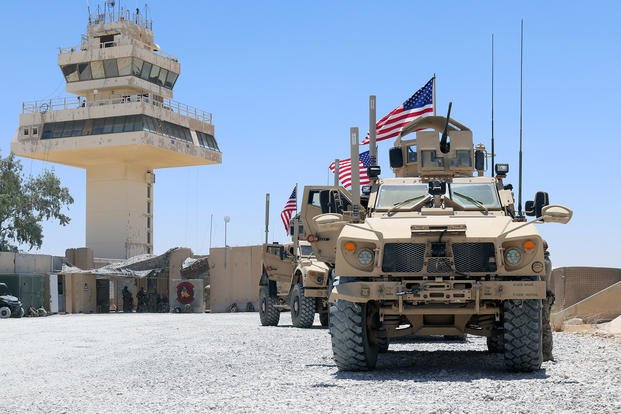
Airmen with the Security Forces Flight, 443d Expeditionary Squadron, conduct a routine flight line patrol with U.S. flags flying from their Mine Resistant Ambush Protected-All Terrain Vehicles at Al Asad Air Base on July 4, 2021. (U.S. Army National Guard photo)
By any other name, it’s still a war.
The suits in Washington call it a “transition.” The Iraqis refer to it as “technical cooperation.” The troops at Ain al-Asad and Harir call it what it’s always been — another tour that was supposed to end six months ago.
Prime Minister Mohammed Shia al-Sudani stood before the cameras this week and said the quiet part out loud: the U.S. isn’t really leaving. Not yet. A “small unit,” he said — 250-350 advisors, give or take — will stick around to “coordinate with forces in Syria.” That’s diplomat-speak for keep the lights on and the targets warm.
The State Department nodded politely. The Pentagon drafted its talking points. “Transitioning to a lasting security partnership,” they called it. Sounds tidy, like a retirement ceremony with cake and folded flags.
But what it means on the ground is that a handful of Americans are still perched on the edge of the desert, staring west toward a border that bleeds trouble. The so-called Islamic State isn’t what it was in 2014, but it isn’t gone either. Syria’s still a mess, Iran’s still testing the fence, and Washington still wants eyes and ears in both directions.
So the mission that was supposed to wrap by September will stretch into another year, maybe two. That’s the thing about “temporary deployments” — they have the lifespan of a rusted Hilux.
But here’s the truth: the United States is playing chess with ghosts. The war we fought, the one about insurgents and IEDs, ended years ago. What’s left is a low-voltage conflict, fought with drones, training teams, and nervous handshakes. It’s risk management masquerading as strategy.
You can respect the troops still pulling that duty — they’re doing what soldiers have always done when the politicians lose the plot. They stand watch, fill the gap, and try not to get caught in the next “incident.”
So yes, the coalition’s banner may come down next year. The flags may change. But as long as we’re still flying MQ-9s over the Euphrates and running convoys out of al-Asad, the mission isn’t over. It’s just dressed in civilian clothes.
The long goodbye rolls on — one more time zone, one more acronym, one more generation that thought this would be the last rotation.
Because in America’s forever wars, even the exits have extensions.