

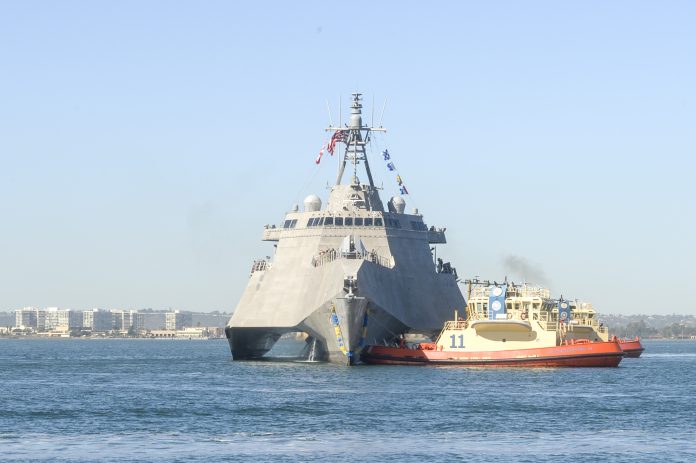
The Navy is about to spend $33 million cracking open one of its newest ships to see what’s wrong with it.
Let that sink in.
USS Augusta (LCS-34)—commissioned in 2023, barely out of the wrapper—is heading into dry dock in San Diego for a full teardown. Not for upgrades. For answers.
They’re looking for cracks. In the hull.
Same story that’s been dogging the entire Independence-class line for years. Thin aluminum hulls, high stress, and now the bill comes due. Again.
While they’re at it, they’ll check the propulsion system—another chronic weak spot in the Littoral Combat Ship program. Engines that don’t deliver. Gear that doesn’t hold up. Ships that look good on paper and limp in reality.
This isn’t normal.
You don’t haul a $500 million warship into the yard this early unless something’s off. The Navy calls it a “Docking Selected Restricted Availability.” That’s bureaucratic language for: we need to take this thing apart and figure out what went wrong.
The work will be done at the BAE Systems yard in Barrio Logan. Price tag: $33.5 million, possibly more. Timeline: through August 2027. That’s a long time for a ship that hasn’t even made its first real deployment.
Think about that.
Three years in the fleet, and it hasn’t gone to war. Now it’s going to the shop.
Meanwhile, the Navy’s workhorses—the Arleigh Burke-class destroyer—don’t go through this kind of early-life soul-searching. They deploy. They fight. They come back. Then they get fixed.
Different philosophy. Different results.
The LCS was supposed to be fast, flexible, lethal in the shallows. A knife fighter along the coast—hunting mines, chasing subs, dropping special operators where they don’t belong.
But cracks slow ships down. Weak propulsion strands them. And every hour in dry dock is an hour they’re not doing the job they were built for.
The Navy will say this is routine. Scheduled. Part of lifecycle maintenance.
Maybe.
But when your “routine” includes checking whether your hull is breaking apart before the ship has even stretched its legs, that’s not maintenance.
That’s a warning sign.