

The people protesting giant AI data centers across America are not anti-technology radicals hiding in the woods wearing tin foil hats.
Most are ordinary homeowners.
Farmers.
Retirees.
Small-town residents.
Parents worried about water bills, electrical rates, noise, traffic, and giant industrial buildings suddenly appearing next to neighborhoods that used to be quiet.
And in many ways, they have a point.
Across the country, local governments are slowing or pausing data center projects because residents are increasingly alarmed by what these facilities consume. Massive amounts of electricity. Massive amounts of water. Endless cooling fans. Industrial substations. Backup generators. Light pollution. Concrete warehouses stretching for hundreds of acres.
From Texas to Indiana to South Carolina, the backlash is growing.
Moratoriums are spreading.
Town halls are overflowing.
And underneath the anger is a deeper fear that many Americans cannot quite articulate yet:
They sense these buildings are part of something much larger than just “the cloud.”
They are right.
Because this is no longer simply a tech story.
It is becoming a defense story.
The United States is entering what may be the largest electrical infrastructure expansion since World War II, driven largely by artificial intelligence, hyperscale computing, and the digitization of the electrical grid itself.
That may sound abstract until you realize what it actually means.
The future American economy — and increasingly the future American military — will depend on enormous amounts of electricity managed by software.
Not just electricity.
Smart electricity.
Software-controlled infrastructure.
Networked systems.
Digitally managed power flows.
The Pentagon already understands this.
Modern military operations increasingly depend on artificial intelligence, autonomous systems, cloud computing, sensors, drones, advanced logistics, and data processing at an enormous scale. All of that requires electrical infrastructure far beyond what America built for the industrial age.
The AI revolution is not happening inside smartphones.
It is happening inside giant industrial facilities consuming enough power to rival cities.
That is why data centers are suddenly appearing everywhere.
Virginia.
Texas.
Georgia.
Indiana.
Arizona.
The companies building them say America needs them to remain competitive in artificial intelligence.
National security analysts increasingly agree.
But there is a problem buried underneath this buildout that most Americans have not heard much about.
The United States is still heavily dependent on China for many of the components needed to build this new electrical backbone.
Not just solar panels.
Not just batteries.
The whole emerging “electrotech stack” — transformers, power electronics, industrial semiconductors, embedded control systems, battery management software, smart grid infrastructure, and digitally connected systems that increasingly manage how electricity moves through the modern economy.
A recent paper from the Foundation for Defense of Democracies and Carnegie Mellon’s Institute for Strategy and Technology warned that America’s electrical grid is evolving into a kind of digital nervous system for the nation’s economy. The same industrial systems powering AI infrastructure also increasingly support defense systems, autonomous technologies, manufacturing, robotics, transportation, and military logistics.
In plain English:
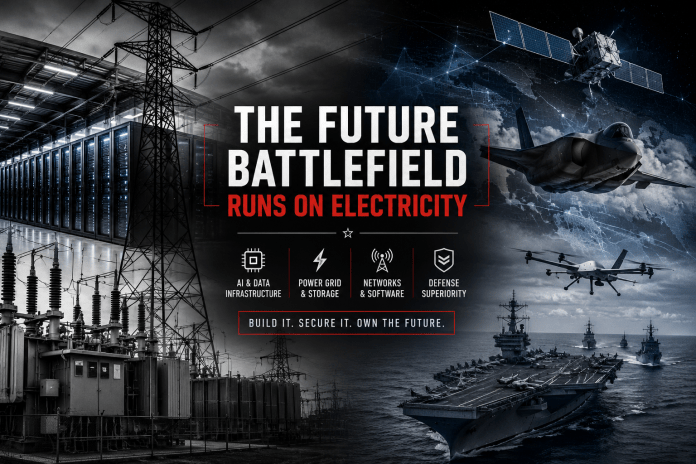
The future battlefield runs on electricity controlled by software.
That changes everything.
Most Americans still think of the power grid the old way — giant turbines spinning somewhere far away while electricity moves through transmission towers built decades ago.
But the modern grid is becoming something entirely different.
The new systems are connected.
Remotely updated.
Software-defined.
Constantly monitored.
Cloud integrated.
That makes them more flexible and more efficient.
It also creates new vulnerabilities.
Military planners understand this instinctively because modern warfare increasingly revolves around networks, software, sensors, communications, and cyber operations.
The same logic now applies to the electrical grid.
The concern is not that Chinese engineers are secretly flipping switches in Texas tomorrow morning. The real concern is strategic dependency. If the United States cannot manufacture enough of its own critical electrotech systems, then America risks building the infrastructure of the AI age on top of foreign-controlled industrial supply chains.
That matters because the AI boom is moving far faster than America’s aging infrastructure can handle.
Transformer shortages are already widespread.
Utilities are reporting major delays for critical equipment.
Transmission expansion is lagging badly.
And AI demand is accelerating all of it.
One federal projection estimates data centers could consume as much as 12 percent of all U.S. electricity by 2028.
Some proposed AI campuses are so massive that they would consume as much electricity as a mid-sized city.
That is why local residents are getting nervous.
Because while national leaders talk about artificial intelligence, local communities are staring at the physical reality of what AI actually requires:
Power plants.
Substations.
Transmission lines.
Cooling systems.
Water consumption.
Industrial noise.
Gigantic buildings.
And tax incentives for some of the richest corporations on Earth.
The uncomfortable truth is that both sides of this argument may be right at the same time.
The United States may genuinely need this infrastructure to remain economically and militarily competitive in the AI era.
And local communities may also bear real environmental, financial, and quality-of-life costs from hosting it.
That tension is becoming one of the defining political fights of the next decade.
Because America is trying to build a new industrial backbone at hyperspeed, while local governments, electrical infrastructure, environmental systems, and public trust all move much more slowly.
The result is collision.
National necessity versus local consequence.
And unlike many political fights in America today, this one is not cleanly partisan.
Conservatives who normally support industrial growth are increasingly resisting data centers in rural communities.
Progressives worried about climate and corporate power are also fighting projects.
Meanwhile, the Pentagon and national security planners increasingly view AI infrastructure as strategically necessary.
Everybody is colliding with everybody else.
And looming over all of it is the biggest reality of all:
Industrial power matters again.
For years, America convinced itself the future economy would float weightlessly in “the cloud,” disconnected from factories, heavy industry, power generation, and physical infrastructure.
The AI era is exposing that illusion.
The cloud is not floating in the sky.
It sits inside giant industrial buildings connected to substations, transformers, cooling systems, and power grids that require enormous physical resources to build and maintain.
And whoever controls the industrial systems underneath that infrastructure will shape economic power, military power, and technological dominance for decades to come.
That is why this is no longer just a local zoning fight.
It is becoming a national defense issue.