
USS George Washington heads for the Indian Ocean as families report suicide attempts, failing services and exhausted sailors aboard the long-deployed Lincoln
Relief is finally moving toward USS Abraham Lincoln.
But it is coming at a cost.
USS George Washington, the Navy’s only forward-deployed aircraft carrier, has left the western Pacific and is moving through the Indian Ocean to relieve Lincoln in the Middle East.
The carrier movements come as families of Lincoln sailors report attempted suicides, exhaustion, broken toilets, moldy showers, laundry facilities out of service, shortages of food, water and basic hygiene supplies.
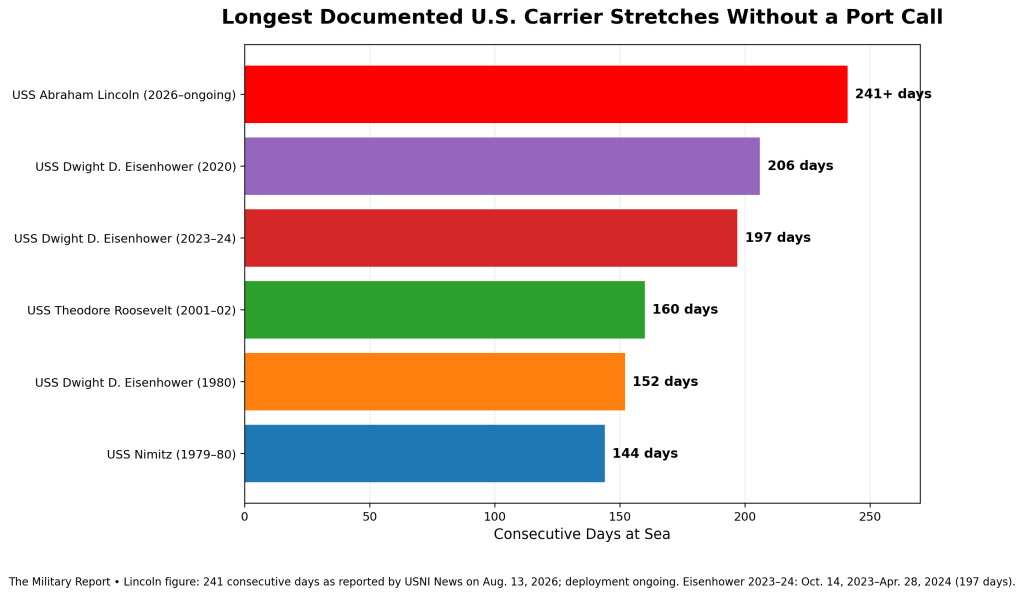
The San Diego-based carrier has been deployed for more than 260 days. Its crew has gone more than 240 consecutive days without a port call—a modern record for a U.S. aircraft carrier.
The ship was expected home in May.
It is still in the Arabian Sea.
The Navy has not publicly announced when it will return.
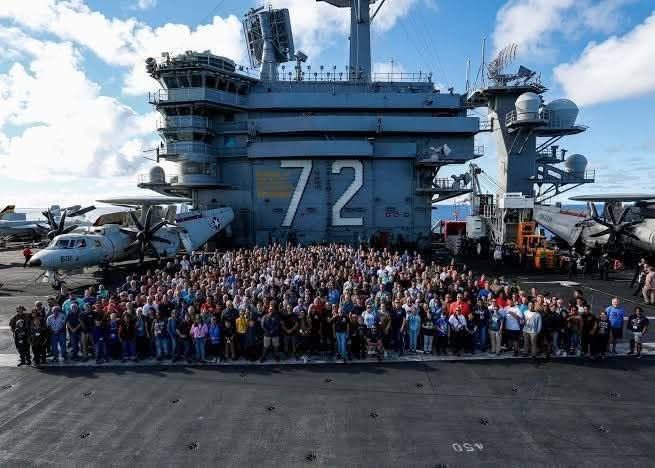
Nearly 5,000 sailors and Marines aboard Lincoln have spent most of the year at sea, much of it supporting combat operations against Iran. They have worked through repeated extensions, sustained operational demands and an increasingly uncertain homecoming.
Now their relief is crossing the Indian Ocean.
U.S. officials confirmed Thursday that George Washington is headed to the region to replace Lincoln. The Navy described the movement as a previously planned rotation, although it has not announced when the carriers will conduct the turnover.
The decision removes the carrier normally positioned closest to Japan, Taiwan, Korea and the South China Sea.
Meanwhile, aboard Lincoln, the human and mechanical strains are becoming harder to conceal.
Sailors reportedly stopped from going overboard
At least two apparent suicide or self-harm incidents have been described by family members in reports published by Military Times and Stars and Stripes.
Annabelle Loma told Military Times that her husband attempted to jump from the carrier after being repeatedly overextended. He was placed on medical hold following the incident, she said.
In another incident, Maria Rodriguez said her husband encountered a sailor preparing to go overboard while standing watch. He called to the sailor, grabbed the individual by the arms and pulled the sailor back onto the deck as other crew members arrived to help.
Stars and Stripes separately reported that watchstanders stopped a sailor from jumping overboard and that the incident was announced to the crew over the ship’s public-address system.
CNN reported another incident in which a sailor went overboard in July and was rescued and medically evaluated. It remains unclear how the sailor entered the water or whether that case overlaps with either incident described by family members.
The Navy has not disclosed how many sailors aboard Lincoln have attempted suicide, engaged in self-harm or reported suicidal thoughts during the deployment.
“Based on information available to the command, we have not identified an increase in reported suicidal ideation or suicide attempts aboard the ship,” the Navy said.
That is a carefully drawn statement.
It does not say that no attempts occurred. It says the command has not identified an increase against a baseline the Navy has not disclosed.
Without the number of incidents, the period covered and the baseline used for comparison, the public cannot evaluate the Navy’s claim.
Families sound the alarm
More than 200 family members attended a meeting in San Diego with senior Navy officials to discuss the deployment. Families raised additional concerns about mental health, exhaustion and safety during a subsequent virtual meeting.
Vice Adm. Joseph Cahill, commander of Naval Surface Forces, acknowledged the effect on sailors and their families.
“We hear you loud and clear regarding the impact this has on families, on service members and the long-term ability of us to sustain our forces’ health,” Cahill said during the virtual meeting, according to a recording reviewed by MS NOW.
Family members describe sailors as exhausted, depressed and increasingly uncertain about when they will return home. Communications are inconsistent. Mail and care packages have reportedly been delayed or lost for months.
The uncertainty adds its own pressure.
A sailor can count down a difficult deployment when there is a return date. Lincoln’s crew has no publicly announced date to count toward.
Basic services reportedly failing
Families and members of Congress have reported a growing list of habitability and supply problems aboard the carrier:
- Mold in shower spaces
- Broken toilets
- Laundry facilities unavailable for weeks
- Extended periods without hot water
- Potable-water problems
- Inadequate meals
- Shortages of soap, toothpaste, deodorant and other toiletries
- Delayed or missing mail and care packages
- Flight-deck safety concerns
Rep. Mike Levin, D-Calif., said families had described “moldy showers, broken toilets, laundry down for weeks, long stretches with no hot water” and shortages of food and basic hygiene products.
The Navy has not released an engineering report showing how many toilets, showers, washing machines or other systems are out of service. It has not publicly released water-test results or documented the duration of reported supply shortages.
There is no public indication that Lincoln has lost propulsion, flight operations or defensive capabilities.
The reported failures involve the systems that keep nearly 5,000 people fed, clean and physically capable of doing their jobs. At sea, those are not luxuries. They are part of combat readiness.
A broken toilet is routine shipboard maintenance. Dozens of failing services, accumulating during eight months without a port call, are something else.
Hegseth rejects portrayal
Defense Secretary Pete Hegseth said Thursday that reports describing deteriorating conditions aboard Lincoln had been “completely misrepresented.”
“We make sure every ship, every crew, every captain has everything we can provide them at every single moment,” Hegseth told reporters in Panama.
He praised the sailors for operating under “austere conditions” with fewer port calls.
Hegseth did not publicly answer the individual allegations involving suicide attempts, potable water, plumbing, food, sanitation or supply shortages.
The Navy says the carrier has counselors, chaplains, medical professionals and other support services aboard. Shipboard Human Factors Councils are also supposed to identify fatigue, stress and other threats to crew performance.
The service has not disclosed how many mental-health professionals are aboard, how many sailors have requested care or whether demand exceeds the carrier’s treatment capacity.
Congress demands numbers
Sen. Richard Blumenthal, D-Conn., has asked Hegseth and Navy leaders to provide the figures the service has so far withheld.
Blumenthal cited reports of water contamination, plumbing failures, basic-supply shortages, deteriorating mental health, flight-deck safety concerns and disruptions in the mail system.
He asked for:
- The number of reported suicide attempts and cases of suicidal ideation aboard Lincoln
- The number of mental-health professionals assigned to the carrier
- Information about medical evacuations
- The measurements used to assess fatigue and morale
- A list of significant habitability failures and corrective actions
- An explanation of the decision to extend the deployment
He requested a response by Aug. 27.
“The men and women aboard the Lincoln have answered the call to serve their country,” Blumenthal wrote. “The Department owes them not only adequate supplies, maintenance, and support during this deployment, but also a sustainable force-generation model that does not place undue burdens on any one crew.”
Not just another long deployment
Eight- and nine-month carrier deployments are not unprecedented (see charts below).
USS Abraham Lincoln completed a 294-day deployment in January 2020. USS Nimitz returned from a nearly 11-month deployment in February 2021. USS Gerald R. Ford completed a record 326-day deployment in May 2026.
But total deployment length tells only part of the story.
Carrier deployments ordinarily include port calls. Sailors get off the ship. Repair teams come aboard. Supplies are replenished. The crew gets a brief break from the noise, confinement and relentless work of life at sea.
Lincoln’s crew has not had that break for more than 240 days.
The strain is the product of time, combat, failing services and uncertainty. The sailors have been asked to keep going without being told publicly where the finish line is.
A wider Navy problem
From 2015 through 2024, 624 active-duty sailors died by suicide—an average of approximately 62 a year.
The annual number rose from 43 in 2015 to 73 in 2019 before fluctuating between 59 and 71 during the next five years. Sixty active-duty sailors died by suicide in 2024, the latest year for which complete figures are available.
Those figures do not prove that deployments caused the deaths. Most Navy suicides occur ashore and involve combinations of personal, occupational, financial, legal and psychological factors.
They also do not establish whether Lincoln has experienced an unusual concentration of suicidal behavior.
Only the Navy has the information needed to answer that question. It has not released it.
For now, family accounts and multiple news reports establish that serious incidents have occurred. The Navy says those incidents do not constitute an increase but has provided no numbers supporting that conclusion.
The carrier is still launching aircraft. Its reactors are still turning shafts. The mission continues.
But a carrier is more than steel, reactors and aircraft.
Its crew is part of the weapons system.
Carrier Shuffle Exposes Strain on the Fleet
USS George Washington has left the western Pacific and is moving toward the Indian Ocean to relieve USS Abraham Lincoln.
The Yokosuka, Japan-based carrier departed Da Nang, Vietnam, on Aug. 5 with Carrier Air Wing 5. Its escorts include the cruiser USS Robert Smalls and the destroyers USS Benfold and USS Shoup.
The strike group passed through the Singapore Strait and Strait of Malacca on its way toward the Indian Ocean. U.S. officials confirmed Thursday that George Washington is intended to replace Lincoln and described the movement as a previously planned rotation.
USS Carl Vinson and Theodore Roosevelt were most recently reported in San Diego.
USS Ronald Reagan remains at Naval Base Kitsap, Wash., where it is completing a 17-month maintenance period. The Navy expects the work to conclude by the end of August, but the carrier must complete sea trials and additional training before returning to the deployment cycle.
Two carriers—Lincoln and USS George H.W. Bush—are operating in the Arabian Sea.
| Carrier | Reported status |
|---|---|
| USS George Washington | Moving toward the Indian Ocean to relieve Lincoln |
| USS Theodore Roosevelt | In San Diego |
| USS Carl Vinson | In San Diego |
| USS Ronald Reagan | Completing maintenance at Bremerton |
| USS Abraham Lincoln | Operating in the Arabian Sea |
| USS George H.W. Bush | Operating in the Arabian Sea |
That does not leave the region defenseless. American submarines, surface ships, amphibious forces and land-based aircraft remain throughout the Indo-Pacific.
But carriers are moved to signal commitment as much as to deliver combat power. Removing the only forward-deployed carrier from waters near China, Taiwan, Korea and Japan is not a routine adjustment.
It is the price the Navy is paying to bring Lincoln home.
Length of carrier deployment since 2011
| Carrier | Deployment | Approximate length |
|---|---|---|
| USS Abraham Lincoln | 2011–2012 | 8 months |
| USS Harry S. Truman | 2015–2016 | 8 months |
| USS Abraham Lincoln | 2019–2020 | 294 days—about 9.7 months |
| USS Nimitz | 2020–2021 | Nearly 11 months |
| USS Harry S. Truman | 2021–2022 | 9 months |
| USS Gerald R. Ford | 2023–2024 | 8 months |
| USS Dwight D. Eisenhower | 2023–2024 | 9 months |
| USS Theodore Roosevelt | 2024 | 9 months |
| USS Carl Vinson | 2024–2025 | 9 months |
| USS Nimitz | 2025 | 9 months |
| USS Gerald R. Ford | 2025–2026 | 326 days—almost 11 months |
| USS Abraham Lincoln | 2025–present | More than 8½ months and continuing |