

The military wants its bases to survive three months without civilian infrastructure. The harder question is whether the country supporting those bases could survive the same disruption.
The Pentagon wants American military bases to be able to operate for 90 days without outside support.
No civilian electrical grid. No municipal water supply. No dependable fuel deliveries. No guarantee that the communications networks connecting military installations to the rest of the country will continue functioning.
Ninety days.
That’s three months of keeping America’s military installations operational while the infrastructure surrounding them may be falling apart.
The idea makes sense. What deserves closer examination is whether the Pentagon understands just how difficult that will be.
Because there’s a considerable difference between keeping the lights on at a military base and keeping that base capable of fighting a war.
And the difference begins outside the fence.
A fortress for the next war
Defense Secretary Pete Hegseth announced FORTRESS America on Sept. 30, describing an ambitious effort to protect military installations, supply chains and essential defense infrastructure against attacks and prolonged disruptions.
FORTRESS stands for Federal Operations for Resilience, Troop Resources, Energy, Supply, and Survivability.
The initiative establishes five priorities: independent energy generation, stronger defense supply chains, strategic reserves, hardened installations and cybersecurity, and protection of military space and communications capabilities.
On Oct. 6, Under Secretary of Defense for Acquisition and Sustainment Michael Duffey issued an implementation memorandum establishing a program office to coordinate the effort.
Richard “Matt” O’Malley was designated interim director.
The Pentagon wasn’t simply announcing another study. It was establishing an organization responsible for turning the concept into a working program.
Then came the 90-day requirement.
On Oct. 25, Fox News Digital reported that internal Pentagon planning documents call for major military installations in the continental United States to sustain essential operations independently for at least 90 days.
That includes electricity, water, fuel and communications.
Pentagon chief spokesperson Sean Parnell explained the reasoning.
“We don’t want to rely on standard civilian municipal infrastructure to run our national defense,” he told Fox News. “We just simply can’t. It’s an intolerable risk.”
He’s right about the risk.
But there’s an important qualification. The Pentagon’s publicly available Sept. 30 announcement does not establish the 90-day standard. That figure comes from internal documents reviewed by Fox News, which have not been publicly released.
The requirement’s precise language, compliance deadlines and definition of essential operations remain unverified publicly.
Those details matter.
The enemy doesn’t have to attack the base
For much of American military history, the oceans provided a considerable measure of protection.
An enemy contemplating an attack against the continental United States faced an enormous geographical obstacle.
That protection began losing some of its value with the development of long-range bombers and intercontinental ballistic missiles.
Today, an adversary doesn’t necessarily need an aircraft, missile or warship to disrupt an American military installation.
It may only need access to the civilian systems supporting it.
In 2024, American intelligence and cybersecurity agencies warned that Chinese state-sponsored hackers associated with Volt Typhoon were positioning themselves inside critical infrastructure networks.
The concern wasn’t simply espionage.
Officials warned that the intrusions could allow China to disrupt essential services during a military confrontation.
Electricity. Water. Transportation. Communications.
These are the same systems that keep military installations operating.
The 2021 Colonial Pipeline ransomware attack demonstrated how vulnerable civilian infrastructure can be. Although it wasn’t a foreign military attack, the disruption interrupted fuel distribution and contributed to shortages across parts of the eastern United States.
Imagine a similar disruption during a military mobilization.
Now imagine several disruptions occurring simultaneously.
An adversary could interfere with American military operations without ever penetrating a military installation.
That’s the threat FORTRESS America is intended to address.
Keeping the lights on
The Pentagon’s first priority is electricity.
That’s understandable.
Modern military installations depend on electrical power for virtually everything: command centers, radar systems, communications, maintenance facilities, fuel pumps, security systems and water treatment.
Even the equipment designed to provide backup power requires fuel, maintenance and functioning distribution systems.
Hegseth has called for every major military installation to generate its own electricity independently of the civilian grid.
The proposed solutions include microgrids, large battery systems and potentially nuclear microreactors.
A microgrid allows an installation to generate and distribute electricity locally, disconnecting from the commercial grid when necessary.
But generating electricity isn’t the same as generating enough electricity.
A base operating under emergency conditions may be able to power its command center, communications equipment and essential security systems.
That doesn’t necessarily mean it can operate aircraft maintenance facilities, industrial equipment, ship repair operations and every other activity required during wartime.
The distinction is particularly important at large naval installations and shipyards.
A shipyard doesn’t simply need enough electricity to illuminate its buildings.
It needs industrial power to maintain and repair warships.
And the electricity must remain available while the installation is operating under extraordinary demands.
The Pentagon has not publicly demonstrated that its proposed independent energy systems can support those requirements for 90 days.
The problem outside the gate
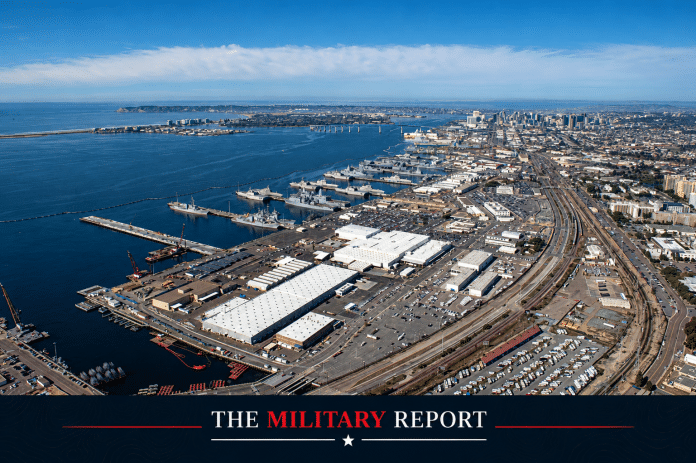
Consider Naval Base San Diego.
The installation is one of the Navy’s principal Pacific Fleet homeports, supporting warships, sailors, maintenance operations and the extensive logistics network required to keep ships ready for deployment.
Suppose the Navy successfully installs independent electrical generation and sufficient fuel reserves.
Suppose the base can continue operating after the regional electrical grid fails.
What happens outside the gate?
Thousands of military personnel, civilian employees and contractors live throughout San Diego County.
They depend on roads, traffic signals, gasoline stations, grocery stores, hospitals, water systems and communications networks.
If those systems fail, how do workers reach the installation?
What happens to sailors whose families have no electricity or running water?
How many civilian contractors can continue working when their own households are struggling to obtain food, fuel and medical care?
A military installation may have sufficient electricity to operate its facilities.
But electricity doesn’t repair a ship.
People do.
And those people must be able to get to work.
The same problem exists at Norfolk, Pearl Harbor, Puget Sound and the military’s major aviation, logistics and maintenance installations.
A military base is not an isolated island of military capability.
It is part of a much larger civilian and industrial system.
A fence separates the installation from the surrounding community.
It does not separate the installation from its dependence on that community.
We’ve been here before
The American military has spent decades preparing for disruptions to essential infrastructure.
During the Cold War, the United States invested heavily in hardened command centers, emergency communications, backup power and facilities intended to preserve military command and control during a nuclear attack.
The Strategic Air Command maintained elaborate systems to ensure that American nuclear forces could receive orders and respond even after major portions of the country had been attacked.
Continuity-of-government planning reflected similar concerns.
The objective was survival of essential command functions.
But the military of the 1950s and 1960s was considerably different from today’s force.
Modern weapons systems depend on sophisticated electronics, software, satellite communications and specialized components produced through complicated international supply chains.
Aircraft require parts manufactured by contractors scattered across the country and overseas.
Warships depend on specialized maintenance facilities and suppliers.
Ammunition production relies on chemicals, metals, electronics and industrial equipment that cannot always be replaced quickly.
The Pentagon recognizes this problem.
FORTRESS America calls for strategic reserves of ammunition, fuel, critical minerals, electronics, medical supplies and replacement parts.
It also proposes alternative manufacturing arrangements and the ability to shift civilian industrial production toward military requirements during an emergency.
That’s sensible planning.
But stockpiling supplies and maintaining industrial production are two different problems.
A warehouse full of replacement parts helps until the parts run out.
A manufacturing plant helps only if it has electricity, workers, raw materials and transportation.
The Pentagon is attempting to address vulnerabilities that extend across the entire American economy.
That is a considerably larger undertaking than installing generators.
The Navy’s particular problem
The Navy illustrates why the definition of essential operations is so important.
A naval installation has responsibilities that extend well beyond maintaining buildings and equipment.
It must support ships preparing to deploy, ships returning from deployment and vessels requiring repairs.
It must move fuel, ammunition, food, replacement parts and personnel.
Some of those operations require civilian ports, rail connections, highways, pipelines and commercial suppliers.
During a major conflict in the Pacific, those requirements could increase dramatically.
Ships might return damaged.
Maintenance demands could exceed peacetime capacity.
Replacement parts could become scarce.
Fuel and ammunition consumption could rise sharply.
The Navy would need its shore installations operating at precisely the moment the civilian infrastructure supporting them might be under attack.
That raises an uncomfortable question.
Can a naval base claim 90 days of independence if its electrical systems work but the transportation network delivering supplies has collapsed?
And what happens if the shipyard has electricity but the manufacturers producing critical replacement parts do not?
The Pentagon’s publicly available documents do not answer those questions.
Ninety days of what?
This may be the most important question surrounding FORTRESS America.
What exactly does the Pentagon expect military installations to accomplish during those 90 days?
There are several possible interpretations.
The first is basic survival: keeping essential personnel safe, maintaining communications, protecting equipment and preserving command functions.
The second is maintaining routine military operations despite disruptions to civilian infrastructure.
The third is sustaining wartime operations at the level required during a major conflict.
Those are very different missions.
They require different amounts of electricity, fuel, water, supplies and personnel.
They also carry vastly different costs.
A military installation might be able to maintain emergency command functions for three months using backup generators and stored fuel.
Supporting intensive aircraft operations or major ship repairs for the same period would be considerably more demanding.
The Pentagon needs to explain which standard it intends to meet.
Otherwise, the public may be left with the impression that American military installations can fight independently for 90 days when the actual objective is considerably narrower.
Who pays for the fortress?
There’s another issue.
Money.
At an Oct. 20 Defense Writers Group roundtable, a senior Pentagon official acknowledged that the department was still assessing the energy requirements of roughly 500 installations in the continental United States.
The official said the department was trying to determine the cost.
That’s not a minor detail.
The Center for Strategic and International Studies examined FORTRESS America and described several of its objectives as extremely ambitious.
Independent electricity generation presents particular difficulties.
Conventional generators require fuel deliveries.
Solar and wind generation require sufficient capacity and storage to maintain operations when production is unavailable.
Nuclear microreactors offer the possibility of long-duration power generation but are not yet available for widespread installation across hundreds of military bases.
There are also construction costs, maintenance requirements, security considerations and the expense of upgrading