

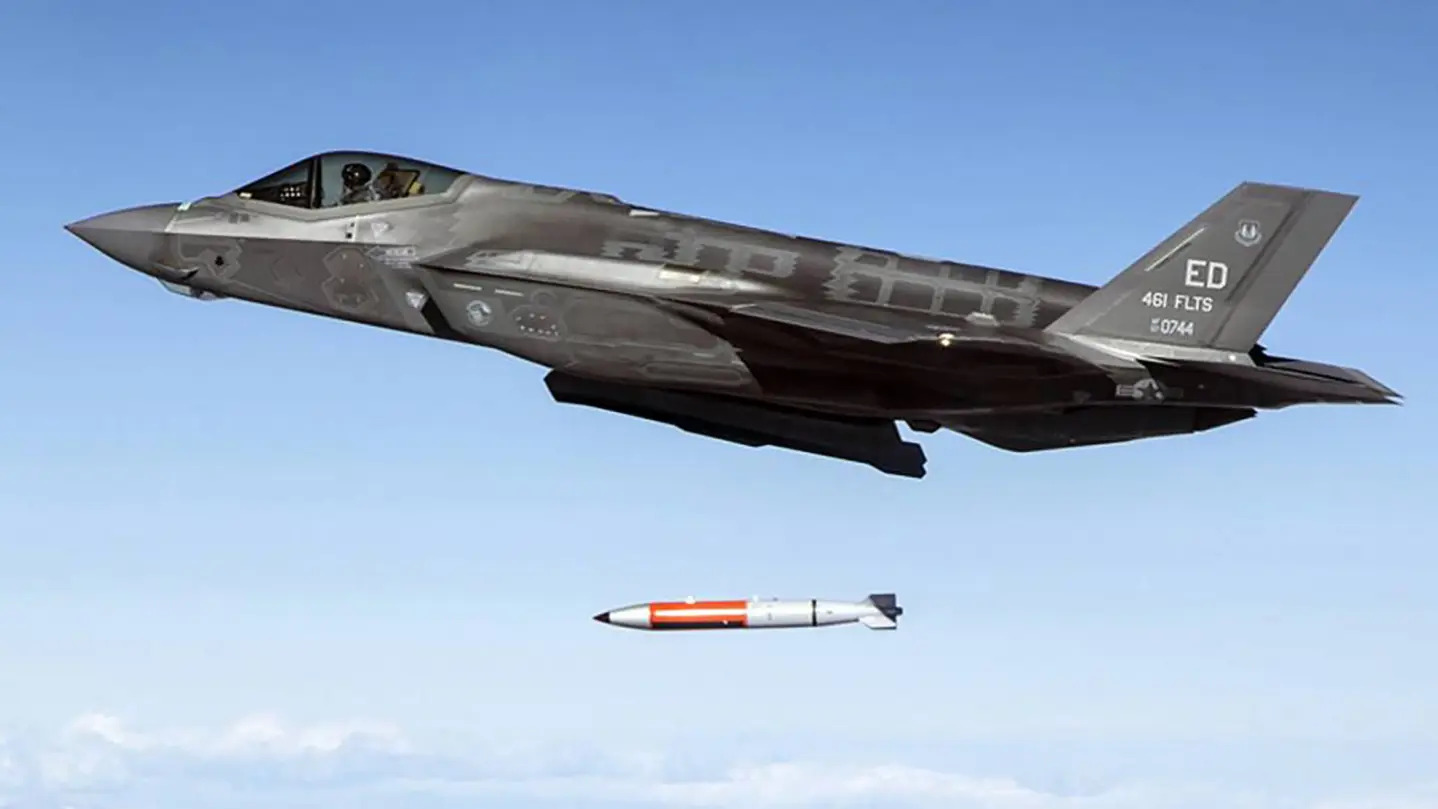
The Air Force’s F-35A fighter jet, developed by Lockheed Martin, has been granted approval to be equipped with nuclear weapons, according to Russ Goemaere, a spokesperson for the F-35 Joint Program Office. This significant update was confirmed several months after the certification was officially given, but it has only recently been disclosed to the public.
This development permits certain F-35A models to be armed with two B61-12 nuclear gravity bombs, enhancing their role in precision targeting. The approval positions the F-35A as a versatile “dual-capable” aircraft, ready for both traditional and nuclear combat missions.
A nuclear gravity bomb is a type of nuclear weapon designed to be dropped from aircraft and fall towards its target solely under the force of gravity, without any form of propulsion. Unlike guided missiles or bombs that may have systems to direct them towards a target after release, gravity bombs follow a ballistic trajectory influenced by gravity and air resistance.
Goemaere highlighted the uniqueness of this certification, noting it as the first for a fifth-generation fighter jet and the first instance since the early 1990s that such a designation has been achieved by any fighter or bomber. “The F-35A’s nuclear certification marks over a decade of dedicated effort across various sectors,” Goemaere explained. “Achieving this certification ahead of schedule delivers a vital capability to the US and NATO allies, reinforcing US commitments to deterrence ahead of expectations.”
It was specified that this nuclear certification applies exclusively to the F-35A variant, not extending to the Marine’s F-35B or the Navy’s F-35C models.
The decision to grant nuclear capabilities to the F-35A comes as the US military strategizes to counter evolving global threats. The addition of nuclear armament significantly enhances the F-35A’s combat potential, slated to succeed the aging fleet of F-16s within the US Air Force. The F-35A is lauded for its exceptional agility, maneuverability, and advanced technology, enabling it to access challenging targets, penetrate adversary defenses with stealth, and deliver nuclear payloads with unmatched precision.